Midnight AC Failure in La Grange: When to Pay for 24-Hour Repair vs. Waiting for Morning
Waking up to a broken AC in the middle of the night triggers immediate panic over emergency fees. Weigh the actual safety risks against next-day scheduling realities to make the right call.
Waking Up to a Hot House: The Late-Night AC Dilemma
Are you staring at a climbing thermostat, wondering about a midnight AC failure in La Grange: when to pay for 24-hour repair vs. waiting for morning? Waking up covered in sweat to the realization that your air conditioning has stopped working is incredibly stressful. The house is growing stiflingly warm, the ambient noise of the compressor is gone, and immediate panic often sets in. You know that making an emergency call at 2:00 a.m. means facing an emergency after-hours dispatch fee premium, but trying to sleep in a sweltering bedroom feels equally impossible. The debate between waking up a technician right now or toughing it out until the sun comes up requires a clear head. We are going to look at this objectively so you can make a calm, criteria-based choice.
If you decide your situation can wait, explore our standard HVAC services for next-day scheduling.
The Initial Shock and Next Steps
Most homeowners experience a moment of denial when the air conditioning fails overnight. You might adjust the thermostat down a few degrees, hoping the system just needs a nudge. When nothing happens, the reality of the situation sets in. During peak summer nights, the lack of cooling becomes noticeable within an hour. The immediate challenge is avoiding a knee-jerk reaction. Calling for service right away might seem like the safest bet, but it is not always the most practical or financially sound decision. By taking a few minutes to evaluate your specific situation, you can determine if an immediate dispatch is truly necessary or if standard scheduling will suffice.
Setting an Objective Framework
To make the best decision, you need to separate discomfort from actual danger. Discomfort is trying to sleep with a fan blowing directly on you; danger is a rapidly rising indoor heat index threatening the health of vulnerable family members. An objective framework evaluates the people in the home, the physical environment, and the mechanical state of the equipment. By breaking down the decision into these three categories, you remove the emotion from the late-night dilemma. This systematic approach ensures you only pay an emergency after-hours dispatch fee premium when the situation genuinely demands it.
Assessing Immediate Safety Risks for Vulnerable Occupants
The most critical factor in deciding whether to call for emergency service overnight is the health and resilience of the people living in your home. What constitutes an uncomfortable night for a healthy adult can quickly escalate into a medical emergency for someone with a compromised ability to regulate their body temperature.
Understanding WHO Temperature Guidelines
The World Health Organization provides clear guidelines regarding safe indoor temperatures, particularly during heatwaves. When indoor temperatures exceed safe thresholds, the body must work significantly harder to maintain its core temperature. For healthy adults, a warm room might cause restless sleep and dehydration. However, the WHO flags severe health risks when indoor heat rises rapidly and occupants cannot cool down. During peak summer nights, a house that loses air conditioning can see indoor temperatures jump several degrees per hour, depending on the home's insulation and layout. Monitoring the actual temperature on your thermostat, rather than just how warm the room feels, is the first step in assessing the risk level.
Identifying Vulnerable Household Members
If your household includes individuals from vulnerable populations, the threshold for an emergency call is much lower. You must pay close attention to the following groups:
• Infants and toddlers: Young children have underdeveloped temperature regulation systems. They cannot sweat as efficiently as adults and are highly susceptible to heat rash, dehydration, and heat exhaustion.
• The elderly: Older adults often have a reduced ability to sense temperature changes and may not sweat adequately. Cardiovascular stress increases significantly when the body tries to cool itself in a hot environment.
• Medically compromised individuals: Anyone taking specific medications (such as diuretics or beta-blockers) or living with chronic conditions like heart disease, asthma, or multiple sclerosis faces heightened risks in an un-air-conditioned home.
If vulnerable individuals are present and the house is rapidly heating, immediate emergency action is justified. The cost of an emergency dispatch is negligible compared to the health and safety of your family.
When Indoor Heat Index Levels Become a True Emergency
Temperature is only one half of the comfort equation. To accurately assess whether your home is safe to sleep in overnight, you must understand how humidity interacts with heat to create the indoor heat index.
The Science of Indoor Thermal Mass
Many homeowners assume that once the sun goes down, the house will naturally begin to cool off. Unfortunately, this ignores the concept of structural thermal mass. Throughout the day, your home's roof, walls, attic insulation, and even furniture absorb solar radiation and ambient heat. During peak summer nights, this stored heat is slowly released back into the living spaces. Even if the outside temperature drops to 75 degrees, the thermal mass inside your home can keep the indoor temperature hovering in the mid-80s for hours. This delayed heat release prevents the house from cooling down naturally after sunset, meaning the environment will likely get worse before it gets better.
The Kentuckiana Humidity Factor
In our region, humidity plays a massive role in overnight comfort. La Grange and the broader Kentuckiana area experience high overnight summer humidity. When your AC breaks down, it stops removing moisture from the air. National Weather Service data shows that high indoor humidity severely limits the body's ability to cool itself via sweat evaporation. If the air is already saturated with moisture, your sweat simply sits on your skin, trapping body heat. Because of this localized climate factor, natural ventilation—like opening windows—is often completely ineffective for cooling. Letting in thick, humid night air can actually make the house feel worse. An indoor temperature of 80 degrees feels significantly hotter and more dangerous when heavy humidity is trapped inside, pushing the heat index into unsafe territory.
Protecting Your Equipment: Symptoms That Demand Immediate Shutdown
Sometimes the decision to call for emergency service isn't about human comfort, but about preventing catastrophic damage to your HVAC system. Continuing to run a malfunctioning air conditioner can turn a minor repair into a complete system replacement.
Diagnosing Dangerous System Sounds
If your system is running but not cooling, or if it is making unusual noises, you must act quickly. Certain sounds indicate severe mechanical distress:
1. Loud screeching or squealing: This often points to a failing blower motor bearing or a broken fan belt. Continuing to run the system can cause the motor to burn out entirely.
2. Heavy grinding or metal-on-metal clanking: These noises usually originate from the outdoor compressor. The compressor is the heart of your AC system, and grinding indicates internal components are tearing themselves apart.
3. Rapid clicking at the thermostat or unit: This suggests a failing electrical relay or capacitor, which can cause the system to short-cycle and overheat.
Electrical Odors and Fire Risks
Smell is another critical diagnostic tool. If you detect a burning electrical odor, an acrid plastic smell, or the scent of ozone coming from your vents or the equipment itself, you have an immediate electrical emergency. This indicates melting wires, a failing motor, or a short circuit. Never ignore burning smells. The dangers of leaving a malfunctioning system running under these conditions cannot be overstated; it poses a severe fire risk to your home. In these scenarios, paying the emergency after-hours dispatch fee premium is necessary to ensure your home is safe from electrical hazards.
Safe Shutdown Procedures
If you observe any of the dangerous symptoms above, you must protect the unit until a professional arrives. Do not attempt DIY repairs. Instead, follow these safe shutdown instructions:
• Step 1: Turn the thermostat to the "Off" position. Do not just raise the temperature; ensure the system is commanded to stop.
• Step 2: Locate your home's main electrical panel.
• Step 3: Find the dedicated breaker for your air conditioning unit (often a double-pole breaker labeled "AC" or "HVAC").
• Step 4: Flip the breaker to the "Off" position. This completely severs power to the unit, preventing it from attempting to start and causing further damage.
Once the system is safely powered down, you can contact us for emergency AC repair to have a technician diagnose the root cause safely.
The Financial Decision: Weighing Premium Rates vs. Standard Scheduling
When the immediate safety of your family and your equipment is secured, the decision matrix shifts to a cost-benefit analysis. Understanding the financial reality of late-night service calls helps you make a logical choice.
Demystifying the After-Hours Premium
The reality of the HVAC industry is that dispatching a licensed, trained technician at 3:00 a.m. costs more. Technicians are paid overtime or double-time for being on call, and the logistics of securing parts in the middle of the night are complex. This results in the emergency after-hours dispatch fee premium. When you call for overnight service, you are paying for immediate prioritization and the technician's immediate availability. If your situation involves vulnerable occupants or severe electrical risks, this premium provides genuine, life-saving value. However, if your home is just uncomfortably warm and everyone is healthy, that premium might not offer the best return on investment.
Our Philosophy on Honest Guidance
We believe in providing transparent, honest guidance that prioritizes your well-being and cost savings over collecting unnecessary after-hours fees. If your system is safely shut down and occupants are not in danger, waiting for standard morning rates is almost always the smartest financial choice. We want to give homeowners permission to wait. There is often immense pressure to fix the problem instantly, but enduring a few hours of discomfort can save you a significant amount of money. A reputable HVAC provider will always tell you when it is safe to hold off until normal business hours, ensuring you receive the same high-quality repair without the midnight price tag.
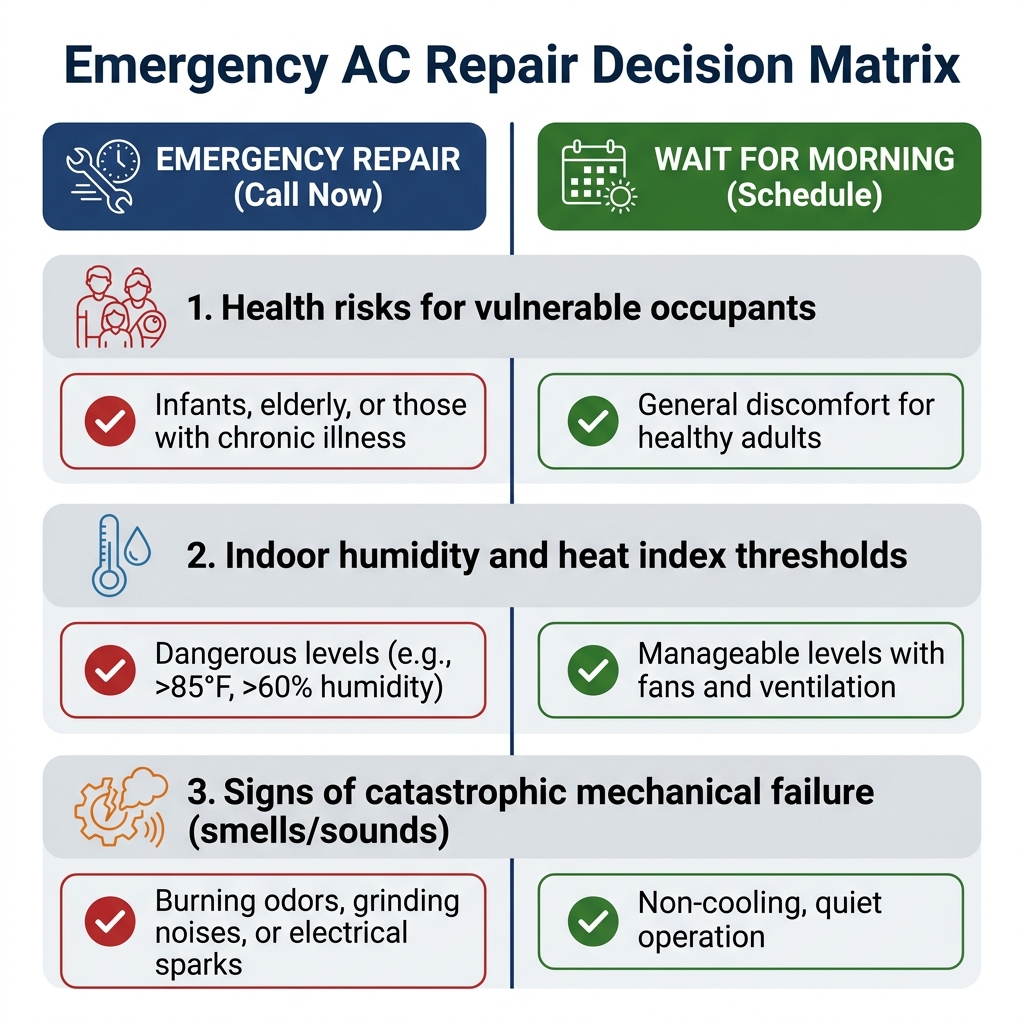
The Decision Matrix: Call Now or Wait for Morning?
To synthesize everything we have covered, we have built a clear, side-by-side comparison. Use this matrix to confidently decide your next step during a late-night cooling failure.
Using the Emergency Matrix
Review the criteria below. If your situation aligns more closely with the "Call Immediately" column, do not hesitate to reach out for 24-hour service. If your situation matches the "Wait for Morning" column, you can safely power down your system and try to get some rest.
• Occupant Health — Call Immediately (Emergency Service): Infants, elderly, or medically vulnerable individuals present. — Wait for Morning (Standard Service): Healthy adults and older children who can tolerate warmth.
• Indoor Environment — Call Immediately (Emergency Service): Temperature rising rapidly past 80°F with high, suffocating humidity. — Wait for Morning (Standard Service): Temperature stable in the upper 70s; fans providing adequate relief.
• System Symptoms — Call Immediately (Emergency Service): Burning electrical smells, loud grinding, or sparks visible. — Wait for Morning (Standard Service): System simply blowing warm air or won't turn on; no unusual smells.
• Equipment Status — Call Immediately (Emergency Service): System will not shut off at thermostat; requires breaker intervention. — Wait for Morning (Standard Service): System is safely powered off at the thermostat and breaker.
Understanding when to call for HVAC emergency repair comes down to trusting this objective criteria. During peak summer nights, it is easy to let frustration guide your actions, but relying on this checklist ensures you make the most logical choice for your home and budget.
What to Expect If You Choose to Wait for Standard Service
If you have consulted the decision matrix and determined that it is safe to wait, your goal shifts to managing expectations and staying as comfortable as possible for the remainder of the night.
Overnight Comfort Strategies
Surviving a few hours without air conditioning during peak summer nights requires a bit of strategy. First, keep all exterior doors and windows closed to lock out the heavy Kentuckiana humidity. Rely on ceiling fans and portable oscillating fans to create a wind-chill effect on your skin. Hydration is critical; drink plenty of ice water to help regulate your core temperature. If your home has a basement or a lower level, consider moving your sleeping arrangements downstairs. Heat rises, and subterranean levels are naturally insulated by the earth, often remaining several degrees cooler than the upper floors of the house.
Securing Your Spot on the Morning Schedule
The most important step you can take overnight is preparing for the morning. Set an alarm for right before your HVAC provider's office opens. The importance of calling first thing in the morning cannot be overstated; early callers secure the priority spots on the daily schedule. When you call, clearly explain the symptoms you observed before shutting the system down. Reassure yourself that making an informed, calm decision overnight leads to a smoother, more cost-effective repair process the next day. You avoided the emergency premium, protected your equipment from further damage, and positioned yourself for a prompt morning resolution.
Frequently Asked Questions
Is a broken AC considered an emergency?
A broken AC is considered a true emergency when it threatens the health of vulnerable occupants or poses an electrical fire risk. If the indoor temperature is rising rapidly and infants, elderly, or medically compromised individuals are in the home, you should call for immediate service. However, if the home only contains healthy adults and the system is safely shut off, it is usually safe to wait for standard service hours.
How long is it safe to sleep without AC in summer?
It is generally safe for healthy adults to sleep without AC for a night, provided they stay hydrated and use fans for air circulation. The safety window drops significantly if the indoor temperature exceeds 80 degrees with high humidity, as the body struggles to cool itself. Always monitor the indoor thermostat and prioritize moving to a lower, cooler floor if the bedrooms become unbearably hot.
Will an AC unit fix itself overnight?
No, an air conditioning unit will never fix itself overnight. Mechanical failures, electrical shorts, and refrigerant leaks require professional diagnosis and repair. Hoping the system will reset by morning often leads to frustration and delayed service scheduling. It is best to leave the system turned off to prevent further damage until a technician arrives.
What happens if I leave a broken AC turned on?
Leaving a broken AC turned on can cause catastrophic damage to the compressor and other vital components. If the system is struggling to cool, running it continuously forces the motor to overheat, potentially turning a minor electrical repair into a total system replacement. Always turn the system off at the thermostat and the breaker if it is blowing warm air or making strange noises.
How does high humidity impact indoor cooling overnight?
High humidity prevents your body's sweat from evaporating, which is your primary natural cooling mechanism. When an AC breaks down, it stops dehumidifying the air, causing the indoor heat index to skyrocket even if the actual temperature only rises a few degrees. This is why opening windows during a humid night often makes the house feel much worse.
Does waiting for morning guarantee a faster repair time?
Waiting for morning does not guarantee a faster repair, but it does guarantee you will avoid emergency dispatch premiums. By calling first thing in the morning, you secure a spot on the standard daily schedule. Technicians operating during normal business hours also have immediate access to local supply houses if your system requires a specialized replacement part.
Facing a midnight AC failure is never pleasant, but having a clear plan removes the panic from the situation. By assessing your household's safety, listening for dangerous system symptoms, and understanding the financial impact of after-hours calls, you can confidently decide whether to request immediate dispatch or hold off until sunrise. If you determine it is safe to wait, remember to reinforce your decision by scheduling our standard HVAC services first thing in the morning. A calm, criteria-based approach ensures your system gets the exact repair it needs, giving you the peace of mind to finally get some sleep.
Contact Us Or Schedule Expert Service
Other Blogs
ready to transform your home?
Discover our exceptional home services tailored to meet your needs and enhance your living space.
WHAT OUR CLIENTS HAVE TO SAY ABOUT US

We had a complete HVAC system and a hot water heater installed. The guys were professional, well mannered, and completed the work in a timely manner. Would definitely use them again.
I was nervous at first because my AC broke in the middle of 80 degree weather which is strange for April, but Allegiance Heating and Air was incredibly prompt and professional. The technician arrived within an hour, explained the problem clearly, and completed the repair. The technician , Mr. Garrett Moon was a very nice and courteous young man. He found the problem and fixed it within a timely manner. I highly recommend them for any heating or cooling needs. I’ll definitely give them a call again should I ever have another issue, but hopefully not. Knock on wood 😁. Give them a call… you won’t be disappointed!
From the moment I called to schedule a service, the team was quick to respond and arrived right on time. The technician was professional, friendly, and clearly knowledgeable about my heating system. He explained the repair options in plain language and completed the job efficiently. I appreciated the reliable service and the fact that the work was done the same day. I would definitely recommend Allegiance Heating and Air for any residential HVAC needs.
5/5 stars – I was very impressed with the efficient, affordable and timely service from Allegiance Heating and Air. The technician arrived on time, and performed the service quickly, no repairs needed at this time. Communication was clear and the whole experience felt hassle‑free. I would definitely recommend them for any residential HVAC needs.
Knowledgeable, experienced individual.
Explains Allegiance Heating and Air was incredibly reliable, professional and affordable. They arrived right on time, kept the work area clean and finished the furnace repair quickly. The technician explained everything clearly and the price was a great value. If happiness had a location on Google Maps, it would be here.
Gilbert had to go above and beyond because York is no longer making the part for my furnace. But he was able to find a way to construct a housing bracket for my furnace. Ingenuity, determination and integrity is what finally got my furnace fixed. Gilbert is truly a one of a kind technician.
Thank you for always going the extra mile. Gilbert is always respectful and helpful with any concerns.
"Great service, most knowledgeable and capable HVAC business in Kentuckiana!! Pete Flemming and Bryan the owner, are HVAC encyclopedias. They have the highest integrity of any HVAC business I have ever used. Allegiance has put numerous units in for me over the last 17 years. I will continue to use and trust them."
"Fast response from Allegiance when our heat was out on New Year’s day! Service technician was friendly and efficient. He took the time to explain the problem, tell us about the temporary fix and the plan for permanent repair. We were impressed!"
"Love Allegiance! Their technicians, in particular Benjamin, explain everything. Fast and thorough. A/C was out on a Sunday. Called Allegiance and within a few hours Benjamin arrived. Such a comfort as he was the one who last serviced our units. He quickly replaced part and cooling is restored!"
"My heat pump went out and I had to call after hours. The technician (Garrett) was outstanding and thorough. He got my system up and working until Monday and gave me several options of units. Also took the time to explain the issue to my Home warranty company. I highly recommend this company."
"Right on time :) respectful, fast, and polite. Even gave my fur babies some attention."
"Had Garrett out today to fix our AC. Fantastic tech. He showed up exactly when he said he would and kept us informed of what he was checking and what he found. Highly recommend!"
"Lucas with Allegiance showed up on time as promised, was professional and extremely patient and responsive with all my questions. He took care of the issue, and I feel he was trustworthy! He had us back to cool and comfortable on one of the hottest days of the year."
"Lucas did a great job! Very professional and expedient. Explained the process very well and represented Allegiance as a truly professional and reputable company."
"Arrived on time and work diligently to fix issue. These guy are great. Worked quickly to resolve my issues."
"Lucas was great - he spent a lot of time trying to figure out what was going on and explained everything he was doing. I trust Allegiance and wouldn’t want anyone else working on/in my house!!"

RELATED ARTICLES
The Ultimate Guide to Smart Ways to Cool Your Home Without High Bills
Identifying Malfunctions in Your Heat Pump System