Why NATE Certification Should Matter When Choosing an HVAC Company in Greenville, IN
Why NATE certification should matter when choosing an HVAC company comes down to one simple question: do you want the job done right the first time? When your furnace stops working on a cold southern Indiana night or your AC quits in the middle of summer, the technician who shows up makes all the difference. Not all HVAC technicians have the same level of training, and there is no guarantee that a licensed contractor has ever been tested on whether they can actually diagnose and fix your system correctly.
NATE — which stands for North American Technician Excellence — is the HVAC industry's most widely recognized independent certification. It is voluntary, which means the technicians who earn it chose to go beyond the minimum requirements. That choice matters for you as a homeowner.
Here is a quick snapshot of why it matters:
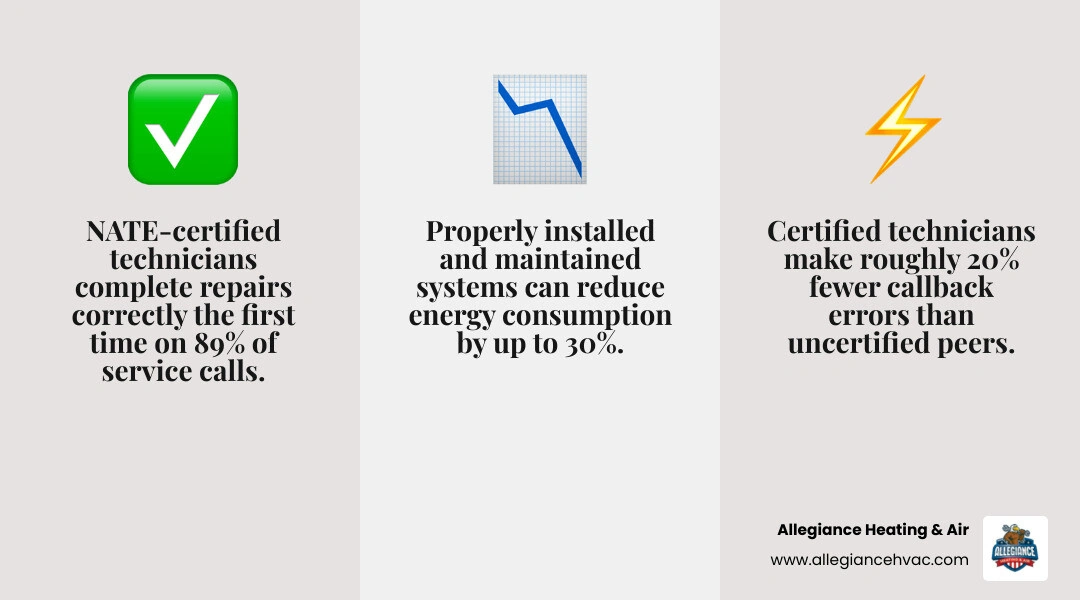
- Fewer repeat visits: NATE-certified technicians complete repairs correctly the first time on 89% of service calls, compared to 72% for non-certified technicians
- Fewer mistakes overall: Certified technicians make roughly 20% fewer callback errors than uncertified peers
- Energy savings: Properly installed and maintained systems can reduce energy consumption by up to 30%
- Industry confidence: 79% of contractors say NATE-certified technicians are better prepared in the field
- Warranty protection: Many major manufacturers require work by qualified professionals — NATE certification is the recognized standard
- Accountability: 55% of all service callbacks involve technicians who are not NATE certified
The sections below break down exactly what NATE certification is, how it differs from basic state licensing, and what to look for when hiring an HVAC company in Greenville, IN and the surrounding area.
What is NATE Certification and How Does It Protect Your Home?
At its core, North American Technician Excellence (NATE) is the nation’s largest non-profit certification organization for heating, ventilation, air conditioning, and refrigeration (HVACR) technicians. Established in 1997 by leading trade associations and original equipment manufacturers (OEMs), NATE was created to establish a clear, unyielding benchmark for real-world technician competency.
Unlike manufacturer-specific training programs that only teach a technician how to service one particular brand, NATE testing is entirely brand-agnostic. A NATE-certified specialist has proven they understand the fundamental physics, electrical systems, and mechanical principles that govern all heating and cooling equipment. Whether you have a decades-old furnace or a brand-new, ultra-high-efficiency heat pump, a certified professional possesses the diagnostic versatility to handle it safely.
For you as a homeowner, this voluntary credential acts as a protective shield for your home and budget. When you invite a technician into your living space, you are trusting them with some of the most expensive and complex mechanical systems in your home. NATE certification ensures that the person working on your equipment has moved past theoretical textbook scenarios and has demonstrated true field competency.
To understand why this distinction is so vital for your peace of mind, it helps to read more about Why NATE Certification Matters for Your HVAC Service.

NATE vs. EPA 608 and State Licensing Requirements
A common point of confusion for homeowners in southern Indiana is the difference between a technician being "licensed," "certified," and "EPA-compliant." These terms are not interchangeable, and relying on a company that only meets the bare legal minimums can put your HVAC system at risk.
To help clarify the differences, here is how these three credentials compare:
| Feature / Credential | EPA Section 608 Certification | State & Local Licensing | NATE Certification |
|---|---|---|---|
| Who Issues It? | Federal Government (EPA) | State of Indiana / Local Municipalities | Independent Non-Profit Organization |
| Is It Required by Law? | Yes, for anyone handling chemical refrigerants. | Yes, for operating an HVAC contracting business. | No, it is a voluntary credential of excellence. |
| What Does It Test? | Safe handling, recovery, and disposal of refrigerants. | Basic business operations, safety codes, and liability. | Real-world diagnostic, installation, and repair competency. |
| Does It Prove Skill? | No. It only proves the technician knows how not to leak chemicals. | No. It proves the business is legally registered and insured. | Yes. It is the gold standard for technical troubleshooting and expertise. |
To put this in perspective, think of EPA Section 608 as a driver's permit that proves you know the rules of the road, while state licensing is the vehicle registration that makes the car legal to drive. NATE certification, on the other hand, is like a professional racing license. It is the only credential in this group that actually measures a technician’s ability to diagnose a complex system failure under pressure.
Why NATE Certification Should Matter When Choosing an HVAC Company
When you begin looking at your options for local home comfort service, you will notice a vast difference in how companies approach technician credentials. Some local providers place a high premium on technical mastery, while others rely on basic, uncertified labor to keep their overhead low.
Understanding What to Look for When Choosing an HVAC Company in the Kentuckiana Area is the first step toward avoiding frustrating service experiences. When you prioritize NATE certification, you are actively choosing higher service quality, a longer lifespan for your equipment, and a dramatically lower likelihood of experiencing a stressful breakdown right after a technician leaves your property.
Why NATE Certification Should Matter When Choosing an HVAC Company for Heating Repairs
During our freezing southern Indiana winters, a broken furnace is more than an inconvenience — it can quickly turn into a household safety emergency. Heating systems rely on controlled combustion, venting systems, and electrical relays to keep your home warm.
When a NATE-certified technician performs a furnace repair, they do not just replace a broken part and leave. They look at the entire system. This includes performing a comprehensive combustion analysis to ensure your heating system is not leaking deadly carbon monoxide into your living spaces. They calibrate burners, inspect heat exchangers for microscopic cracks, and verify that the safety limits are operating exactly as the manufacturer intended.
An uncertified technician might treat a symptom — like repeatedly replacing a blown fuse — without finding the underlying short circuit that is causing the issue. A certified expert has the training to identify the root cause of the failure, keeping your family safe and warm when the temperature drops.
Why NATE Certification Should Matter When Choosing an HVAC Company for AC Installation
An air conditioning installation is not a simple "plug-and-play" project. In fact, a brand-new cooling system's performance, reliability, and efficiency are almost entirely dependent on the quality of the installation.
If a system is installed with even a 10% undercharge or overcharge of refrigerant, or if the ductwork airflow is not optimized, the unit can experience a significant drop in cooling efficiency. This forces the compressor to work harder, leading to hot spots in your home, high energy bills, and premature system failure.
NATE-certified technicians are trained to calculate precise airflow requirements and verify refrigerant levels using advanced diagnostic tools. This level of precision ensures that your new air conditioner achieves its rated SEER2 (Seasonal Energy Efficiency Ratio) efficiency from day one, delivering the reliable, crisp cooling you expect during humid Kentuckiana summers.
Maximizing Energy Efficiency and Lowering Utility Bills
According to data from the U.S. Department of Energy, a properly installed and meticulously calibrated HVAC system can reduce your home's monthly heating and cooling energy consumption by up to 30%.
When systems are poorly configured or neglected, they develop subtle operational inefficiencies. For instance, a slightly misaligned blower fan or a minor restriction in the refrigerant line will force your system to run longer cycles to meet the thermostat's demands. A NATE-certified professional knows how to optimize every component of your system — from duct static pressure to electrical voltage draw — to ensure your equipment runs as efficiently as possible, keeping your utility bills under control.
Protecting Your Manufacturer Warranty Coverage
Your heating and cooling systems represent a major financial investment. To protect that investment, manufacturers offer multi-year warranties on major components like compressors and heat exchangers. However, these warranties come with strict conditions.
If a major component fails and you submit a warranty claim, the manufacturer will often require proof that the system was installed and maintained by a qualified, certified professional. If the failure was caused by an installation error made by an uncertified technician, the manufacturer has the legal right to void your warranty. Choosing a company with NATE-certified technicians ensures that your installations and repairs meet strict manufacturer standards, keeping your warranty coverage fully intact.
How Homeowners Can Verify NATE Credentials
It is one thing for an HVAC company to put a NATE logo on their website or service trucks, but it is another for the actual technician standing in your home to hold an active certification. Because NATE certifications are awarded to individual technicians rather than the company as a whole, savvy homeowners should know how to verify these credentials directly.
Fortunately, verifying a technician’s status is a straightforward process:
- Ask for their name and NATE ID card: Every certified technician receives a physical or digital NATE ID card listing their name, unique certification number, and active specialties.
- Use the official online verification tool: You can visit the official NATE website at
natex.organd use their "Verify a Technician" tool. By entering the technician’s ID number, you can instantly confirm if their certification is active. - Check their specialty stamps: NATE technicians can specialize in specific disciplines, such as Gas Heating, Heat Pump Service, or Air Conditioning. Make sure their specific "specialty stamps" align with the type of equipment they are servicing in your home.
Verifying credentials is a key step in ensuring you are working with a trustworthy provider. To learn more about how established companies demonstrate their professionalism, you can read about How a 20-Year HVAC Company Builds Trust Differently Than a New Competitor.
Frequently Asked Questions About NATE Certified Service
When it comes to maintaining home comfort, we want our customers to feel completely confident in the choices they make for their homes. Here are some of the most common questions we hear from local homeowners regarding certified HVAC service.
How often do NATE-certified technicians have to recertify?
NATE certifications are not a one-time "participation trophy." To ensure that technicians stay current with rapidly evolving smart home technology, variable-speed systems, and new low-GWP (Global Warming Potential) refrigerant regulations, all NATE certifications operate on a strict biennial (two-year) cycle.
To maintain their active status, technicians must complete at least 16 hours of approved continuing education units (CEUs) every two years or retake the specialty exams. This ongoing requirement ensures that a certified technician’s knowledge is always sharp and up to date.
Do all HVAC companies require NATE certification?
No. Because NATE is a voluntary program, many HVAC companies do not require their employees to earn or maintain this credential. It takes a significant investment of time, study, and dedication for a technician to pass these rigorous exams.
Top-tier contractors choose to require NATE certification because they know it directly translates to better field preparation, fewer service callbacks, and higher customer satisfaction.
Can a non-certified technician void my HVAC warranty?
Yes, it is entirely possible. If a non-certified technician performs an improper installation or uses incorrect repair techniques that directly cause a system component to fail, the manufacturer can deny your warranty claim. Most major brand warranties explicitly state that the equipment must be installed and serviced by a "licensed and qualified" professional according to local codes and manufacturer specifications. Using NATE-certified technicians is the best way to ensure compliance with these strict guidelines.
Conclusion
When it comes to keeping your home comfortable, safe, and energy-efficient, the expertise of the technician working on your system is the single most important factor. By choosing an HVAC provider that prioritizes NATE-certified professionals, you protect your manufacturer warranty, reduce the risk of annoying repeat service calls, and ensure your system runs at peak efficiency for years to come.
At Allegiance Heating & Air, LLC, we have been proudly "Taking Home Comfort Under Our Wing" as a family-owned business since 2005. We believe in providing our neighbors throughout Greenville, IN and our surrounding southern Indiana communities with honest, transparent, and highly skilled service. If you are interested in learning more about the difference a dedicated local provider can make, read about the Benefits of Choosing a Family-Owned HVAC Company.
Ready to experience the peace of mind that comes with certified expertise? Contact us today to schedule our comprehensive HVAC services and keep your home perfectly comfortable all year round!
Contact Us Or Schedule Expert Service
Other Blogs
ready to transform your home?
Discover our exceptional home services tailored to meet your needs and enhance your living space.
WHAT OUR CLIENTS HAVE TO SAY ABOUT US

We had a complete HVAC system and a hot water heater installed. The guys were professional, well mannered, and completed the work in a timely manner. Would definitely use them again.
I was nervous at first because my AC broke in the middle of 80 degree weather which is strange for April, but Allegiance Heating and Air was incredibly prompt and professional. The technician arrived within an hour, explained the problem clearly, and completed the repair. The technician , Mr. Garrett Moon was a very nice and courteous young man. He found the problem and fixed it within a timely manner. I highly recommend them for any heating or cooling needs. I’ll definitely give them a call again should I ever have another issue, but hopefully not. Knock on wood 😁. Give them a call… you won’t be disappointed!
From the moment I called to schedule a service, the team was quick to respond and arrived right on time. The technician was professional, friendly, and clearly knowledgeable about my heating system. He explained the repair options in plain language and completed the job efficiently. I appreciated the reliable service and the fact that the work was done the same day. I would definitely recommend Allegiance Heating and Air for any residential HVAC needs.
5/5 stars – I was very impressed with the efficient, affordable and timely service from Allegiance Heating and Air. The technician arrived on time, and performed the service quickly, no repairs needed at this time. Communication was clear and the whole experience felt hassle‑free. I would definitely recommend them for any residential HVAC needs.
Knowledgeable, experienced individual.
Explains Allegiance Heating and Air was incredibly reliable, professional and affordable. They arrived right on time, kept the work area clean and finished the furnace repair quickly. The technician explained everything clearly and the price was a great value. If happiness had a location on Google Maps, it would be here.
Gilbert had to go above and beyond because York is no longer making the part for my furnace. But he was able to find a way to construct a housing bracket for my furnace. Ingenuity, determination and integrity is what finally got my furnace fixed. Gilbert is truly a one of a kind technician.
Thank you for always going the extra mile. Gilbert is always respectful and helpful with any concerns.
"Great service, most knowledgeable and capable HVAC business in Kentuckiana!! Pete Flemming and Bryan the owner, are HVAC encyclopedias. They have the highest integrity of any HVAC business I have ever used. Allegiance has put numerous units in for me over the last 17 years. I will continue to use and trust them."
"Fast response from Allegiance when our heat was out on New Year’s day! Service technician was friendly and efficient. He took the time to explain the problem, tell us about the temporary fix and the plan for permanent repair. We were impressed!"
"Love Allegiance! Their technicians, in particular Benjamin, explain everything. Fast and thorough. A/C was out on a Sunday. Called Allegiance and within a few hours Benjamin arrived. Such a comfort as he was the one who last serviced our units. He quickly replaced part and cooling is restored!"
"My heat pump went out and I had to call after hours. The technician (Garrett) was outstanding and thorough. He got my system up and working until Monday and gave me several options of units. Also took the time to explain the issue to my Home warranty company. I highly recommend this company."
"Right on time :) respectful, fast, and polite. Even gave my fur babies some attention."
"Had Garrett out today to fix our AC. Fantastic tech. He showed up exactly when he said he would and kept us informed of what he was checking and what he found. Highly recommend!"
"Lucas with Allegiance showed up on time as promised, was professional and extremely patient and responsive with all my questions. He took care of the issue, and I feel he was trustworthy! He had us back to cool and comfortable on one of the hottest days of the year."
"Lucas did a great job! Very professional and expedient. Explained the process very well and represented Allegiance as a truly professional and reputable company."
"Arrived on time and work diligently to fix issue. These guy are great. Worked quickly to resolve my issues."
"Lucas was great - he spent a lot of time trying to figure out what was going on and explained everything he was doing. I trust Allegiance and wouldn’t want anyone else working on/in my house!!"

RELATED ARTICLES
How Often Should You Change Your Air Filter in Greenville, IN?

Why High SEER Ratings Are the Coolest Choice for Your Home