What Happens If You Don't Change Your Air Filter — And Why It Matters More Than You Think
What happens if you don't change your air filter is something every homeowner should understand before it turns into an expensive problem. Here is a quick look at what you are risking:
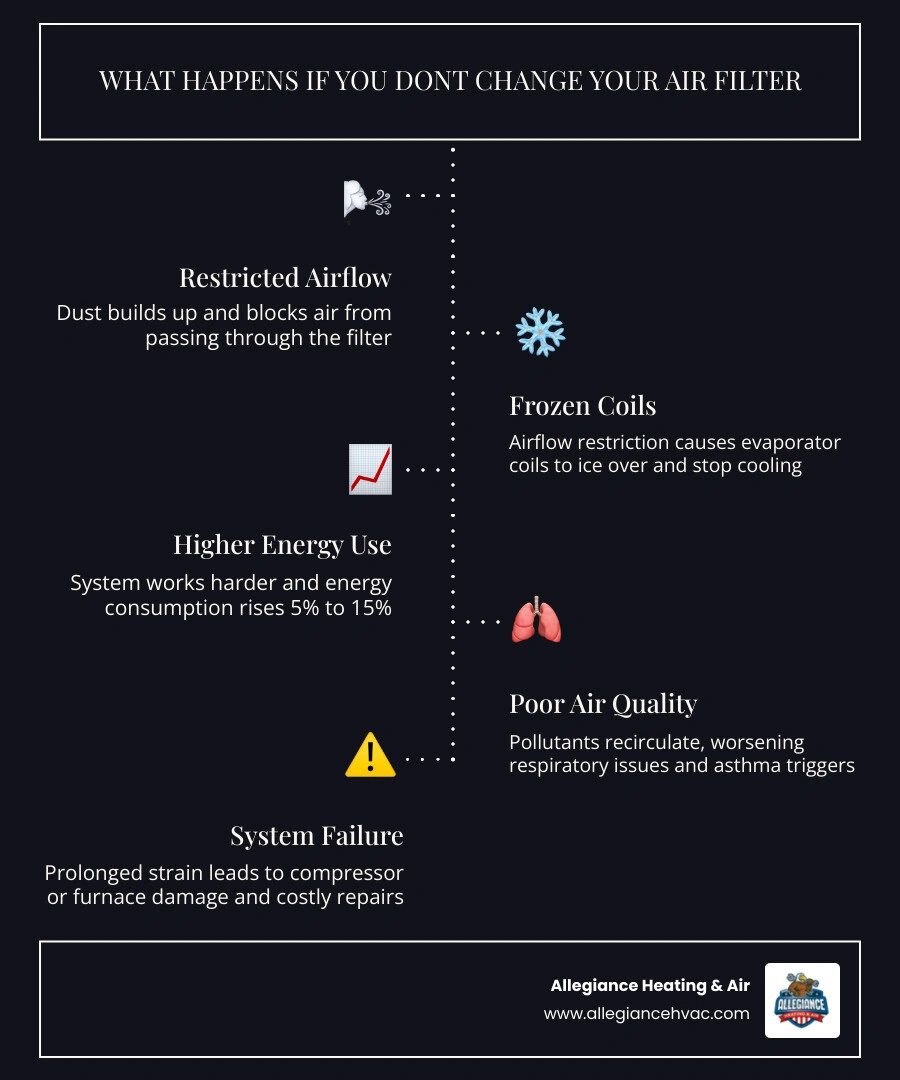
- Higher energy bills — A clogged filter can increase energy consumption by 5% to 15% or more
- Frozen evaporator coils — Restricted airflow causes coils to ice over, stopping your AC from cooling
- HVAC system failure — Dirty filters are one of the leading causes of premature system breakdown
- Poor indoor air quality — The EPA estimates indoor air is already 2 to 5 times more polluted than outdoor air, and a dirty filter makes it worse
- Furnace overheating — Blocked airflow forces your furnace to work harder, risking cracked heat exchangers and carbon monoxide leaks
- Engine damage in your car — A neglected engine air filter can reduce horsepower, hurt fuel economy, and cause long-term wear
Most people forget about their air filter because it is out of sight. But that small, inexpensive part is quietly protecting your HVAC equipment, your family's lungs, and your monthly utility budget all at once. When it gets clogged and goes unchanged, a chain reaction starts — one that can end with a repair bill far more painful than a simple filter swap.
In Greenville, IN, where summer heat and winter cold push HVAC systems hard, staying on top of filter changes is one of the easiest ways to protect your home comfort year-round.
What Happens If You Dont Change Your Air Filter in Your Home?
When you let a home air filter go unchanged, you are essentially suffocating your heating and cooling system. Your HVAC system relies on a constant, steady stream of return air to regulate temperature. If that air cannot pass freely through a clogged filter, the entire system has to work twice as hard to distribute conditioned air throughout your living spaces.
This restriction of airflow triggers a domino effect of mechanical problems. In the summer, restricted airflow causes the temperature of your air conditioner's evaporator coils to plummet. Because there is not enough warm air passing over the coils to facilitate heat transfer, the condensation on the coils freezes solid.
Once your evaporator coils are encased in ice, your system can no longer absorb heat from your home. The refrigerant inside the coils remains in a cold, liquid state instead of vaporizing. This liquid refrigerant can travel back down the line to your outdoor compressor unit. Since compressors are only designed to pressurize gas, this phenomenon—known as "liquid slugging"—can completely destroy your compressor, requiring an incredibly expensive system replacement.
Furthermore, running your system with a clogged filter drastically shortens its overall lifespan. While most modern HVAC components are engineered to last 15 to 20 years, neglecting basic maintenance can easily cut that lifespan in half. Forcing the blower motor to pull air through a dense wall of dust causes the motor to run much hotter than designed, drying out its lubricants and degrading its electrical insulation.
All of this extra strain translates directly to your monthly utility bills. A clogged filter can cause a 15% to 30% increase in energy usage because the system has to run for much longer cycles to reach the temperature set on your thermostat.
If you are curious about what else can happen when you neglect regular system tune-ups, read our detailed breakdown on What Happens If You Skip HVAC Maintenance.
To help you visualize the difference a simple filter swap can make, here is a side-by-side comparison of how a clean filter versus a dirty filter impacts your home and system:
| Performance Metric | Clean Air Filter | Dirty / Clogged Air Filter |
|---|---|---|
| Airflow Volume | Strong, consistent, and evenly distributed | Weak, sluggish, and leads to hot/cold spots |
| Energy Consumption | Optimal efficiency (lower utility bills) | 15% to 30% higher energy usage |
| System Run Times | Short, efficient cycles | Long, continuous running (short cycling) |
| Indoor Air Quality | Traps dust, pollen, pet dander, and allergens | Recirculates pollutants and worsens indoor air |
| Component Stress | Low; motor and coils operate safely | High; risks frozen coils and motor burnout |
| Equipment Lifespan | Maximizes system life (15–20 years) | Shortens lifespan significantly (often to 10 years or less) |
For a step-by-step guide on how to safely locate and swap out your filter, check out our guide on Replacing Your Air Filter.
Furnace Overheating and Cracked Heat Exchangers
In the cold southern Indiana winters, a dirty filter poses a severe safety hazard to your heating system. When your furnace turns on, the heat exchanger becomes incredibly hot. The blower motor must push cold air over this heat exchanger to warm it up and distribute it through your home's vents.
If a clogged filter blocks that air, the heat exchanger cannot shed its heat. The temperature inside the furnace furnace cabinet rises rapidly to dangerous levels. To prevent a fire, your system's high-limit switch will trigger a safety shutdown, turning the furnace off before it can complete a heating cycle. This cycle of starting, quickly overheating, and shutting down is known as "short cycling."
Short cycling puts immense thermal stress on the metal heat exchanger. The constant, rapid expansion and contraction of the metal will eventually cause it to crack. A cracked heat exchanger is one of the most dangerous failures a furnace can experience because it can allow deadly carbon monoxide gas to leak directly into your home's breathing air.
Indoor Air Quality Degradation and Health Risks
Your HVAC system acts as the lungs of your home, recirculating the indoor air you breathe multiple times a day. According to the EPA, indoor air quality is on average two to five times worse than outdoor air, and in some tightly sealed modern homes, it can be up to 100 times worse.
When your air filter becomes saturated with dust, pollen, pet dander, and mold spores, it can no longer hold any more particles. At this point, the filter stops cleaning your air altogether. In fact, under the pressure of the blower motor, the accumulated dust can begin to bypass the filter or break free, recirculating directly back into your living spaces.
This constant pollutant recirculation can trigger severe respiratory issues, asthma attacks, and seasonal allergies. It also leads to a heavy accumulation of dust on your furniture, walls, and inside your ductwork. If you want to dive deeper into how to protect your family from airborne hazards, read our comprehensive guide on Enhancing Homes Indoor Air Quality.
What Happens If You Don’t Change Your Air Filter in Your Motor Vehicle?
Just like your home’s HVAC system, your car's engine needs to breathe clean air to function properly. The engine air filter is designed to keep road dust, dirt, sand, and organic debris out of your engine's combustion chambers.
When you neglect to replace your vehicle's engine air filter, the engine suffers from severe air restriction. This restriction upsets the precise air-fuel ratio required for efficient combustion. When the engine cannot get enough oxygen, it runs "rich," meaning it burns too much fuel and not enough air.
This imbalance leads to several noticeable performance issues:
- Diminished horsepower and sluggish acceleration — You may notice your car jerking or feeling incredibly slow to respond when you press the gas pedal.
- Fouled spark plugs and engine misfires — Unburnt fuel can create black soot deposits on your spark plugs, leading to rough idling and engine misfires.
- Fouled Mass Airflow (MAF) sensor — A dirty filter can allow micro-particles to pass through, coating the delicate MAF sensor and triggering your "Check Engine" light.
More importantly, neglecting your car's air filter can cause permanent, long-term engine wear. Up to 75% of engine damage can occur in the first 25% of an air filter's life if it is not changed regularly. When a filter becomes completely saturated, the intense suction of the engine can actually deform the filter frame, creating gaps that allow completely unfiltered, abrasive road dirt to enter the engine cylinders. This dirt acts like sandpaper, scratching cylinder walls and piston rings, which leads to costly internal engine damage.
How Often Should You Change Your Air Filter in Greenville, IN?
How often you need to replace your home air filter depends heavily on your household size, whether you have pets, and if anyone in your home suffers from allergies or asthma.
For standard 1-inch pleated filters, the general rule of thumb is to replace them every 90 days. However, this schedule needs to be adjusted based on your specific living conditions. For example, pet dander and fur clog filters much faster than normal dust. If you have a single cat or dog, you should change your filter every 60 days. If you have multiple pets or family members with severe allergies, that window drops to every 30 to 45 days.
The type of filter you choose also matters. Filters are rated using the MERV (Minimum Efficiency Reporting Value) scale, which ranges from 1 to 16 for residential systems. Standard fiberglass filters (MERV 2 to 4) only protect the HVAC equipment from large dust bunnies and should be changed every 30 days. High-quality pleated filters (MERV 8 to 11) capture smaller particles like pollen and pet dander and typically last 60 to 90 days.
For a complete breakdown of filter types and how to pick the right one for your system, read our How Often Should You Change Your Air Filter guide, and prepare your system for the changing seasons with our Spring Air Filter Replacement Complete Guide.
To make it easy, here is a quick reference list of recommended replacement intervals:
- Single occupant home (no pets or major allergies): Change every 90 days
- Average suburban home (1 pet or mild allergies): Change every 60 days
- Active household (multiple pets, smokers, or severe allergy sufferers): Change every 30 to 45 days
- Vacation homes or rarely used properties: Change every 6 to 12 months
- Thicker media filters (4 to 5 inches): Change every 6 to 12 months
Frequently Asked Questions About Air Filter Maintenance
What happens if you dont change your air filter and run your AC?
Running your air conditioner with a dirty, clogged filter will quickly lead to restricted airflow across your indoor evaporator coils. Because the cold refrigerant cannot absorb heat from your home's air, the moisture on the coils will freeze.
Once your system freezes up, it will stop blowing cold air entirely and may start blowing warm or weak air. If you continue to run the system in this state, the liquid refrigerant can travel back to the outdoor unit and cause catastrophic compressor failure. If you are noticing issues with your system's performance, look out for these Signs Your Air Filter Needs Replaced.
What happens if you dont change your air filter and run the system without one?
Running your HVAC system without an air filter—even for a single day—is highly discouraged. Without a filter, there is nothing to stop airborne dust, hair, pet dander, and cooking grease from being sucked directly into your system's internal cabinet.
This debris will quickly coat your blower motor, fan blades, and delicate evaporator coils. A layer of dust on your coils acts as an insulator, drastically reducing heating and cooling efficiency. Furthermore, the dark, damp environment of an evaporator coil combined with organic dust creates the perfect breeding ground for mold and bacteria, which will pollute your indoor air and cause foul, musty odors.
What are the first warning signs that my air filter needs to be replaced?
You don't have to wait until your system breaks down to know your filter is dirty. Keep an eye out for these common warning signs:
- Weak airflow coming from your home's supply registers.
- A rapid increase in household dust settling on your furniture shortly after cleaning.
- Musty or dusty odors circulating through your home whenever the heating or cooling kicks on.
- An unexpected spike in your monthly energy bills without a corresponding change in outdoor temperatures.
- Longer system run times where your AC or furnace struggles to reach the temperature set on your thermostat.
An overworked system can also struggle to balance moisture levels in your home. To learn more about managing indoor comfort, read our guide on How to Control Indoor Humidity with Your HVAC.
Conclusion: Protect Your Greenville Home’s Comfort
Changing your air filter is the simplest, most cost-effective preventative maintenance task you can perform for your home. Neglecting this quick chore can lead to frozen coils, cracked heat exchangers, poor indoor air quality, and high utility bills.
At Allegiance Heating & Air, LLC, we have been "Taking Home Comfort Under Our Wing" as a family-owned business since 2005. Our licensed, insured, and highly experienced technicians are proud to serve Greenville, IN, and surrounding communities like Floyds Knobs, New Albany, Clarksville, and Georgetown. We are dedicated to providing honest, transparent service to ensure your family enjoys reliable, year-round comfort.
Proper maintenance goes beyond just changing filters; it also involves keeping your home's humidity in check. Learn more about why this matters by reading about the Proper Humidity Control Importance.
To make sure your heating and cooling systems are always running at peak efficiency, consider signing up for our comprehensive Allegiance Maintenance Plan. Our team will handle the deep cleaning, safety checks, and tune-ups so you never have to worry about the hidden dangers of a neglected system. Reach out to us today to schedule your next service visit!
Contact Us Or Schedule Expert Service
Other Blogs
ready to transform your home?
Discover our exceptional home services tailored to meet your needs and enhance your living space.
WHAT OUR CLIENTS HAVE TO SAY ABOUT US

We had a complete HVAC system and a hot water heater installed. The guys were professional, well mannered, and completed the work in a timely manner. Would definitely use them again.
I was nervous at first because my AC broke in the middle of 80 degree weather which is strange for April, but Allegiance Heating and Air was incredibly prompt and professional. The technician arrived within an hour, explained the problem clearly, and completed the repair. The technician , Mr. Garrett Moon was a very nice and courteous young man. He found the problem and fixed it within a timely manner. I highly recommend them for any heating or cooling needs. I’ll definitely give them a call again should I ever have another issue, but hopefully not. Knock on wood 😁. Give them a call… you won’t be disappointed!
From the moment I called to schedule a service, the team was quick to respond and arrived right on time. The technician was professional, friendly, and clearly knowledgeable about my heating system. He explained the repair options in plain language and completed the job efficiently. I appreciated the reliable service and the fact that the work was done the same day. I would definitely recommend Allegiance Heating and Air for any residential HVAC needs.
5/5 stars – I was very impressed with the efficient, affordable and timely service from Allegiance Heating and Air. The technician arrived on time, and performed the service quickly, no repairs needed at this time. Communication was clear and the whole experience felt hassle‑free. I would definitely recommend them for any residential HVAC needs.
Knowledgeable, experienced individual.
Explains Allegiance Heating and Air was incredibly reliable, professional and affordable. They arrived right on time, kept the work area clean and finished the furnace repair quickly. The technician explained everything clearly and the price was a great value. If happiness had a location on Google Maps, it would be here.
Gilbert had to go above and beyond because York is no longer making the part for my furnace. But he was able to find a way to construct a housing bracket for my furnace. Ingenuity, determination and integrity is what finally got my furnace fixed. Gilbert is truly a one of a kind technician.
Thank you for always going the extra mile. Gilbert is always respectful and helpful with any concerns.
"Great service, most knowledgeable and capable HVAC business in Kentuckiana!! Pete Flemming and Bryan the owner, are HVAC encyclopedias. They have the highest integrity of any HVAC business I have ever used. Allegiance has put numerous units in for me over the last 17 years. I will continue to use and trust them."
"Fast response from Allegiance when our heat was out on New Year’s day! Service technician was friendly and efficient. He took the time to explain the problem, tell us about the temporary fix and the plan for permanent repair. We were impressed!"
"Love Allegiance! Their technicians, in particular Benjamin, explain everything. Fast and thorough. A/C was out on a Sunday. Called Allegiance and within a few hours Benjamin arrived. Such a comfort as he was the one who last serviced our units. He quickly replaced part and cooling is restored!"
"My heat pump went out and I had to call after hours. The technician (Garrett) was outstanding and thorough. He got my system up and working until Monday and gave me several options of units. Also took the time to explain the issue to my Home warranty company. I highly recommend this company."
"Right on time :) respectful, fast, and polite. Even gave my fur babies some attention."
"Had Garrett out today to fix our AC. Fantastic tech. He showed up exactly when he said he would and kept us informed of what he was checking and what he found. Highly recommend!"
"Lucas with Allegiance showed up on time as promised, was professional and extremely patient and responsive with all my questions. He took care of the issue, and I feel he was trustworthy! He had us back to cool and comfortable on one of the hottest days of the year."
"Lucas did a great job! Very professional and expedient. Explained the process very well and represented Allegiance as a truly professional and reputable company."
"Arrived on time and work diligently to fix issue. These guy are great. Worked quickly to resolve my issues."
"Lucas was great - he spent a lot of time trying to figure out what was going on and explained everything he was doing. I trust Allegiance and wouldn’t want anyone else working on/in my house!!"

RELATED ARTICLES

Managing Commercial AC Emergencies in Clarksville

Troubleshooting Common Issues with Ductless Heaters