What Shortens HVAC System Lifespan — And How to Stop It From Happening to Yours
What shortens HVAC system lifespan is one of the most important things you can understand as a homeowner. Most systems are built to last 15 to 25 years — but many fail in half that time. The difference almost always comes down to a handful of avoidable mistakes.
Here is a quick answer if you want it:
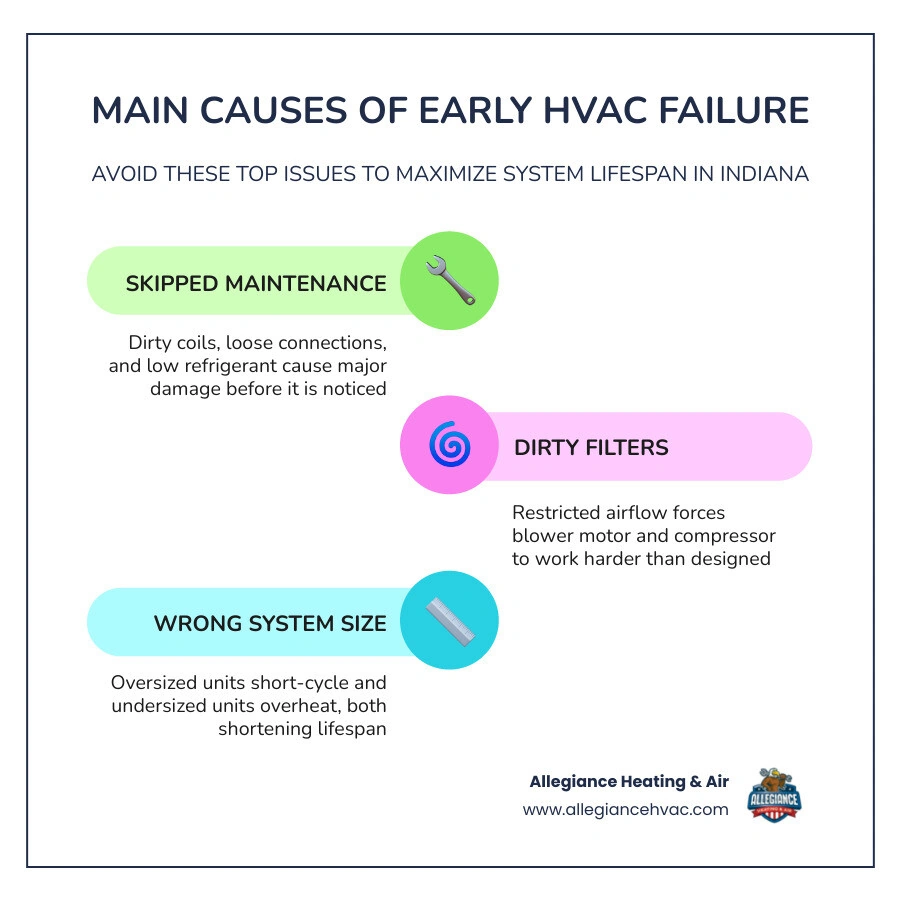
The main things that shorten HVAC system lifespan:
- Skipping regular maintenance — dirty coils, loose connections, and low refrigerant go unnoticed until they cause major damage
- Neglecting air filter changes — restricted airflow forces the blower motor and compressor to work harder than they should
- Improper system sizing — oversized systems short-cycle 30 to 50 times a day instead of the normal 6 to 8, burning out components years early; undersized systems run nonstop and overheat
- Environmental stress — extreme heat, dust, and humidity cause components to wear out faster, especially in climates with long cooling seasons
- Ignoring early warning signs — strange noises, rising energy bills, and uneven temperatures are your system telling you something is wrong
In Indiana, where summers can be hot and humid and winters are hard on heating equipment, these factors hit closer to home than most people realize. A system that runs hard from June through August and then carries the load through a cold winter is under serious stress — and without the right habits in place, that stress adds up fast.
The good news is that most of the damage is preventable. Below, we cover five things you can do right now to protect your investment and get every year of life your system was built to deliver.
What shortens hvac system lifespan vocabulary:
The Science of Wear and Tear: What Shortens HVAC System Lifespan?
To understand how to protect your heating and cooling equipment, we first have to look at the mechanical physical stress it undergoes. An HVAC system is not a static appliance like a refrigerator; it is a complex assembly of high-powered motors, pressurized refrigerant lines, electrical relays, and thermal exchangers.
In Southern Indiana, our climate forces these systems to transition from freezing winter conditions to sweltering, humid summer heatwaves. This constant shift leads to significant thermal expansion and contraction of metal parts, putting high stress on every weld, electrical contactor, and mechanical seal.

When we look at what shortens HVAC system lifespan, we are looking at how everyday wear accelerates into permanent mechanical failure. For example, a central air conditioner’s compressor pump operates under extreme pressures. If the system is forced to run under sub-optimal conditions, the oil lubricating the compressor loses its viscosity due to excess heat. This leads to internal metal-on-metal grinding, which ultimately destroys the compressor—the most expensive component in the system.
Different types of systems experience this wear in unique ways:
- Central Air Conditioners: Primarily suffer from condenser coil blockage, electrical wear on contactors and capacitors, and compressor fatigue.
- Heat Pumps: Because they run year-round—providing both heating in the winter and cooling in the summer—they accumulate double the runtime hours of a standard air conditioner. This constant operation makes them more susceptible to premature wear if regular care is neglected.
- Furnaces: Deal with high thermal stress. The constant cycling of the burner assembly heats the metal heat exchanger to extreme temperatures, which then cools down when the cycle ends. Over time, this thermal cycling can cause the metal to fatigue and crack.
- Geothermal Systems: While the indoor heat exchanger and compressor face typical wear, the ground loops are highly durable. However, scale buildup inside the water-to-refrigerant heat exchangers can severely limit heat transfer and force the system to work much harder.
As of July 2026, modern high-efficiency HVAC systems are engineered with tighter tolerances than ever before. While this makes them incredibly efficient, it also means they are less forgiving of neglect. If you are wondering where your current equipment stands, it is helpful to assess How Old Is Too Old for an HVAC System to determine whether maintenance or replacement is your best path forward.
Below is a breakdown of the typical lifespans you can expect from different types of residential HVAC equipment when properly maintained versus when they are neglected:
| HVAC System Type | Average Lifespan (With Maintenance) | Average Lifespan (Neglected / Poor Conditions) | Primary Wear Mechanism |
|---|---|---|---|
| Central Air Conditioning | 15 to 20 Years | 8 to 10 Years | Compressor burnout, capacitor failure, coil corrosion |
| Heat Pumps | 15 to 20 Years | 8 to 10 Years | Year-round mechanical fatigue, reversing valve failure |
| Gas Furnaces | 15 to 30 Years | 10 to 12 Years | Heat exchanger cracking, burner corrosion, blower failure |
| Geothermal Systems | 25 to 30 Years (Loops: 50+) | 15 to 18 Years | Scale buildup in heat exchanger, pump module failure |
| Boilers | 15 to 20 Years | 10 to 12 Years | Scale accumulation, pressure vessel leaks, control failures |
1. Schedule Professional Tune-Ups to Prevent Neglect
The single most effective action you can take to prevent early system failure is scheduling regular, professional maintenance. Many homeowners view seasonal tune-ups as an optional luxury, but in reality, they are a mechanical necessity.
During a typical year of operation, your heating and cooling system accumulates minor issues that, if left unaddressed, snowball into catastrophic failures. For example, electrical connections naturally loosen over time due to the vibrations of the blower motor and compressor. Loose connections cause high electrical resistance, which generates heat and can melt wires, destroy control boards, or damage expensive motors.
Furthermore, minor changes in refrigerant levels can quietly destroy your compressor. If a small leak develops, the system has to run longer to satisfy the thermostat, causing the compressor to overheat. Conversely, if the refrigerant charge is incorrect, liquid refrigerant can flood back into the compressor, causing immediate mechanical destruction.
By investing in preventative maintenance, you ensure that a licensed technician inspects, cleans, and calibrates these critical areas twice a year—once in the spring for your AC and once in the fall for your heating system. Skipping this service leads to a cascade of mechanical issues, as detailed in our guide on What Happens If You Skip HVAC Maintenance. To make this process seamless, we highly recommend exploring How a Maintenance Plan Extends Equipment Life, which provides structured, recurring care to protect your investment year-round.
Neglected Maintenance: The Number One Factor in What Shortens HVAC System Lifespan
When a system is neglected, the mechanical strain is continuous. Without regular cleaning, the outdoor condenser coil and indoor evaporator coil accumulate a thick layer of dust, pollen, and pet dander. This buildup acts as an insulating blanket, preventing the system from transferring heat efficiently.
For your air conditioner or heat pump, a dirty condenser coil forces the compressor to operate at significantly higher pressures and temperatures (known as high-head pressure). This constant, high-heat operation breaks down the compressor’s internal lubricating oil, leading to mechanical friction and eventual compressor failure.
On the heating side, neglected maintenance is particularly dangerous for gas furnaces. Dust buildup on the blower wheel reduces the volume of air passing over the heat exchanger. Without sufficient airflow to carry the heat away, the heat exchanger quickly overheats. This triggers the high-limit switch, shutting the system down.
Repeatedly overheating and cooling down causes the metal of the heat exchanger to expand and contract violently. Over time, this extreme thermal stress leads to heat exchanger cracking. A cracked heat exchanger is not only a system-destroying failure; it also poses a serious safety risk by allowing carbon monoxide to leak into your home’s breathing air. To keep your heating system safe and efficient, review these practical Furnace Maintenance Tips.
2. Replace Your Air Filters and Clean Your Ducts Regularly
If professional maintenance is the most important service you can schedule, changing your air filter is the most important task you can perform yourself. The air filter’s primary job is not actually to clean the air you breathe, but to protect the sensitive internal components of your HVAC system from dust and debris.
When an air filter is left in place too long, it becomes heavily loaded with particulates, creating a severe airflow restriction. Your HVAC blower motor is designed to push air against a specific level of resistance, known as static pressure. When a clogged filter increases this static pressure beyond the motor's design limits, the motor must work significantly harder to pull air through the system.
This extra workload causes the blower motor to draw more electrical current, overheating its windings and drastically shortening its operational life. Additionally, a restricted system cannot move enough air to keep the indoor evaporator coil warm during the cooling season, which can lead to ice formation and compressor damage. To avoid these issues, follow our step-by-step instructions on Replacing Your Air Filter to keep air flowing freely.
Airflow Restrictions: How Clogged Filters Represent What Shortens HVAC System Lifespan
The consequences of restricted airflow extend far beyond a worn blower motor. According to the Department of Energy, a dirty air filter can increase your system's energy consumption by up to 15%. This spike in energy use reflects how much longer and harder your system must run to keep your home comfortable.
When airflow is restricted, the temperature of the indoor evaporator coil drops rapidly. Without enough warm air passing over the coil to evaporate the liquid refrigerant inside, the coil's temperature falls below freezing. The moisture pulled from your home's air immediately freezes on the metal fins, creating a solid block of ice. This ice acts as an insulator, completely stopping heat transfer.
If the system continues to run in this state, unevaporated liquid refrigerant can travel back down the suction line to the outdoor unit. Because compressors are designed to compress gas, not liquid, this "liquid slugging" can instantly destroy the compressor's internal valves.
Furthermore, dirty air ducts act as a continuous source of airborne debris. Over years of operation, dust, pet hair, and construction debris accumulate inside your ductwork. When the fan turns on, these particles are pulled back into the HVAC cabinet, quickly clogging your newly replaced filters and coating the sensitive blower wheel and evaporator coil. This continuous cycle of dust accumulation degrades indoor air quality and keeps your system under constant mechanical strain.
3. Ensure Your System is Properly Sized
One of the most critical, yet frequently overlooked, factors in HVAC longevity is the physical size—or capacity—of the equipment relative to your home. Many people assume that a larger system is always better because it will heat or cool the home faster. In the HVAC world, this is a costly misconception.
To determine the exact heating and cooling needs of a home, we perform a detailed calculation known as a Manual J load calculation. This process takes into account:
- The total square footage and layout of the home
- The orientation of the house relative to the sun
- The type and thickness of insulation in the walls, attic, and crawlspace
- The number, size, and efficiency rating of all windows and doors
- Local climate data for our specific Southern Indiana region
Without this calculation, systems are often sized using outdated "rules of thumb" (such as one ton of cooling per 500 square feet). This approach is highly inaccurate and frequently results in systems that are vastly oversized or undersized.
When investing in a new system, choosing the right capacity is essential. To understand how efficiency ratings interact with proper sizing, read our Standard Efficiency vs High Efficiency HVAC Comparison to find the ideal match for your home's thermal load.
The Danger of Oversized Systems and Short Cycling
According to industry data, over 60% of residential HVAC systems are incorrectly sized. In the United States, systems are, on average, significantly larger than necessary. When an air conditioner, heat pump, or furnace is oversized, it heats or cools the home incredibly fast, satisfying the thermostat in a matter of minutes. While this might sound convenient, it triggers a destructive phenomenon known as short cycling.
A properly sized HVAC system should run for continuous cycles of 10 to 20 minutes. This allows the system to reach its peak operating efficiency and evenly distribute conditioned air throughout the home. An oversized system, however, will turn on, blast the home with air, and shut off after only 5 or 6 minutes.
This constant starting and stopping is incredibly hard on the equipment. The startup phase is the most stressful part of an HVAC system's operation. During startup, the compressor and fan motors must overcome static inertia, drawing an inrush current that is 6 to 10 times higher than their normal running current. This surge of electricity generates intense heat within the motor windings.
An oversized system may cycle 30 to 50 times a day instead of the normal 6 to 8 cycles, creating up to 400% to 600% more wear events on critical electrical and mechanical parts. This relentless cycling can easily cut a system's expected 15-to-20-year lifespan down to just 8 to 10 years.
Furthermore, because an air conditioner must run for at least 10 to 15 minutes for its evaporator coil to become cold enough to condense water vapor, a short-cycling system fails to remove humidity from the air. This leaves your home feeling cold and clammy, often prompting homeowners to lower the thermostat even further, compounding the wear on the system.
The Strain of Undersized Systems and Constant Running
On the opposite end of the spectrum, an undersized system presents its own set of severe mechanical hazards. If a system is too small for the thermal load of the home, it will struggle to satisfy the thermostat, especially during extreme summer heatwaves or freezing winter nights.
To compensate for its lack of capacity, an undersized system will run continuously for hours on end. While continuous operation at a low, steady speed is normal for modern variable-speed systems, a single-stage system running flat-out at maximum capacity experiences rapid wear.
The blower motor, outdoor fan motor, and compressor are forced to operate without a break, preventing them from cooling down. This continuous thermal load can cause motor windings to degrade, leading to electrical shorts and eventual motor burnout.
Additionally, an undersized system running nonstop drives utility costs up significantly, as the system draws maximum power for extended periods. The constant operation also accelerates the wear on air filters and coils, requiring far more frequent maintenance to prevent total system failure.
4. Mitigate Environmental Stressors and Extreme Weather
Your outdoor condenser unit is designed to live outside, but that doesn't make it immune to the elements. Extreme heat, windblown dust, agricultural debris, and humidity all act as environmental stressors that can shorten your system's life.
In our region, agricultural dust and seasonal pollen are major contributors to coil blockage. When cottonwood seeds, cut grass, and fine dust are pulled into the outdoor unit by the condenser fan, they coat the delicate aluminum fins of the coil. This debris acts as an insulating barrier, trapping heat inside the system and forcing the compressor to run at elevated temperatures.
Furthermore, the combination of moisture and organic acids in the air can lead to a specific type of chemical wear known as formicary corrosion. This occurs when copper refrigerant lines react with trace acids in the air, creating microscopic tunnels through the copper tubing. Over time, these tiny holes lead to refrigerant leaks that are incredibly difficult to find and repair.
To protect your outdoor unit from these environmental threats, we recommend several simple steps:
- Maintain Clearance: Keep at least two feet of clear space around the entire outdoor unit. Trim back bushes, weeds, and overhanging branches to ensure unrestricted airflow.
- Provide Shade: If possible, shade the outdoor unit from the direct afternoon sun. Shading the unit can reduce the ambient air temperature around it by 10 to 15 degrees, lowering the workload on the compressor. Just ensure the shading structure does not block the top exhaust fan.
- Use Window Coverings: Block radiant solar heat inside your home by closing blinds or drapes on the south and west-facing windows during the hottest parts of the day. This simple habit can reduce your home's total cooling load by up to 12%, giving your HVAC system a much-needed break.
5. Recognize the Warning Signs of System Decline
No matter how well you care for your system, mechanical components will eventually reach the end of their reliable service life. The key to preventing a complete system failure—which often happens during the hottest or coldest days of the year—is recognizing the warning signs of decline early.
Many homeowners ignore minor changes in their system's performance, assuming that as long as air is coming out of the registers, everything is fine. However, catchable symptoms are your system's way of warning you of internal distress before a major component fails.
Keep an eye out for these common warning signs:
- Weak Airflow: If you notice that the air blowing from your vents feels weaker than usual, it could indicate a failing blower motor, a severely clogged filter, or leaking ductwork.
- Unusual Noises: Squealing, grinding, rattling, or clicking sounds should never be ignored. A squealing noise often points to a failing belt or motor bearing, while grinding indicates a compressor in distress. Clicking sounds at startup usually signal failing electrical relays or capacitors.
- Rising Energy Bills: If your utility bills are steadily climbing month over month, but your usage habits haven't changed, your system is losing its efficiency. This is a clear sign that components are working harder than they should to achieve the same results.
- Uneven Temperatures: If some rooms in your home are freezing while others are warm, your system is struggling to distribute conditioned air properly. This can be caused by ductwork leaks, a failing blower, or a system that is losing its heating and cooling capacity.
When these signs begin to appear, it is critical to evaluate your options. Reviewing Signs Your HVAC Needs Replacing Not Just Fixing can help you understand the severity of these symptoms. If you are facing a major repair bill, our guide on When to Repair vs Replace Your HVAC System provides a practical framework to help you make the most cost-effective decision for your home.
Frequently Asked Questions About HVAC Longevity
How can I extend the life of my HVAC system today?
The most immediate action you can take today is to inspect your air filter and replace it if it shows any signs of dust buildup. Next, walk outside and check your outdoor condenser unit; remove any leaves, tall grass, or debris blocking the airflow around the cabinet.
Additionally, we highly recommend installing a smart thermostat. A smart thermostat helps optimize runtimes, preventing unnecessary cycles when you are away from home and reducing overall mechanical wear. For more practical tips, check out our comprehensive guide on How to Extend Your HVAC Lifespan.
Does a high-efficiency HVAC system last longer?
Yes, high-efficiency systems often enjoy a longer operational lifespan, primarily due to advanced technologies like variable-speed blowers and multi-stage compressors. Unlike standard single-stage systems that run at 100% capacity every time they turn on, variable-speed systems adjust their output to match your home's exact heating or cooling needs.
This means they run for longer, gentler cycles at lower speeds, drastically reducing the thermal stress and electrical wear associated with frequent on-off cycling. To see how these systems pay off over time, read about How Much Does a High Efficiency HVAC Save Over Time.
How often should I have my air ducts cleaned to protect my system?
According to the National Air Duct Cleaners Association (NADCA) standards, homeowners should have their air ducts professionally inspected and cleaned every 3 to 5 years.
Regular duct cleaning prevents accumulated dust, pet hair, and airborne debris from being pulled back into your heating and cooling equipment. This keeps your coils cleaner, reduces static pressure, and optimizes airflow, allowing your system to run at peak efficiency with minimal mechanical strain.
Conclusion
Understanding what shortens HVAC system lifespan is the first step toward protecting one of the most significant investments in your home. By staying on top of air filter changes, ensuring proper system sizing, and scheduling regular professional care, you can prevent early equipment failure and enjoy reliable comfort for years to come.
At Allegiance Heating & Air, LLC, we have been "Taking Home Comfort Under Our Wing" as a family-owned business since 2005. Serving Greenville, IN, and our surrounding Southern Indiana and Louisville-area communities, our trusted, licensed, and professional technicians are dedicated to ensuring your system runs safely and efficiently. We pride ourselves on honest, transparent service and complete customer satisfaction.
Don't wait for your system to break down on a hot summer afternoon or a freezing winter night. Protect your home's comfort and extend your system's lifespan—Schedule your professional HVAC service today with our expert team!
Contact Us Or Schedule Expert Service
Other Blogs
ready to transform your home?
Discover our exceptional home services tailored to meet your needs and enhance your living space.
WHAT OUR CLIENTS HAVE TO SAY ABOUT US

We had a complete HVAC system and a hot water heater installed. The guys were professional, well mannered, and completed the work in a timely manner. Would definitely use them again.
I was nervous at first because my AC broke in the middle of 80 degree weather which is strange for April, but Allegiance Heating and Air was incredibly prompt and professional. The technician arrived within an hour, explained the problem clearly, and completed the repair. The technician , Mr. Garrett Moon was a very nice and courteous young man. He found the problem and fixed it within a timely manner. I highly recommend them for any heating or cooling needs. I’ll definitely give them a call again should I ever have another issue, but hopefully not. Knock on wood 😁. Give them a call… you won’t be disappointed!
From the moment I called to schedule a service, the team was quick to respond and arrived right on time. The technician was professional, friendly, and clearly knowledgeable about my heating system. He explained the repair options in plain language and completed the job efficiently. I appreciated the reliable service and the fact that the work was done the same day. I would definitely recommend Allegiance Heating and Air for any residential HVAC needs.
5/5 stars – I was very impressed with the efficient, affordable and timely service from Allegiance Heating and Air. The technician arrived on time, and performed the service quickly, no repairs needed at this time. Communication was clear and the whole experience felt hassle‑free. I would definitely recommend them for any residential HVAC needs.
Knowledgeable, experienced individual.
Explains Allegiance Heating and Air was incredibly reliable, professional and affordable. They arrived right on time, kept the work area clean and finished the furnace repair quickly. The technician explained everything clearly and the price was a great value. If happiness had a location on Google Maps, it would be here.
Gilbert had to go above and beyond because York is no longer making the part for my furnace. But he was able to find a way to construct a housing bracket for my furnace. Ingenuity, determination and integrity is what finally got my furnace fixed. Gilbert is truly a one of a kind technician.
Thank you for always going the extra mile. Gilbert is always respectful and helpful with any concerns.
"Great service, most knowledgeable and capable HVAC business in Kentuckiana!! Pete Flemming and Bryan the owner, are HVAC encyclopedias. They have the highest integrity of any HVAC business I have ever used. Allegiance has put numerous units in for me over the last 17 years. I will continue to use and trust them."
"Fast response from Allegiance when our heat was out on New Year’s day! Service technician was friendly and efficient. He took the time to explain the problem, tell us about the temporary fix and the plan for permanent repair. We were impressed!"
"Love Allegiance! Their technicians, in particular Benjamin, explain everything. Fast and thorough. A/C was out on a Sunday. Called Allegiance and within a few hours Benjamin arrived. Such a comfort as he was the one who last serviced our units. He quickly replaced part and cooling is restored!"
"My heat pump went out and I had to call after hours. The technician (Garrett) was outstanding and thorough. He got my system up and working until Monday and gave me several options of units. Also took the time to explain the issue to my Home warranty company. I highly recommend this company."
"Right on time :) respectful, fast, and polite. Even gave my fur babies some attention."
"Had Garrett out today to fix our AC. Fantastic tech. He showed up exactly when he said he would and kept us informed of what he was checking and what he found. Highly recommend!"
"Lucas with Allegiance showed up on time as promised, was professional and extremely patient and responsive with all my questions. He took care of the issue, and I feel he was trustworthy! He had us back to cool and comfortable on one of the hottest days of the year."
"Lucas did a great job! Very professional and expedient. Explained the process very well and represented Allegiance as a truly professional and reputable company."
"Arrived on time and work diligently to fix issue. These guy are great. Worked quickly to resolve my issues."
"Lucas was great - he spent a lot of time trying to figure out what was going on and explained everything he was doing. I trust Allegiance and wouldn’t want anyone else working on/in my house!!"

RELATED ARTICLES
Affordable Heating Replacement in Louisville: Keeping Your Wallet Toasty
Comprehensive Guide to Air Conditioner Repair, Replacement, and Maintenance