


Why Knowing What to Look for in an HVAC Contractor Credentials Can Save You Time, Money, and Stress
When it comes to what to look for in an HVAC contractor credentials, the short answer is this:
| Credential | Why It Matters |
|---|---|
| State HVAC License | Legal authorization to perform HVAC work in your state |
| EPA Section 608 Certification | Required by federal law for anyone handling refrigerants |
| General Liability Insurance | Protects your home if damage occurs during the job |
| Workers' Compensation Insurance | Covers technician injuries on your property |
| Surety or Performance Bond | Financial protection if the contractor fails to complete work |
| NATE Certification | Voluntary but signals advanced technician knowledge |
| Permit Compliance | Ensures work meets local building codes and passes inspection |
Your heating and cooling system is one of the biggest investments in your home. A bad hire does not just mean uncomfortable temperatures — it can mean voided equipment warranties, failed inspections, refrigerant violations, and repair bills that pile up fast. In Tennessee alone, over 900 contractor complaints were filed in 2023, a 44% rise since 2019, many tied to poor workmanship and unlicensed individuals. That pattern is not unique to one state.
The good news is that verifying a contractor's credentials does not require special training. It takes a few focused questions, a quick online search, and knowing exactly what documents to request before any work begins.
What to Look for in an HVAC Contractor Credentials Before Any HVAC Service
When we talk about what to look for in an HVAC contractor credentials, we are referring to the baseline standard of safety, education, and legal protection. Hiring a Licensed HVAC Professional is the only way to ensure that the people working on your system are legally authorized and technically qualified to do so.
Too often, homeowners assume that anyone with a set of tools and a truck is a qualified contractor. However, there is a massive difference between a handy neighbor and a fully credentialed professional. Credentialed contractors have undergone rigorous testing, carry active insurance policies, and are registered with the local and state authorities to operate safely in your community.
Why What to Look for in an HVAC Contractor Credentials Starts With Legal Authorization
Legal authorization is the foundation of any legitimate home service business. An active license proves that a contractor has demonstrated the necessary technical knowledge, completed the required years of supervised field experience, and passed comprehensive trade and business exams.
Depending on where you live, license classifications dictate exactly what type of work a company can perform. For example, some classifications limit contractors to residential projects, while others allow them to handle massive commercial systems. When we verify a license, we also check its disciplinary history. A clean record with the state licensing board tells you that the contractor operates ethically, complies with local building codes, and resolves customer disputes appropriately.
What to Look for in an HVAC Contractor Credentials for Repair, Installation, and Maintenance
Different HVAC services require different levels of expertise, but the core credentials should always be in place. Whether you need a quick AC repair, a complex furnace replacement, a new heat pump installation, or a ductless mini-split setup, the technicians entering your home must hold the appropriate certifications.
- AC and Heat Pump Repairs: Technicians must have federal refrigerant handling certifications to touch the cooling side of your system legally.
- Heating System Installation: Working with natural gas, propane, or high-voltage electrical lines requires specific trade licensing and strict adherence to safety codes to prevent carbon monoxide leaks or fire hazards.
- Indoor Air Quality (IAQ) Upgrades: Installing advanced air purifiers, whole-home humidifiers, or smart thermostats requires a deep understanding of airflow dynamics and low-voltage wiring.
- Routine Maintenance Plans: Regular tune-ups keep your manufacturer warranties valid, but only if performed by credentialed experts who document their findings according to industry standards.
Red Flags That Credentials May Be Missing or Invalid
Recognizing the warning signs of an uncredentialed or dishonest operator can save you from a home improvement disaster. If you notice any of the following red flags, it is best to walk away:
- No License Number Displayed: Legitimate contractors proudly display their license numbers on their websites, service vehicles, and written estimates. If they refuse to provide a license number, they likely do not have one.
- Vague or Expired Insurance Certificates: If a contractor provides a photocopy of an insurance policy, verify that the expiration date is in the future. Better yet, ask their insurance agency to email a Certificate of Insurance (COI) directly to you.
- Pressure to Skip Permits: If a contractor tells you that pulling a local permit is "unnecessary" or asks you to pull the permit as the homeowner, this is a major red flag. It usually means they are not licensed to pull permits themselves.
- Cash-Only Demands: Reputable companies offer multiple professional payment options, including credit cards and financing. Demands for cash-only payments or large upfront deposits before any equipment is delivered often signal a scam.
- No Physical Address: A business that only operates out of a P.O. Box or has no marked service vehicles lacks local accountability.
EPA-Recognized Credentials and Refrigerant Certifications Homeowners Should Know
The federal government regulates several aspects of HVAC work, particularly when it comes to environmental safety and energy efficiency. Knowing which federal credentials to look for ensures your contractor is complying with national environmental laws.
EPA Section 608 Certification: Why It Is Required
Under Section 608 of the Clean Air Act, any technician who maintains, services, repairs, or disposes of equipment that could release refrigerants into the atmosphere must be certified. Refrigerants are regulated chemicals, and improper handling can lead to severe environmental damage and heavy federal fines.
There are four types of EPA Section 608 certifications:
- Type I: Limited to servicing small appliances (such as window AC units or domestic refrigerators).
- Type II: Covers high-pressure systems, which include typical residential central air conditioners, heat pumps, and gas furnaces with split cooling systems.
- Type III: Covers low-pressure systems (primarily large commercial chillers).
- Universal: Covers all types of equipment.
For residential work, your technician should hold at least a Type II or Universal certification. Never allow an uncertified individual to add or recover refrigerant from your system.
EPA-Recognized HVAC Quality Installation Credentials
If you are building a new home or undertaking a major renovation, you might want to participate in energy-efficiency programs like ENERGY STAR. To qualify for ENERGY STAR certification under "Track B," HVAC contractors must hold an EPA-recognized credential issued by an independent, third-party HVAC Quality Installation Training and Oversight Organization (H-QUITO).
Programs like the ACCA Quality Assured (QA) Contractor Program or the Advanced Energy Contractor Credentialing Program are excellent examples. These credentials prove the contractor is verified to perform detailed system design, accurate duct sizing, and precise refrigerant charging to meet strict national efficiency standards.
NATE Certification: What It Proves and What It Does Not Replace
North American Technician Excellence (NATE) is the nation’s largest non-profit certification organization for heating, ventilation, air conditioning, and refrigeration technicians. It is a voluntary, knowledge-based certification that technicians earn by passing rigorous core and specialty exams.
Understanding Why NATE Certification Matters for Your HVAC Service helps you appreciate the skill level of the person working in your home. With a first-time fail rate of around 25%, passing a NATE exam is no small feat. It proves a technician has a deep, practical understanding of real-world diagnostics and installation practices.
However, it is important to remember that NATE certification is an individual technician credential, not a business license. It does not replace the requirement for state-level or municipal contractor licensing, general liability insurance, or bonding. Think of licensing as the legal permission to run the business, and NATE certification as proof of the technician's technical expertise.
State Licensing, Classifications, Insurance, and Bonding Requirements
HVAC licensing rules vary significantly across state lines. Understanding how your specific area regulates the trade is crucial for choosing a compliant contractor.
How HVAC Licensing Requirements Vary by State
Depending on where you live, licensing may be managed at the state level or left to local municipal boards.
For example, in Kentucky, the state Department of Housing, Buildings and Construction issues a mandatory statewide Master HVAC license. Anyone operating an HVAC business in communities like Louisville, Prospect, or Mount Washington must hold this active state license, pass a comprehensive trade exam, and complete yearly continuing education.
In contrast, Indiana does not issue a statewide HVAC contractor license. Instead, licensing and registration are managed by local city or county governments. In southern Indiana communities like Greenville, New Albany, Jeffersonville, and Clarksville, contractors must register with the local county building commissions or municipal licensing boards (such as the Floyd County or Clark County building departments). They must show proof of experience, pass local exams, and maintain active insurance policies to pull permits locally.
How Contractor Classifications Affect the Work They Can Perform
Many states and municipalities divide HVAC licenses into different classifications or classes. These classifications restrict the size and scope of the systems a contractor can legally work on.
- Class A / Unlimited Licenses: Allow the contractor to work on systems of any size, including massive commercial chillers, boilers, and complex mechanical systems.
- Class B / Limited Licenses: Often restrict the contractor to residential or light commercial systems under a certain cooling or heating capacity (for example, systems under 25 tons of cooling or 1.5 million BTUs of heating).
Always confirm that your contractor’s license classification covers the specific scope of your project. A residential-only contractor should not be hired to install a commercial rooftop system, and vice versa.
Insurance and Bonding a Reputable HVAC Contractor Should Carry
A fully credentialed contractor carries several types of business insurance to protect you, your property, and their employees:
- General Liability Insurance: This policy covers property damage or bodily injury caused by the contractor's work. If a technician accidentally cuts a water pipe and floods your basement, general liability insurance pays for the repairs. Reputable contractors typically carry at least $500,000 to $1,000,000 in coverage.
- Workers' Compensation Insurance: This is non-negotiable. If an uninsured technician falls through an attic ceiling or injures themselves while lifting a heavy compressor on your property, you could be held liable for their medical bills. Workers' comp protects you from this immense financial risk.
- Surety or Performance Bonds: A bond is a financial guarantee that the contractor will complete the job according to the contract and local building codes. If the contractor goes out of business halfway through your installation, the bonding company provides the funds to hire another licensed professional to finish the work.
| Requirement | Who It Protects | What It Covers | How to Verify It |
|---|---|---|---|
| State/Local License | Homeowner & Public | Technical competence, code compliance | Online state/county lookup portal |
| EPA Section 608 | Environment & Homeowner | Safe, leak-free refrigerant handling | Ask to see the technician's EPA card |
| General Liability | Homeowner's Property | Accidental property damage or injuries | Request a Certificate of Insurance (COI) |
| Workers' Comp | Homeowner & Technician | Medical bills for on-the-job injuries | Confirm on the COI or state database |
| Surety Bond | Homeowner | Financial loss from incomplete or bad work | Request the bond number and issuer |
How Homeowners Can Verify HVAC Contractor Credentials
Vetting a contractor is simple when you know the steps. Spending just a few minutes verifying credentials before signing a contract can save you thousands of dollars in potential headaches.
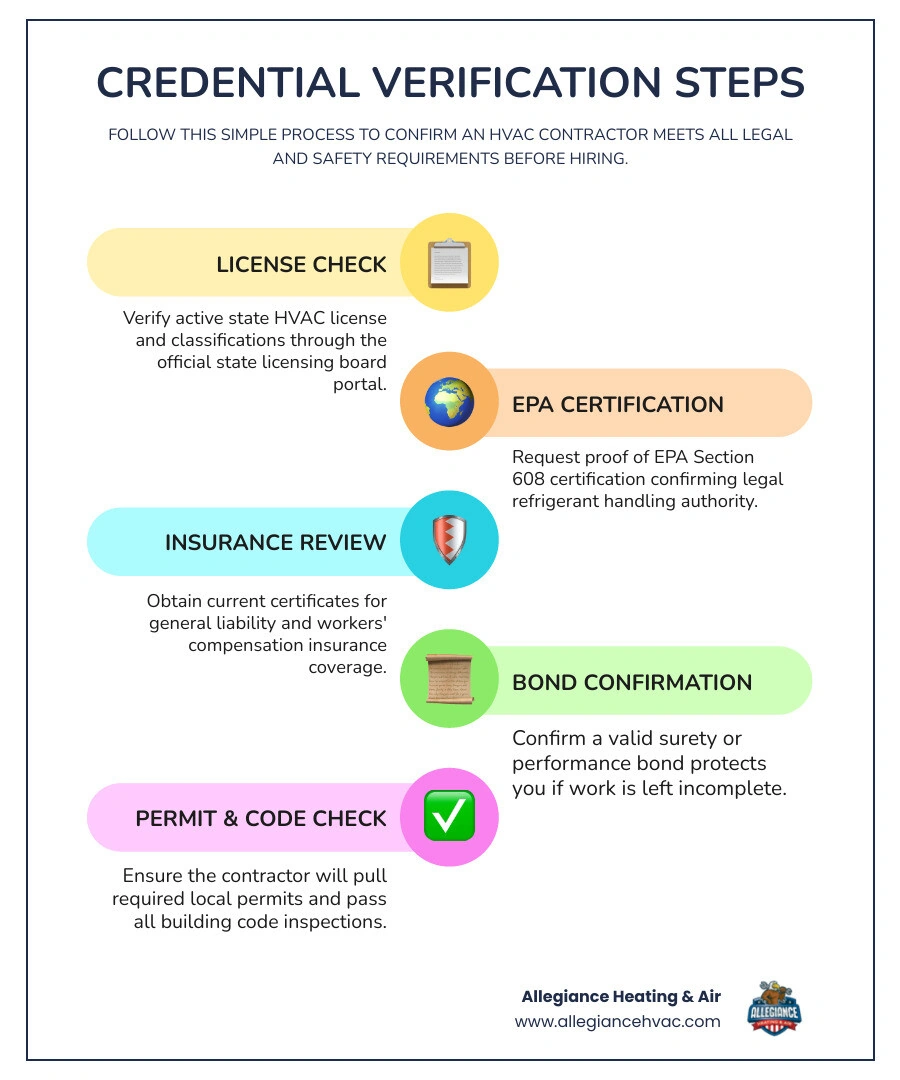
Step-by-Step Credential Verification Checklist
Follow this simple process to verify any HVAC contractor before they begin work on your home:
- Ask for the License Number: Request the contractor’s state license number (for Kentucky) or local registration/license details (for southern Indiana).
- Use Online Search Portals: Visit the Kentucky Department of Housing, Buildings and Construction website or contact your local southern Indiana county building department (such as Floyd or Clark County) to verify that the license is active, in good standing, and has no unresolved disciplinary actions.
- Request a Certificate of Insurance (COI): Ask the contractor to have their insurance agent email a COI directly to you. Check that the general liability and workers' comp policies are active and that the coverage limits are sufficient.
- Confirm Permit Responsibility: Ensure the contract clearly states that the contractor will pull all necessary municipal permits. Professional HVAC Installation Beats DIY because licensed pros handle the entire permitting and inspection process, ensuring your system is 100% code-compliant.
- Verify Technician Certifications: Ask if the technicians assigned to your home carry EPA Section 608 cards and NATE certifications.
Questions to Ask Before Approving HVAC Work
Before you sign a contract or authorize a major installation, ask the contractor these direct questions:
- "Are the technicians who will be working in my home permanent employees, or do you use subcontractors?"
- "Will you perform a detailed Manual J load calculation to determine the exact size of system my home needs, or are you sizing it based on square footage alone?"
- "Does your written estimate include a detailed breakdown of all equipment model numbers, labor, materials, and permit fees?"
- "What is your specific labor warranty on this installation, and is it documented in writing?"
- "How do you handle emergency service calls after normal business hours?"
Documents to Request and Review
Never rely on verbal agreements. Always request physical or digital copies of these essential documents:
- A Detailed Written Estimate: This should include specific manufacturer names, outdoor and indoor unit model numbers, SEER2 efficiency ratings, and a clear scope of work.
- Proof of Licensing and Certifications: Copies of the company's active state or local license, along with NATE and EPA certificates for the technicians.
- Certificate of Insurance: Showing active general liability and workers' compensation policies.
- Written Warranty Terms: Both the manufacturer's parts warranty and the contractor’s labor warranty. Manufacturer warranties often require you to register your new equipment within 60 to 90 days of installation to receive the full 10-year coverage.
Experience, Continuing Education, and Workmanship Protections
While licenses and insurance establish a contractor's legal eligibility, their local experience and commitment to ongoing training determine the actual quality of the service you receive.
Experience That Matters for Home HVAC Systems
Experience is about more than just a number on a page. It is about understanding the unique climate, building designs, and local codes of your specific region.
A company with decades of local service under its belt knows exactly how southern Indiana and Louisville-area homes behave. They understand how the humid summers and freezing winters in communities like Greenville, Floyds Knobs, and New Albany impact heat pumps, furnaces, and indoor air quality. Learning How a 20-Year HVAC Company Builds Trust Differently Than a New Competitor shows how deep local roots translate into reliable system designs, accurate ductwork assessments, and long-term customer relationships.
Continuing Education and Renewal Requirements to Ask About
HVAC technology is constantly evolving. In May 2026, systems are more technologically advanced than ever, featuring variable-speed compressors, eco-friendly A2L refrigerants (like R-454B), and smart home integrations.
To keep pace with these changes, reputable contractors invest heavily in continuing education. State licensing boards and certification organizations like NATE require regular continuing education hours for license and certificate renewals. Ask your contractor how often their technicians attend manufacturer-sponsored training. If a technician has not received updated training on modern inverter systems or the latest refrigerant transitions, they may struggle to diagnose or install newer, high-efficiency equipment properly.
How Credentials Protect Homeowners From Poor Workmanship and Liability
When you hire a fully credentialed contractor, you are purchasing peace of mind. Those credentials act as a protective shield around your home and your finances:
- Code Compliance & Free Inspections: Pulling a permit means a local municipal inspector will review the completed work. This acts as a free quality-control check, ensuring the electrical wiring, gas lines, and venting are perfectly safe.
- Warranty Integrity: Major manufacturers like Trane, Carrier, and Lennox explicitly state in their warranty terms that the equipment must be installed by a licensed HVAC professional. If an unlicensed individual installs your system, your multi-year parts warranty is instantly voided.
- Liability Shielding: With active general liability and workers' compensation insurance, you are completely insulated from the financial fallout of property damage or technician injuries.
Frequently Asked Questions About HVAC Contractor Credentials
What are the most important credentials an HVAC contractor should have?
At a bare minimum, an HVAC contractor must hold an active state license (where required, such as in Kentucky) or local county/city registration (such as in southern Indiana). They must carry active general liability and workers' compensation insurance, hold an EPA Section 608 certification for handling refrigerants, and pull all necessary local building permits for your project.
Is NATE certification required to work on HVAC systems?
No, NATE certification is a voluntary, technician-level credential. It is not legally required by states or municipalities to perform HVAC work. However, it is highly respected in the industry. Hiring a company that employs NATE-certified technicians ensures that your system is serviced by individuals who have proven their advanced technical knowledge through rigorous national testing.
How do I confirm an HVAC contractor is licensed and insured?
For Kentucky, you can verify licenses online through the Kentucky Department of Housing, Buildings and Construction database. For southern Indiana, contact your local county building department (such as Floyd or Clark County) to confirm their local contractor registration. To verify insurance, always ask the contractor's insurance agent to email a Certificate of Insurance (COI) directly to you.
Conclusion
Taking the time to understand what to look for in an HVAC contractor credentials is the single best way to protect your home, your family, and your wallet. By verifying state or local licensing, confirming active insurance coverage, checking for EPA and NATE certifications, and ensuring that all necessary permits are pulled, you can hire with complete confidence.
At Allegiance Heating & Air, LLC, we have been "Taking Home Comfort Under Our Wing" since 2005. As a family-owned business serving Greenville, IN, and surrounding southern Indiana and Louisville-area communities, we pride ourselves on maintaining the highest professional standards. Our technicians are fully licensed, insured, highly experienced, and deeply committed to our local community.
We believe in the unique Benefits of Choosing a Family-Owned HVAC Company and understand How Family-Owned HVAC Companies Provide Better Service compared to massive corporate networks. That is why we focus on honest, transparent communication, expert workmanship, and active community support. Discover Why Hire a Family-Owned HVAC Company Instead of a National Chain and see How Local HVAC Companies Give Back to the Communities They Serve first-hand.
Ready to experience the peace of mind that comes with hiring a fully credentialed, trusted local team? Schedule professional HVAC service with Allegiance Heating & Air, LLC today!
Contact Us Or Schedule Expert Service
Other Blogs
ready to transform your home?
Discover our exceptional home services tailored to meet your needs and enhance your living space.
WHAT OUR CLIENTS HAVE TO SAY ABOUT US

We had a complete HVAC system and a hot water heater installed. The guys were professional, well mannered, and completed the work in a timely manner. Would definitely use them again.
I was nervous at first because my AC broke in the middle of 80 degree weather which is strange for April, but Allegiance Heating and Air was incredibly prompt and professional. The technician arrived within an hour, explained the problem clearly, and completed the repair. The technician , Mr. Garrett Moon was a very nice and courteous young man. He found the problem and fixed it within a timely manner. I highly recommend them for any heating or cooling needs. I’ll definitely give them a call again should I ever have another issue, but hopefully not. Knock on wood 😁. Give them a call… you won’t be disappointed!
From the moment I called to schedule a service, the team was quick to respond and arrived right on time. The technician was professional, friendly, and clearly knowledgeable about my heating system. He explained the repair options in plain language and completed the job efficiently. I appreciated the reliable service and the fact that the work was done the same day. I would definitely recommend Allegiance Heating and Air for any residential HVAC needs.
5/5 stars – I was very impressed with the efficient, affordable and timely service from Allegiance Heating and Air. The technician arrived on time, and performed the service quickly, no repairs needed at this time. Communication was clear and the whole experience felt hassle‑free. I would definitely recommend them for any residential HVAC needs.
Knowledgeable, experienced individual.
Explains Allegiance Heating and Air was incredibly reliable, professional and affordable. They arrived right on time, kept the work area clean and finished the furnace repair quickly. The technician explained everything clearly and the price was a great value. If happiness had a location on Google Maps, it would be here.
Gilbert had to go above and beyond because York is no longer making the part for my furnace. But he was able to find a way to construct a housing bracket for my furnace. Ingenuity, determination and integrity is what finally got my furnace fixed. Gilbert is truly a one of a kind technician.
Thank you for always going the extra mile. Gilbert is always respectful and helpful with any concerns.
"Great service, most knowledgeable and capable HVAC business in Kentuckiana!! Pete Flemming and Bryan the owner, are HVAC encyclopedias. They have the highest integrity of any HVAC business I have ever used. Allegiance has put numerous units in for me over the last 17 years. I will continue to use and trust them."
"Fast response from Allegiance when our heat was out on New Year’s day! Service technician was friendly and efficient. He took the time to explain the problem, tell us about the temporary fix and the plan for permanent repair. We were impressed!"
"Love Allegiance! Their technicians, in particular Benjamin, explain everything. Fast and thorough. A/C was out on a Sunday. Called Allegiance and within a few hours Benjamin arrived. Such a comfort as he was the one who last serviced our units. He quickly replaced part and cooling is restored!"
"My heat pump went out and I had to call after hours. The technician (Garrett) was outstanding and thorough. He got my system up and working until Monday and gave me several options of units. Also took the time to explain the issue to my Home warranty company. I highly recommend this company."
"Right on time :) respectful, fast, and polite. Even gave my fur babies some attention."
"Had Garrett out today to fix our AC. Fantastic tech. He showed up exactly when he said he would and kept us informed of what he was checking and what he found. Highly recommend!"
"Lucas with Allegiance showed up on time as promised, was professional and extremely patient and responsive with all my questions. He took care of the issue, and I feel he was trustworthy! He had us back to cool and comfortable on one of the hottest days of the year."
"Lucas did a great job! Very professional and expedient. Explained the process very well and represented Allegiance as a truly professional and reputable company."
"Arrived on time and work diligently to fix issue. These guy are great. Worked quickly to resolve my issues."
"Lucas was great - he spent a lot of time trying to figure out what was going on and explained everything he was doing. I trust Allegiance and wouldn’t want anyone else working on/in my house!!"

RELATED ARTICLES

Rapid Response: Same-Day Emergency Furnace Repair in Clarksville
Comprehensive Guide to Air Conditioner Repair, Replacement, and Maintenance
