



The Late-Summer Cooling Crisis: Vents Blowing Warm Air While the Outside Unit is Silent
When the absolute worst of the August late-summer heatwaves finally hits, nothing causes panic quite like feeling warm air coming from your ceiling registers. You check your thermostat, and the screen clearly indicates that the system is running. However, when you step outside, your condenser is completely quiet. If you are experiencing an indoor fan blowing, outdoor unit silent: diagnosing a dead capacitor is the very first step to saving your system from permanent damage.
The immediate sensory panic is completely understandable. Feeling uncooled air circulating through your home while the main outdoor unit sits lifeless often leads homeowners to believe their entire air conditioner has suffered a catastrophic failure. Fortunately, a completely silent outdoor unit does not automatically mean you need to replace your entire system. More often than not, this specific combination of symptoms points to a failed electrical component.
If you need professional HVAC services, recognizing this issue early is critical. One local homeowner lost their AC completely during the hottest week in August. Because they noticed the outdoor unit was silent while the indoor fan continued to run, they recognized the danger and called for help. A technician promptly took care of replacing the old, blown component, and the old system was back up and running without requiring a massive overhaul.
Your critical first directive: If your indoor fan is blowing but the outdoor unit is silent, turn your thermostat to the "OFF" position immediately. Do not let the system continue to run while you investigate. Shutting the system down is the only way to prevent further, catastrophic damage to your compressor while you wait for a professional.
The Heart of the Compressor: Understanding Your AC Capacitor
To understand why your system is behaving this way, you have to understand the mechanical reality of how your air conditioner starts. The outdoor unit requires a massive amount of electrical energy to get heavy mechanical parts moving from a dead stop. Your home's standard electrical grid cannot provide this intense surge of power all at once. That is where the capacitor comes in.
A capacitor acts like a powerful, short-term battery. It stores up electrical energy and delivers a massive initial jolt to start the compressor and the outdoor fan motors. Once the motors are running, the capacitor continues to provide a steady, regulated electrical current to keep them spinning efficiently. If this component fails, the outdoor unit loses its ability to start, leaving it completely stalled.
Many homeowners in Greenville IN area homes wonder why the indoor fan continues to blow if the outdoor unit is dead. The answer lies in your system's wiring. The indoor blower motor (located in your furnace or air handler) operates on an entirely separate electrical circuit from the outdoor condenser. When your thermostat calls for cooling, it sends a signal to both units. The indoor fan successfully turns on, but the outdoor unit fails to start because its capacitor is dead. As a result, the indoor fan simply circulates uncooled, room-temperature air throughout the house.
Extreme ambient heat pushes aging capacitors past their breaking point. When you factor in how Ohio River Valley humidity affects your AC, the problem compounds. Intense regional humidity forces air conditioning units to run extended dehumidification cycles. The system runs longer, works harder, and struggles to dissipate heat properly. This relentless thermal stress literally cooks the internal components of the capacitor until it fails.
Start Capacitors vs. Run Capacitors
Most modern residential air conditioning systems rely on a dual-capacitor setup, which combines two distinct functions into one metal cylinder:
• Start capacitors: These components provide the massive initial torque required to get the heavy compressor moving from a standstill. If this function fails, the compressor will not start.
• Run capacitors: Once the system is moving, the run capacitor takes over, maintaining a steady, precise electrical current to keep the motors spinning at the correct speed.
• Total failure: The failure of either side of a dual capacitor can result in a completely silent outdoor unit, or a unit that produces a faint, struggling electrical hum.
Recognizing the Sensory Symptoms of a Dead Capacitor
You do not need to be an electrician to figure out what is happening to your air conditioner. You can diagnose the likely issue using only your senses, without ever touching the equipment or attempting dangerous electrical testing. By isolating the symptoms, you can confidently request air conditioning repair and service.
We frequently see this scenario unfold during August late-summer heatwaves: a homeowner experiences sudden AC trouble, isolates the symptoms perfectly, and shuts the system down. When a technician arrives, they isolate the trouble to the exact defective part, show the homeowner the swollen capacitor, and replace it with a new one. Because the homeowner recognized the signs early, the AC is up and running in a timely manner without secondary damage.
Use this sensory checklist to evaluate your system:
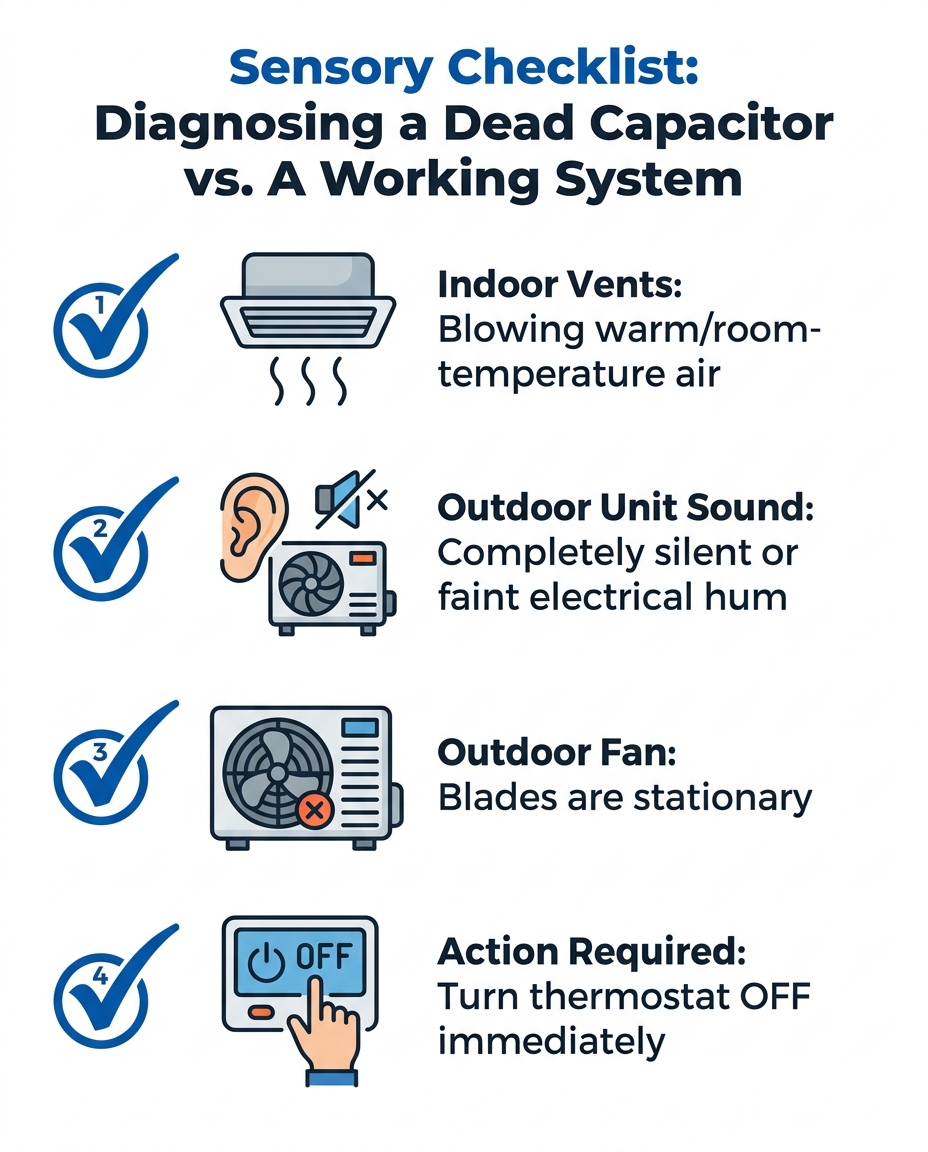
• Sight: Check your indoor thermostat. It should clearly indicate that the system is set to "Cooling" and is actively calling for air. Next, look at the outdoor unit through a window or from a safe distance. The large fan blades at the top of the unit will be completely stationary.
• Sound: Stand near the outdoor unit and listen closely. Instead of the loud, familiar roar of the compressor and fan, you will hear nothing. In some cases, you might hear a faint, low electrical hum, buzzing, or occasional clicking sound. This indicates the system is desperately trying to pull power but lacks the energy to start.
• Touch: Hold your hand up to the indoor supply registers (the vents blowing air into your rooms). The air blowing out will feel warm, humid, or exactly like room temperature. There will be no crisp, cold edge to the airflow.
These three sensory clues confirm that your indoor blower is functioning perfectly, but your outdoor electrical components have failed.

Why You Must Turn Your Thermostat Off Immediately
The single most important thing you can do when you notice a silent outdoor unit is to turn the system off. Leaving the thermostat set to "cool" while the outdoor unit is stalled is incredibly dangerous for the mechanical health of your air conditioner.
When the capacitor is dead, the compressor still receives a signal from the thermostat telling it to turn on. Because it lacks the initial jolt of energy to actually start spinning, the compressor becomes locked in place. As it struggles to start, it begins pulling massive amounts of electricity from your home's grid. This phenomenon is known as pulling Locked Rotor Amps (LRA).
When a motor pulls Locked Rotor Amps without spinning, all of that electrical energy has nowhere to go. It instantly converts into intense heat inside the compressor's copper windings. The compressor overheats rapidly. While modern compressors have internal thermal overload switches designed to shut them down if they get too hot, relying on this fail-safe is extremely risky.
If you leave the system running, you risk turning a simple, routine capacitor swap into a permanent, catastrophic compressor failure. A compressor replacement is one of the most extensive repairs in the HVAC industry, often requiring the replacement of the entire outdoor unit.
• Thermostat Left ON — Compressor Condition: Pulling Locked Rotor Amps (LRA), rapid overheating, thermal overload. — Risk Level: Extremely High — Resulting Repair: Potential catastrophic compressor death.
• Thermostat Turned OFF — Compressor Condition: Power cut. Compressor rests safely at ambient temperature. — Risk Level: Low — Resulting Repair: Standard capacitor replacement.
To protect your equipment, go to your thermostat immediately. Switch the system mode from "COOL" to the "OFF" position. If your fan setting is on "ON," switch it to "AUTO" so the indoor blower stops circulating warm air through your Greenville IN area homes.
The Severe Risks of DIY AC Electrical Troubleshooting
When faced with a broken air conditioner, it is tempting to search for quick fixes online. Unfortunately, many online guides irresponsibly encourage homeowners to test and replace electrical components themselves. Firm safety boundaries must be established: diagnosing and replacing high-voltage AC components strictly requires a licensed HVAC professional.
AC capacitors are not like standard household batteries. They are designed to store massive, lethal amounts of high-voltage energy. Even after you have completely shut off the main power to the air conditioning unit at your home's electrical breaker panel, the capacitor remains fully charged. It holds that electrical energy indefinitely until it is safely and properly discharged.
If you attempt to open the service panel and accidentally touch the capacitor's terminals, or if you discharge it improperly with the wrong tools, that stored energy will travel through you. This can result in severe electrical burns, shock, or even death. The risk is absolute and unforgiving.
Furthermore, attempting DIY electrical repairs on your air conditioner often voids the manufacturer warranties on the entire HVAC system. Manufacturers require proof that a licensed, certified technician performed all diagnostic and repair work. If a DIY mistake causes a short circuit that fries the control board or the compressor, you will be entirely responsible for replacing the system out of pocket. For the safety of your family and the protection of your property in Greenville IN area homes, leave the high-voltage electrical panels closed.
How a Licensed Technician Restores Your Cooling System
When you hire a professional to address a silent outdoor unit, you are paying for speed, accuracy, and uncompromising safety. As a rapid-response, family-owned safety net in Greenville, we know that August late-summer heatwaves create uncomfortable and potentially unsafe indoor environments. Our goal is to quickly dispatch technicians to swap dead capacitors before homes reach dangerous temperatures.
When the air-conditioning broke for one customer on a day when it was 89° outside, our team arrived at the house within a couple of hours. Because they called early, the AC was safely repaired and cooling the house again before the afternoon sun peaked.
Here is exactly how a licensed technician will restore your system:
1. Verification and Safe Discharge: The technician first verifies that all power to the unit is disconnected at the disconnect box and the main breaker. Using specialized, insulated tools, they safely discharge any residual high-voltage energy stored inside the failed capacitor to make the work area safe.
2. Diagnostic Testing: Using a professional-grade multimeter, the technician tests the old capacitor to measure its microfarad (µF) output. If the reading falls below the manufacturer's required tolerance, the component is confirmed dead.
3. Precise Replacement: The professional sources a new capacitor that matches the exact microfarad and voltage ratings required by your specific compressor model. Installing the wrong size can cause the compressor to run dangerously hot or fail to start altogether.
4. System-Wide Safety Check: Once the new part is installed, the technician restores power and turns the system on. They perform a comprehensive system-wide check to ensure the failed capacitor didn't cause secondary electrical damage to the contactor switch or the compressor itself.
If your system is showing these symptoms, you can request a free estimate to have a professional safely restore your comfort.
Protecting Your System from Heat-Induced Electrical Failures
While you cannot control the weather, you can absolutely control how well your air conditioner is prepared to handle it. Heat-induced electrical failures are incredibly common, but they are also highly preventable through routine care.
The most effective way to protect your system is through routine AC maintenance. During a professional tune-up, technicians do much more than just clean the equipment. They proactively test the electrical degradation of your capacitor. Capacitors rarely fail overnight; they slowly lose their ability to hold a charge over time. By measuring the microfarads before the summer heat arrives, a technician can replace a weak capacitor before it completely fails and leaves you stranded without air conditioning.
Additionally, keeping the outdoor unit clean reduces the thermal stress on electrical parts. When an outdoor condenser is choked by tall grass, dirt, cottonwood fuzz, or debris, it cannot pull enough air through the aluminum fins to cool the compressor. This forces the internal temperature of the unit to spike, baking the capacitor in its own heat. Maintaining a two-foot clearance of clean space around the unit greatly improves airflow and heat dissipation.
Finally, never underestimate the power of a clean indoor air filter. A clogged indoor filter forces the entire system to run longer cooling cycles to push air through the home. These marathon cooling sessions give the outdoor components no time to rest and cool down, accelerating electrical wear and tear in Greenville IN area homes.
Frequently Asked Questions About Silent Outdoor AC Units
When your cooling system stops working during August late-summer heatwaves, you need fast, accurate answers. Here are the most common questions homeowners ask when facing this specific issue.
Why is my AC running inside but not outside?
The indoor blower and outdoor condenser operate on independent motors and separate electrical circuits. Because they are powered differently, a failure outside (like a dead capacitor, a broken contactor, or a tripped outdoor breaker) won't stop the indoor fan from running. The indoor unit simply receives the thermostat's command to circulate air, completely unaware that the outdoor unit has failed to start cooling it.
Can a bad capacitor cause the outside unit not to turn on?
Yes, a bad capacitor is the most common reason an outdoor unit fails to turn on during hot weather. Without the capacitor's stored energy, the compressor and outdoor fan lack the massive initial torque required to overcome mechanical inertia. The system will try to start, but without that electrical jolt, the motors remain completely stationary.
What happens when an AC capacitor goes bad?
When an AC capacitor goes bad, the outdoor unit will either remain completely silent or produce a faint, struggling electrical hum as it tries to pull power. Physically, the top of the metal capacitor may bulge outward like a swollen canned good, or it may leak an oily fluid. However, these visual signs are only visible once the high-voltage service panel is safely removed by a licensed professional.
Should I turn off my AC if the outside unit is not running?
Absolutely, you must turn the system off immediately. Leaving the thermostat set to cool forces the compressor to continually attempt to start without the capacitor's help. This causes the compressor to pull locked rotor amps, leading to severe overheating and the high risk of catastrophic, permanent mechanical failure.
Is a blown AC capacitor considered an emergency?
Yes, a blown AC capacitor is often considered an emergency during extreme weather. During intense heatwaves, a lack of indoor cooling can quickly escalate from an uncomfortable nuisance into a severe safety hazard, especially for vulnerable individuals, the elderly, and indoor pets. Fast, professional replacement is highly recommended to restore a safe indoor environment.
Restore Your Cooling Safely and Quickly
A silent outdoor unit paired with an active indoor fan is stressful, but it is also a highly fixable problem if you address it immediately. By recognizing the sensory symptoms—warm air from the vents and a quiet condenser—you can prevent massive mechanical damage to your system in Greenville IN area homes.
Remember the most critical step: leave the system completely off. Do not force your air conditioner to struggle through a breakdown. Schedule an expert diagnostic to have a licensed professional safely test your high-voltage components, replace the dead capacitor, and restore your home's comfort quickly and securely.
Contact Us Or Schedule Expert Service
Other Blogs
ready to transform your home?
Discover our exceptional home services tailored to meet your needs and enhance your living space.
WHAT OUR CLIENTS HAVE TO SAY ABOUT US

We had a complete HVAC system and a hot water heater installed. The guys were professional, well mannered, and completed the work in a timely manner. Would definitely use them again.
I was nervous at first because my AC broke in the middle of 80 degree weather which is strange for April, but Allegiance Heating and Air was incredibly prompt and professional. The technician arrived within an hour, explained the problem clearly, and completed the repair. The technician , Mr. Garrett Moon was a very nice and courteous young man. He found the problem and fixed it within a timely manner. I highly recommend them for any heating or cooling needs. I’ll definitely give them a call again should I ever have another issue, but hopefully not. Knock on wood 😁. Give them a call… you won’t be disappointed!
From the moment I called to schedule a service, the team was quick to respond and arrived right on time. The technician was professional, friendly, and clearly knowledgeable about my heating system. He explained the repair options in plain language and completed the job efficiently. I appreciated the reliable service and the fact that the work was done the same day. I would definitely recommend Allegiance Heating and Air for any residential HVAC needs.
5/5 stars – I was very impressed with the efficient, affordable and timely service from Allegiance Heating and Air. The technician arrived on time, and performed the service quickly, no repairs needed at this time. Communication was clear and the whole experience felt hassle‑free. I would definitely recommend them for any residential HVAC needs.
Knowledgeable, experienced individual.
Explains Allegiance Heating and Air was incredibly reliable, professional and affordable. They arrived right on time, kept the work area clean and finished the furnace repair quickly. The technician explained everything clearly and the price was a great value. If happiness had a location on Google Maps, it would be here.
Gilbert had to go above and beyond because York is no longer making the part for my furnace. But he was able to find a way to construct a housing bracket for my furnace. Ingenuity, determination and integrity is what finally got my furnace fixed. Gilbert is truly a one of a kind technician.
Thank you for always going the extra mile. Gilbert is always respectful and helpful with any concerns.
"Great service, most knowledgeable and capable HVAC business in Kentuckiana!! Pete Flemming and Bryan the owner, are HVAC encyclopedias. They have the highest integrity of any HVAC business I have ever used. Allegiance has put numerous units in for me over the last 17 years. I will continue to use and trust them."
"Fast response from Allegiance when our heat was out on New Year’s day! Service technician was friendly and efficient. He took the time to explain the problem, tell us about the temporary fix and the plan for permanent repair. We were impressed!"
"Love Allegiance! Their technicians, in particular Benjamin, explain everything. Fast and thorough. A/C was out on a Sunday. Called Allegiance and within a few hours Benjamin arrived. Such a comfort as he was the one who last serviced our units. He quickly replaced part and cooling is restored!"
"My heat pump went out and I had to call after hours. The technician (Garrett) was outstanding and thorough. He got my system up and working until Monday and gave me several options of units. Also took the time to explain the issue to my Home warranty company. I highly recommend this company."
"Right on time :) respectful, fast, and polite. Even gave my fur babies some attention."
"Had Garrett out today to fix our AC. Fantastic tech. He showed up exactly when he said he would and kept us informed of what he was checking and what he found. Highly recommend!"
"Lucas with Allegiance showed up on time as promised, was professional and extremely patient and responsive with all my questions. He took care of the issue, and I feel he was trustworthy! He had us back to cool and comfortable on one of the hottest days of the year."
"Lucas did a great job! Very professional and expedient. Explained the process very well and represented Allegiance as a truly professional and reputable company."
"Arrived on time and work diligently to fix issue. These guy are great. Worked quickly to resolve my issues."
"Lucas was great - he spent a lot of time trying to figure out what was going on and explained everything he was doing. I trust Allegiance and wouldn’t want anyone else working on/in my house!!"

RELATED ARTICLES
The Ins and Outs of Single Stage vs Variable Speed AC
Signs Your HVAC System Is Reaching End of Life
