
The Simple Answer to When to Change Your HVAC Air Filter
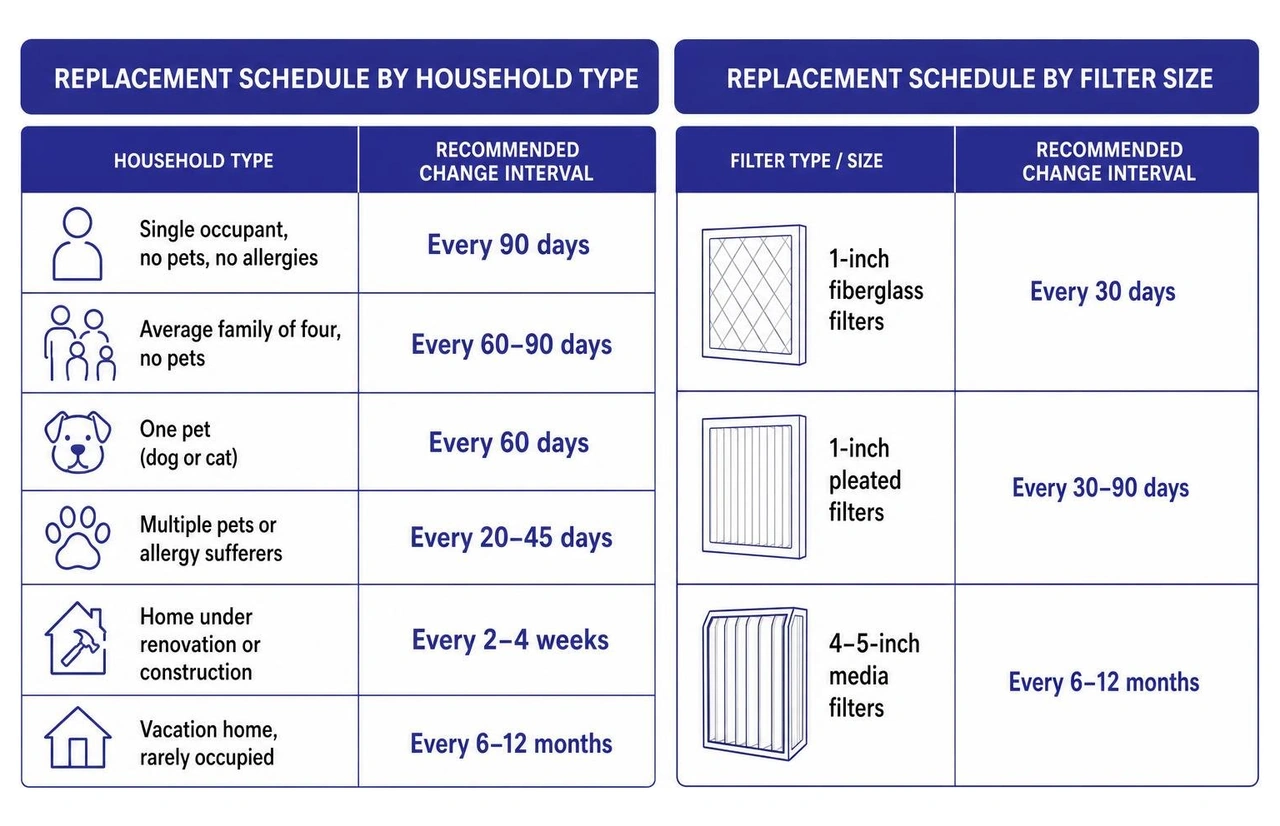
Knowing when to change your HVAC air filter is one of the easiest ways to protect your home comfort system — and most Greenville, IN homeowners are either changing theirs too late or guessing entirely. Here is a quick-reference guide based on your household situation:
| Household Type | Recommended Change Interval |
|---|---|
| Single occupant, no pets, no allergies | Every 90 days |
| Average family of four, no pets | Every 60–90 days |
| One pet (dog or cat) | Every 60 days |
| Multiple pets or allergy sufferers | Every 20–45 days |
| Home under renovation or construction | Every 2–4 weeks |
| Vacation home, rarely occupied | Every 6–12 months |
Filter type also plays a major role:
- 1-inch fiberglass filters — replace every 30 days
- 1-inch pleated filters — replace every 30–90 days
- 4–5-inch media filters — replace every 6–12 months
Most homeowners think about their HVAC filter only after something goes wrong — a spike in the energy bill, weak airflow, or a musty smell coming from the vents. By then, the filter has already been working against the system for weeks, sometimes months.
The good news is that staying ahead of filter changes is simple once you know what to look for. A clean filter keeps your system running efficiently, your indoor air quality healthy, and your equipment protected from the kind of strain that leads to expensive repairs.
This guide walks you through exactly how to identify the right replacement schedule for your home, the warning signs that your filter needs to go now, and how to swap it out correctly in just five minutes.
Understanding When to Change Your HVAC Air Filter
To take control of your home's air quality and system performance, you first need to understand the relationship between filter types, MERV ratings, and system compatibility. There is no single "one-size-fits-all" schedule because every home in Southern Indiana operates under different conditions.
When you are trying to determine How Often Should You Change Your Air Filter, the physical design of the filter is your starting point. Filters are rated using the MERV (Minimum Efficiency Reporting Value) scale, which ranges from 1 to 20. The higher the MERV rating, the smaller the particles the filter can trap. However, higher is not always better for every residential system. Tighter filters create more resistance to airflow, which can put unnecessary strain on your blower motor if your system is not designed to handle it.
Our updated Air Filter Change Guide 2026 highlights three primary residential filter categories:
- Fiberglass Filters (MERV 1–4): These are the flat, green or blue spun-glass filters you often see in bulk packs. They are designed strictly to keep large debris, like pet hair and carpet fibers, out of your furnace or air handler. They do very little to clean your indoor air and saturate incredibly fast, requiring replacement every 30 days.
- Pleated Filters (MERV 8–13): Made of polyester or cotton folds, these filters have significantly more surface area than flat fiberglass. This allows them to capture much smaller particles — such as mold spores, pollen, and dust mites — without immediately choking your system's airflow. Standard 1-inch pleated filters are the residential sweet spot, lasting anywhere from 30 to 90 days depending on household traffic.
- Media Filters (MERV 11–16): These are thick, deeply pleated filters (usually 4 to 5 inches thick) housed in a dedicated media cabinet. Because of their massive surface area, they can hold a tremendous amount of dust and fine particulates before causing a pressure drop. They typically last 6 to 12 months.
| Filter Type | Thickness | Average Lifespan | MERV Rating | Best Suited For |
|---|---|---|---|---|
| Flat Fiberglass | 1-inch | 30 days | MERV 1–4 | Basic equipment protection; households with no pets or allergies |
| Standard Pleated | 1-inch | 30–90 days | MERV 8–11 | Average households; moderate dust control |
| High-Efficiency Pleated | 1-inch | 30–60 days | MERV 12–13 | Households with mild allergies or single pets |
| Deep Media Filter | 4–5-inch | 6–12 months | MERV 11–16 | Allergy sufferers; high-traffic homes; long-term convenience |
How Household Factors Impact When to Change Your HVAC Air Filter
While the manufacturer's packaging provides a helpful baseline, your daily home life ultimately dictates your replacement schedule.
If you share your home in Floyds Knobs or Georgetown with a Golden Retriever, a long-haired cat, or multiple pets, pet dander and shedding fur will coat a filter far faster than a calendar-based schedule can account for. For pet-friendly households, we recommend checking 1-inch pleated filters every 30 days and replacing them by day 45 to 60 at the latest.
Indoor air quality is also a health priority. For the millions of Americans living with asthma or severe seasonal allergies, a saturated filter is more than a mechanical issue — it directly impacts daily comfort. When a filter becomes fully loaded, it can no longer capture incoming irritants. Air bypasses the filter edges, sending dust, pollen, and dander right back into your living areas. If anyone in your household has chronic respiratory concerns, keeping your filter on a strict 30-day replacement cycle is a simple, proactive way to keep indoor air clean.
Additionally, household size and daily habits play a role. A home with six active occupants naturally generates more airborne dust, fabric fibers, and skin cells than a single-occupant home. If anyone smokes indoors, or if you regularly use a wood-burning fireplace during Southern Indiana winters, those combustion particles will load your filter quickly, requiring monthly swaps to keep your air fresh.
How Seasonal Changes Dictate When to Change Your HVAC Air Filter
Weather patterns in the Louisville and Southern Indiana region swing dramatically throughout the year, and your filter maintenance should adjust accordingly.
During the spring, local pollen counts skyrocket. Our Spring Air Filter Replacement Complete Guide emphasizes that heavy outdoor allergen loads inevitably find their way inside on your clothes, shoes, and pet paws. If you leave your windows open for a cross-breeze, your filter will quickly capture that outdoor pollen once the AC kicks back on.
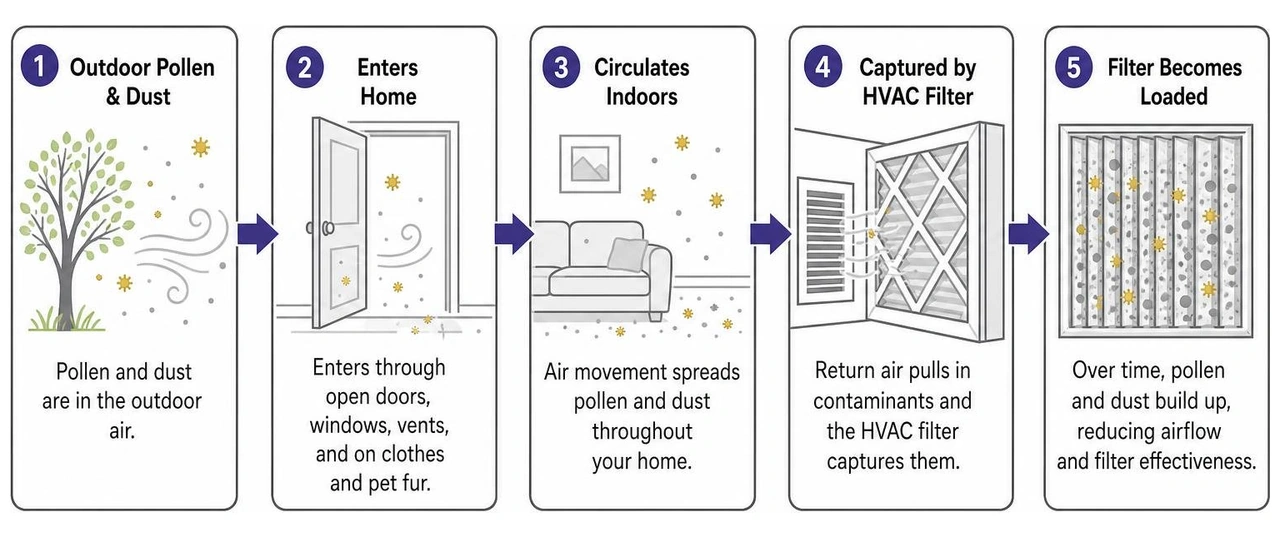
Summer and winter represent peak usage seasons. When temperatures top 90 degrees in July or drop below freezing in January, your HVAC system may run up to 18 to 20 hours a day. More runtime means more air passing through the filter, which accelerates dust accumulation. We recommend checking your filter on the first of every month during these high-demand periods.
Conversely, during the mild "shoulder seasons" of late spring and early autumn, your system runs infrequently. With less air circulating, your filter will accumulate debris much slower, allowing you to comfortably stretch your replacement interval toward the longer end of its rated lifespan.
Signs Your Filter Needs Immediate Replacement
Relying purely on a calendar can leave you vulnerable to system issues. It is always better to inspect the physical condition of your filter.
The most reliable DIY test is the light test. Slide your filter out of its slot and hold it up to a bright light bulb or toward a window. If the light passes through the pleats easily, your filter still has useful life left. If the light is completely blocked by a gray, fuzzy mat of dust and debris, the filter is saturated and needs to be replaced immediately.
Beyond visual inspections, your home and your HVAC system will drop hints when the filter is overdue for a swap:
- Reduced Airflow: If you notice that the air blowing out of your registers feels weaker than usual, a clogged filter is the most common culprit. The system is struggling to pull air through the blocked media, which limits the volume of conditioned air reaching your rooms.
- Musty or Dusty Odors: When a filter is packed with organic matter like pet dander, skin cells, and moisture from the air, it can develop a stale, musty smell. Every time your system turns on, this odor is distributed throughout your home.
- Excessive Dust on Home Surfaces: If you find yourself dusting your furniture and hardwood floors far more often than usual, your filter may be fully saturated. Once a filter is full, it can no longer trap new dust, allowing particles to settle directly onto your tables, shelves, and floors.
Ignoring these warning signs can have serious consequences. If you want to know What Happens If You Don't Change Your Air Filter, the answer ranges from higher utility bills to major system breakdowns. A restricted filter forces your blower motor to work much harder to move air, which can increase your heating and cooling energy consumption by 5% to 15% according to the Department of Energy.
Over time, this restricted airflow can cause your air conditioner's evaporator coils to freeze over in the summer or your furnace's heat exchanger to overheat and crack in the winter. For a detailed breakdown of these warning signs, check out our guide on the Signs Your Air Filter Needs Replaced.
How to Change Your HVAC Air Filter in 5 Easy Steps
Changing your HVAC air filter is a quick, safe, and highly rewarding DIY maintenance task. By following a structured routine, you can avoid common mistakes — like installing the filter backward — which happens in roughly one out of every five DIY attempts.
Before you begin, make sure you have your new, correctly sized replacement filter on hand. You can find the nominal dimensions printed clearly on the cardboard frame of your existing filter (for example, 20" x 25" x 1").
Here is our step-by-step guide to Replacing Your Air Filter safely and effectively:
Step 1: Turn Off the Power to Your HVAC System
Never replace a filter while the blower fan is running. Doing so can pull loose dust, debris, or even the filter itself directly into the fan cabinet. Turn your system off at the thermostat, or flip the dedicated service switch located on or near your indoor unit.
Step 2: Locate and Open the Filter Slot
Your filter is typically located in the return air duct slot right next to your indoor air handler or furnace, or behind a return air grille on a wall or ceiling. Open the latch, slide off the cover door, and set it aside.
Step 3: Remove the Old Filter and Inspect the Slot
Gently slide the old filter out of the housing. Keep it level to prevent loose dust and pet hair from spilling onto your floor. Take a moment to look inside the empty slot. If you see any loose dust or debris clinging to the frame, wipe it clean with a damp cloth or vacuum it out.
Step 4: Verify Airflow Direction and Insert the New Filter
Look at the cardboard edge of your new filter. You will see one or more printed arrows indicating the proper airflow direction. These arrows must point in the direction that air flows through your system — which is always toward the blower motor or furnace. Slide the new filter smoothly into the slot, ensuring a snug fit with no gaps or crumpled edges.
Step 5: Secure the Cover Door and Log the Date
Replace the filter door or latch securely to prevent unconditioned air from bypassing the filter. Using a permanent marker, write the current date on the exposed cardboard edge of the filter frame. This simple step eliminates any future guesswork about when the filter was installed. Turn your system back on at the thermostat or service switch, and you are good to go!
Frequently Asked Questions About HVAC Filters
What is the difference between 1-inch and 4-inch filters?
The primary differences are thickness, surface area, and lifespan. While a 1-inch filter has a flat or shallow pleated surface, a 4-inch media filter features deep, accordion-like folds. This design provides significantly more surface area to trap dust without restricting airflow.
Because of this high capacity, 4-inch filters typically last 6 to 12 months, whereas 1-inch filters must be changed every 30 to 90 days. That you cannot simply slide a 4-inch filter into a standard 1-inch slot; your system must be equipped with a dedicated media cabinet designed to hold the thicker size.
What happens if you put an air filter in backwards?
Installing a filter backward restricts airflow and reduces the filter's structural integrity. Air filters are designed with a sturdy wire or cardboard mesh on the back (the downstream side) to support the media under the pressure of the system's airflow.
If installed backward, the air pressure pushes against the unsupported side, which can cause the filter to bend, buckle, or collapse entirely into the blower cabinet. Additionally, the directional fibers are woven to capture larger particles first and smaller particles deeper in the media; running it backward clogs the filter much faster and strains your blower motor.
When should you call a professional technician instead of DIY?
While changing a standard filter is a straightforward DIY task, certain situations require a professional eye:
- Frozen Evaporator Coils: If you see ice buildup on your indoor copper refrigerant lines or outdoor unit, turn the system off immediately and call us. A dirty filter may have triggered the freeze, but a technician needs to inspect the system for proper refrigerant levels and airflow once it thaws.
- Clogged Condensate Lines: If you notice water pooling around the base of your indoor unit, your condensate drain line may be blocked.
- Abnormal Noises or Failure to Start: If your system makes whistling, rattling, or grinding noises after a filter change, or if it fails to turn back on, an electrical or mechanical issue requires professional diagnostics.
- Hard-to-Reach Filters: If your filter is located in a tight crawlspace, a high attic, or requires opening the main blower compartment of an older system, our professional team can handle the replacement safely during a routine maintenance visit.
Conclusion
Staying on top of your HVAC air filter replacement is one of the simplest, most cost-effective habits you can build as a homeowner. By adjusting your replacement schedule to match your household size, your pets, and the changing seasons in Southern Indiana, you can enjoy cleaner indoor air, lower monthly utility bills, and a more reliable system year-round.
At Allegiance Heating & Air, LLC, we have been "Taking Home Comfort Under Our Wing" since 2005. As a family-owned business serving Greenville, IN and surrounding communities from Floyds Knobs to New Albany, we are committed to providing honest, transparent, and professional service.
If you want to take the hassle out of seasonal home maintenance, consider joining our Allegiance Heating & Air Maintenance Plan. Our comprehensive plans include professional system tune-ups, safety inspections, and filter checks to keep your heating and cooling equipment running at peak efficiency through every hot summer and freezing winter.
Contact us today to schedule your annual system tune-up or to speak with one of our trusted, professional technicians about upgrading your home's indoor air filtration system!
Contact Us Or Schedule Expert Service
Other Blogs
ready to transform your home?
Discover our exceptional home services tailored to meet your needs and enhance your living space.

WHAT OUR CLIENTS HAVE TO SAY ABOUT US

We had a complete HVAC system and a hot water heater installed. The guys were professional, well mannered, and completed the work in a timely manner. Would definitely use them again.
I was nervous at first because my AC broke in the middle of 80 degree weather which is strange for April, but Allegiance Heating and Air was incredibly prompt and professional. The technician arrived within an hour, explained the problem clearly, and completed the repair. The technician , Mr. Garrett Moon was a very nice and courteous young man. He found the problem and fixed it within a timely manner. I highly recommend them for any heating or cooling needs. I’ll definitely give them a call again should I ever have another issue, but hopefully not. Knock on wood 😁. Give them a call… you won’t be disappointed!
From the moment I called to schedule a service, the team was quick to respond and arrived right on time. The technician was professional, friendly, and clearly knowledgeable about my heating system. He explained the repair options in plain language and completed the job efficiently. I appreciated the reliable service and the fact that the work was done the same day. I would definitely recommend Allegiance Heating and Air for any residential HVAC needs.
5/5 stars – I was very impressed with the efficient, affordable and timely service from Allegiance Heating and Air. The technician arrived on time, and performed the service quickly, no repairs needed at this time. Communication was clear and the whole experience felt hassle‑free. I would definitely recommend them for any residential HVAC needs.
Knowledgeable, experienced individual.
Explains Allegiance Heating and Air was incredibly reliable, professional and affordable. They arrived right on time, kept the work area clean and finished the furnace repair quickly. The technician explained everything clearly and the price was a great value. If happiness had a location on Google Maps, it would be here.
Gilbert had to go above and beyond because York is no longer making the part for my furnace. But he was able to find a way to construct a housing bracket for my furnace. Ingenuity, determination and integrity is what finally got my furnace fixed. Gilbert is truly a one of a kind technician.
Thank you for always going the extra mile. Gilbert is always respectful and helpful with any concerns.
"Great service, most knowledgeable and capable HVAC business in Kentuckiana!! Pete Flemming and Bryan the owner, are HVAC encyclopedias. They have the highest integrity of any HVAC business I have ever used. Allegiance has put numerous units in for me over the last 17 years. I will continue to use and trust them."
"Fast response from Allegiance when our heat was out on New Year’s day! Service technician was friendly and efficient. He took the time to explain the problem, tell us about the temporary fix and the plan for permanent repair. We were impressed!"
"Love Allegiance! Their technicians, in particular Benjamin, explain everything. Fast and thorough. A/C was out on a Sunday. Called Allegiance and within a few hours Benjamin arrived. Such a comfort as he was the one who last serviced our units. He quickly replaced part and cooling is restored!"
"My heat pump went out and I had to call after hours. The technician (Garrett) was outstanding and thorough. He got my system up and working until Monday and gave me several options of units. Also took the time to explain the issue to my Home warranty company. I highly recommend this company."
"Right on time :) respectful, fast, and polite. Even gave my fur babies some attention."
"Had Garrett out today to fix our AC. Fantastic tech. He showed up exactly when he said he would and kept us informed of what he was checking and what he found. Highly recommend!"
"Lucas with Allegiance showed up on time as promised, was professional and extremely patient and responsive with all my questions. He took care of the issue, and I feel he was trustworthy! He had us back to cool and comfortable on one of the hottest days of the year."
"Lucas did a great job! Very professional and expedient. Explained the process very well and represented Allegiance as a truly professional and reputable company."
"Arrived on time and work diligently to fix issue. These guy are great. Worked quickly to resolve my issues."
"Lucas was great - he spent a lot of time trying to figure out what was going on and explained everything he was doing. I trust Allegiance and wouldn’t want anyone else working on/in my house!!"

RELATED ARTICLES

Enhancing Indoor Air Quality: A Comprehensive Guide to Ventilators, Humidifiers, Dehumidifiers, and Air Cleaners
Essential HVAC Tasks to Do Every Spring