


The Empty House Cooling Myth: Why Turning Off Your AC During the Workday Costs You More
Coming home to a sweltering house at 5 PM means your cooling strategy backfired. Discover why leaving your AC completely off during the workday actually costs you more in energy recovery.
The Misconception of the 'Off' Switch During Summer Workdays
Turning off your air conditioning before you head to the office seems like the ultimate energy-saving hack. The logic feels sound: if nobody is home to enjoy the cool air, why pay to keep the system running? However, this common assumption overlooks the fundamental physics of how your home absorbs and retains heat throughout the day.
The reality of this strategy usually hits you the moment you walk through the front door. Coming home in peak July summer heat to a completely sweltering house is not just uncomfortable—it is a sign that your cooling strategy has actually backfired. When a home is left completely unconditioned for eight to ten hours, the indoor environment undergoes a drastic transformation that requires a massive amount of energy to reverse.
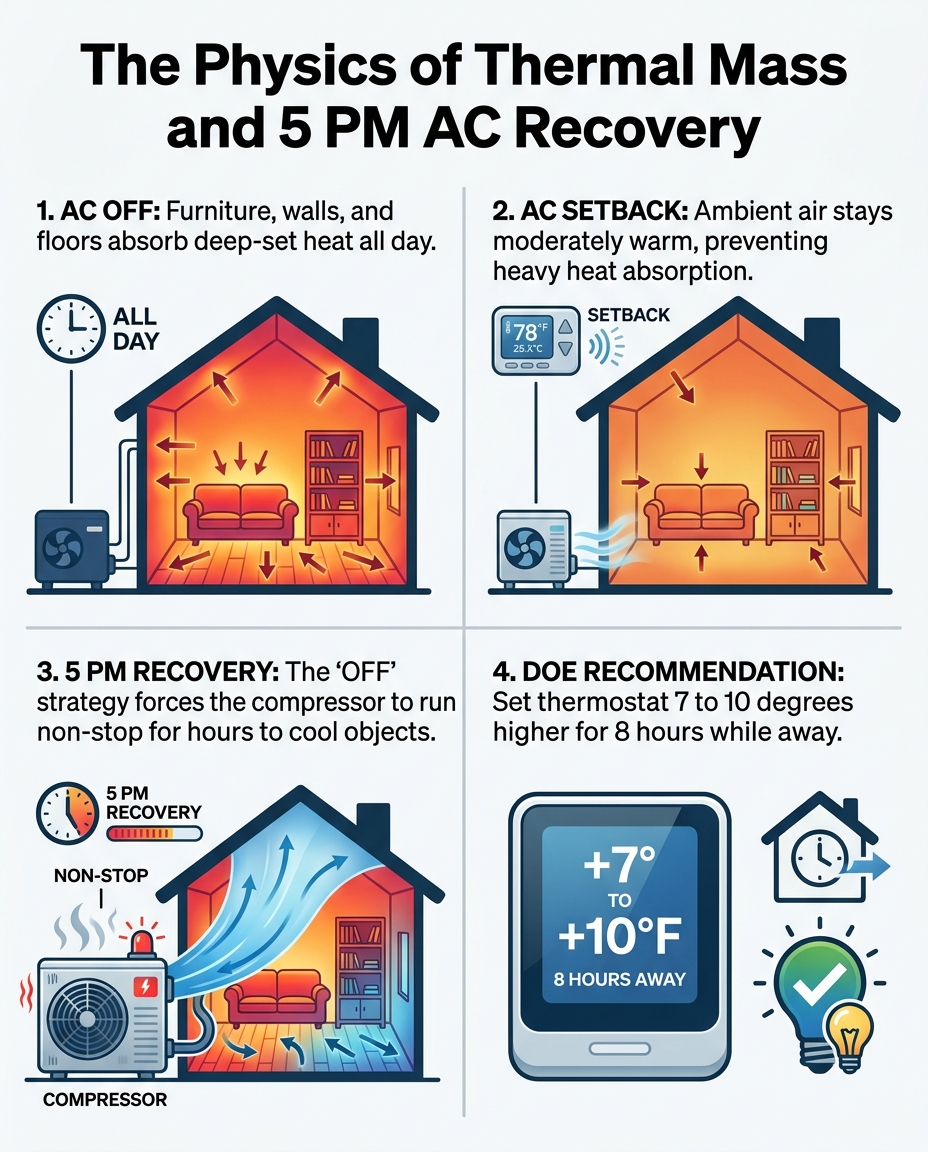
This leaves every homeowner facing a critical decision point: Is it better to turn the system completely off before work, or utilize a minor temperature setback? While shutting the system down might stop the meter from spinning during the morning hours, the resulting afternoon recovery period often consumes far more energy than you saved. The reason for this counterintuitive reality comes down to a scientific concept known as thermal mass, which proves that the "off" strategy is ultimately counterproductive.
Understanding Thermal Mass: You Aren't Just Cooling the Air
To understand why a completely unconditioned house is so difficult to cool down, you have to look past the air you breathe. When you look around your living room, you see furniture, walls, flooring, and cabinetry. In the context of HVAC science, these physical objects are known as thermal mass. Thermal mass refers to the ability of heavy, dense materials to absorb, store, and eventually release heat energy over time.
When the cooling system is shut off all day, the indoor ambient air gets hot. But more importantly, every physical object inside the home also begins to heat up. An air conditioner does not just cool the ambient air; it must extract deep-set heat from all of these solid objects. If you want a deeper dive into how your system processes this heat transfer, reading a comprehensive air conditioning guide can clarify the mechanics, but the core principle is that physical objects act like thermal batteries.
The "Thermal Battery" Effect
Consider what happens inside an unconditioned home between 9 AM and 5 PM:
• Drywall and insulation: These materials absorb radiant heat from the sun beating down on the exterior of the house, slowly transferring that heat into the interior rooms.
• Hardwood floors and tile: Dense flooring materials soak up ambient heat throughout the afternoon, holding onto it long after the sun begins to set.
• Upholstered furniture: Sofas, mattresses, and thick rugs trap warm air within their fibers, becoming significantly warmer than the air around them.
• Cabinetry and solid wood: Kitchen cabinets and large wooden furniture pieces absorb heat steadily, requiring hours of continuous cooling to return to a neutral temperature.
When you utilize a moderate setback strategy—keeping the system running but at a higher temperature—you prevent these objects from absorbing maximum heat. The ambient air stays moderately warm, but the heavy thermal mass of the home is protected from becoming completely saturated with heat.
The Hidden Burden of Latent Heat and Humidity
Thermal mass only tells half the story. The other hidden factor that destroys the efficiency of the "off" switch is humidity. In regions like Greenville, IN, and throughout the Ohio Valley, hot, humid summers mean that turning off the cooling system allows heavy moisture to build up inside the home. This drastically increases what HVAC professionals call the latent cooling load.
Air conditioners perform two distinct jobs simultaneously: they lower the temperature (removing sensible heat) and they extract moisture from the air (removing latent heat). When a house sits completely unconditioned during a muggy July afternoon, outdoor humidity infiltrates the indoor space. This moisture permeates the drywall, sinks into the carpets, and saturates the upholstery.
Sensible vs. Latent Heat Under Load
• Sensible Heat — What It Measures: The actual temperature of the air and objects, measurable by a standard thermometer. — Impact of Turning AC Off All Day: Indoor temperatures climb steadily, baking the thermal mass of the house.
• Latent Heat — What It Measures: The amount of moisture (humidity) trapped in the air and physical materials. — Impact of Turning AC Off All Day: Moisture levels spike, making the air feel heavy, sticky, and drastically warmer than the thermostat reads.
Removing heavy moisture from drywall and fabrics takes significantly more energy than just lowering the air temperature. An air conditioner must run continuously for a long period to wring this moisture out of the indoor environment. If the system is turned off all day, the house feels incredibly uncomfortable upon return, and the equipment must work double-time to address both the soaring temperature and the suffocating humidity.
The 5 PM Recovery: Why Your System Struggles After Work
The true cost of the empty house cooling myth becomes apparent the moment you walk through the door after work. You are immediately hit with a wave of stagnant, humid heat. Naturally, you walk straight to the thermostat and drop the temperature back down to a comfortable 72 degrees. What follows is a massive, sustained strain on your cooling equipment.
The 5 PM indoor temperature spike and prolonged equipment recovery time represent the most grueling operational phase your system will endure all summer. Because the thermal mass of the house is fully baked and the humidity is high, the compressor cannot simply run a standard 15-minute cooling cycle. Instead, it must engage in a prolonged battle against the deep-set heat.
The sequence of a 5 PM recovery:
1. The initial air cooldown: The system runs for the first 30 to 45 minutes just to lower the temperature of the ambient air. The house might start to feel slightly better, but the job is far from over.
2. The humidity extraction: As the system runs, it begins pulling gallons of water out of the indoor air, working to overcome the latent heat load that built up over the previous eight hours.
3. The thermal mass release: Just as the air starts to cool, the hot furniture, floors, and walls begin radiating their stored heat back into the rooms. The AC must now cool the air all over again.
4. The continuous marathon: To overcome this constant release of stored heat, the compressor is forced to run at maximum capacity for several consecutive hours without a break.
This extreme operational spike often negates any energy saved during the morning. The sheer volume of electricity required to run a compressor non-stop for three or four hours during the hottest part of the late afternoon easily outpaces the cost of maintaining a moderate temperature throughout the day. For homeowners looking to optimize this process, exploring professional HVAC services can help ensure the system is capable of handling these heavy loads efficiently.

Wear and Tear: The Hidden Cost of Prolonged Cooling Cycles
Beyond the monthly utility bill, there is a much larger financial risk associated with the empty house cooling myth: accelerated equipment degradation. Forcing a system to run non-stop for hours every single evening places an immense burden on the most critical components of the machinery.
An air conditioner is designed to run in cycles. It turns on, cools the space, and then shuts off to rest. When a system is forced into a three-hour marathon recovery every afternoon, the compressor and the blower motor are subjected to sustained heat and friction. Overworked compressors are far more likely to overheat, trip breakers, or fail entirely during peak heat waves.
A typical pattern we see is older units failing under the immense stress of afternoon recovery cycles. For example, one local homeowner experienced this firsthand when they lost their AC entirely during the hottest week in August. The system had been pushed past its breaking point under extreme load, and a technician had to be dispatched to promptly replace the old AC system with a new one to restore cooling.
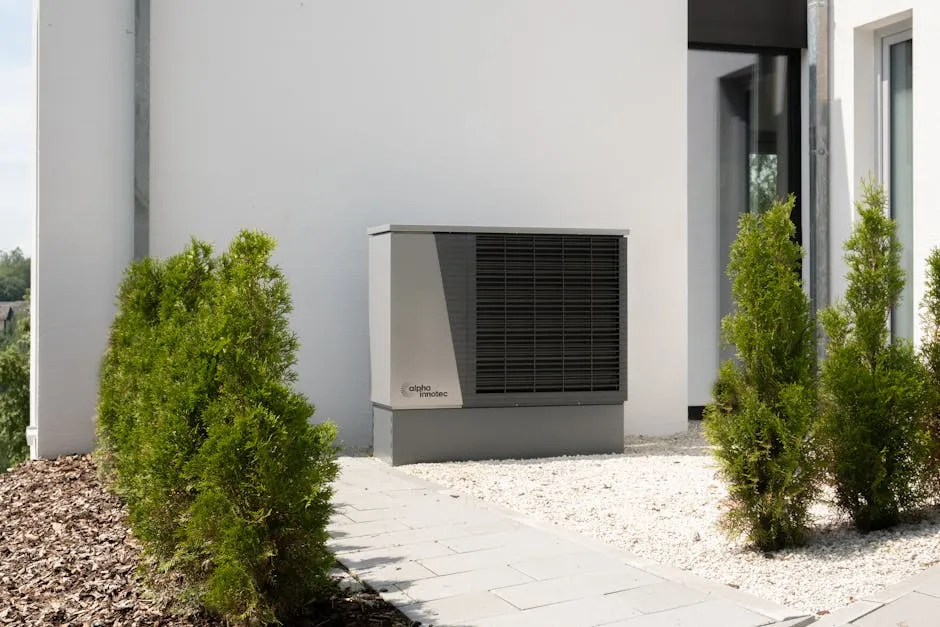
Connecting these daily extreme recovery cycles to a shortened overall lifespan for the HVAC equipment is vital. Avoiding excessive, sustained strain is a key part of long-term system care. A moderate setback strategy not only stabilizes your energy bills but also protects the mechanical integrity of the investment sitting in your backyard.
The Department of Energy's 8-Hour Setback Strategy
If turning the system off is a bad idea, what is the correct approach? The solution lies in a data-backed strategy that balances energy conservation with thermal mass management. The U.S. Department of Energy provides an official recommendation for away-from-home settings that achieves this balance perfectly.
As a trusted local HVAC expert, Allegiance Heating & Air provides honest, physics-based advice to help homeowners avoid generic myths and actually optimize their systems. The science shows that a moderate setback is the most effective way to manage a home during the workday.
The official setback strategy:
• Determine your baseline: Identify the temperature you find most comfortable when you are home and awake (for example, 72 degrees).
• Apply the setback: Set the thermostat 7 to 10 degrees higher than that normal comfort setting for the 8-hour workday (moving it to 79 or 82 degrees).
• Maintain the baseline: Leave the system at this elevated setting while the house is empty.
This specific setback range is highly effective. By keeping the house at 80 degrees, the system will occasionally cycle on during the hottest parts of the day. These brief cycles are just enough to pull the excess humidity out of the air and prevent the thermal mass (your furniture and floors) from baking. When you return at 5 PM and lower the temperature back to 72 degrees, the system only has to cool the air—the heavy objects and the humidity have already been kept in check.
Automating Efficiency: Smart Thermostat Best Practices
Managing a daily setback strategy manually can be tedious. It relies on you remembering to adjust the dial every single morning as you rush out the door, and it still requires you to walk into a warm house at 5 PM while you wait for the system to recover. Technology offers a seamless solution to handle this automatically.
Programmable and smart thermostats are designed specifically to manage workday setbacks without human intervention. A standard programmable thermostat allows you to input your daily schedule, ensuring the temperature rises at 8 AM and begins dropping at 4:30 PM. This means the system can begin the recovery process 30 minutes before you arrive home, allowing you to walk into a perfectly conditioned space.
Modern smart thermostats take this automation a step further. Features like geofencing use your smartphone's location to determine when you are heading home, automatically triggering the cooling cycle as you commute. Additionally, advanced thermostats include built-in humidity sensors that will override the temperature setback if indoor moisture levels climb too high, protecting your home from latent heat buildup. If you are interested in upgrading your home's climate controls to handle these physics automatically, securing a free estimate for a smart thermostat installation is a great first step.
Frequently Asked Questions About Workday AC Settings
Is it better to leave the AC on all day or turn it off?
It is better to leave it on but set to a higher temperature. Turning the system off completely allows thermal mass and humidity to build up unchecked inside the home. When you finally turn the system back on, it requires significantly more energy to extract that deep-set heat and moisture than it would have taken to maintain a moderate temperature all day.
What is the best AC temperature for an empty house?
The Department of Energy recommends setting your thermostat 7 to 10 degrees higher than your normal comfort setting. Typically, this means aiming for 78 to 80 degrees while you are away at work. This range prevents the house from baking while still reducing the total energy consumed during the peak heat of the afternoon.
Does turning off the AC during the day save energy?
In most hot and humid climates, no. The energy required to cool baked furniture, floors, and walls, while simultaneously removing extreme humidity at 5 PM, often exceeds the energy saved by shutting the unit off in the morning. A moderate setback is far more efficient than a complete shutdown.
How long does it take to cool a hot house?
Depending on the severity of the heat and the home's insulation, it can take several hours to fully recover from an all-day shutdown. The system must cool the physical objects inside the home, not just the ambient air. Until the furniture and walls release their stored heat, the air will continue to feel warm.
Can extreme temperature swings damage my HVAC system?
Yes, forcing the compressor to run continuously at maximum capacity to recover from high heat increases wear and tear on the equipment. Daily marathon cooling cycles place immense strain on the motors and electrical components. Maintaining a moderate setback reduces this daily strain and helps extend the lifespan of your system.
Keep Your System Running Efficiently All Summer
Understanding thermal mass is the key to actionable, physics-based energy savings. The empty house cooling myth sounds great in theory, but in practice, it forces your equipment into grueling daily battles against deep-set heat and heavy humidity. Reverting to a moderate 7-to-10-degree setback is much smarter than turning the unit completely off, protecting both your utility bill and your machinery.
As summer temperatures peak, it is vital to ensure your system is prepared to handle the daily workload efficiently. An overworked system struggling to overcome afternoon heat waves is a prime candidate for a breakdown. To keep your equipment optimized and capable of managing thermal mass without unnecessary strain, consider enrolling in a professional AC maintenance plan to maximize your comfort all season long.
Contact Us Or Schedule Expert Service
Other Blogs
ready to transform your home?
Discover our exceptional home services tailored to meet your needs and enhance your living space.
WHAT OUR CLIENTS HAVE TO SAY ABOUT US

We had a complete HVAC system and a hot water heater installed. The guys were professional, well mannered, and completed the work in a timely manner. Would definitely use them again.
I was nervous at first because my AC broke in the middle of 80 degree weather which is strange for April, but Allegiance Heating and Air was incredibly prompt and professional. The technician arrived within an hour, explained the problem clearly, and completed the repair. The technician , Mr. Garrett Moon was a very nice and courteous young man. He found the problem and fixed it within a timely manner. I highly recommend them for any heating or cooling needs. I’ll definitely give them a call again should I ever have another issue, but hopefully not. Knock on wood 😁. Give them a call… you won’t be disappointed!
From the moment I called to schedule a service, the team was quick to respond and arrived right on time. The technician was professional, friendly, and clearly knowledgeable about my heating system. He explained the repair options in plain language and completed the job efficiently. I appreciated the reliable service and the fact that the work was done the same day. I would definitely recommend Allegiance Heating and Air for any residential HVAC needs.
5/5 stars – I was very impressed with the efficient, affordable and timely service from Allegiance Heating and Air. The technician arrived on time, and performed the service quickly, no repairs needed at this time. Communication was clear and the whole experience felt hassle‑free. I would definitely recommend them for any residential HVAC needs.
Knowledgeable, experienced individual.
Explains Allegiance Heating and Air was incredibly reliable, professional and affordable. They arrived right on time, kept the work area clean and finished the furnace repair quickly. The technician explained everything clearly and the price was a great value. If happiness had a location on Google Maps, it would be here.
Gilbert had to go above and beyond because York is no longer making the part for my furnace. But he was able to find a way to construct a housing bracket for my furnace. Ingenuity, determination and integrity is what finally got my furnace fixed. Gilbert is truly a one of a kind technician.
Thank you for always going the extra mile. Gilbert is always respectful and helpful with any concerns.
"Great service, most knowledgeable and capable HVAC business in Kentuckiana!! Pete Flemming and Bryan the owner, are HVAC encyclopedias. They have the highest integrity of any HVAC business I have ever used. Allegiance has put numerous units in for me over the last 17 years. I will continue to use and trust them."
"Fast response from Allegiance when our heat was out on New Year’s day! Service technician was friendly and efficient. He took the time to explain the problem, tell us about the temporary fix and the plan for permanent repair. We were impressed!"
"Love Allegiance! Their technicians, in particular Benjamin, explain everything. Fast and thorough. A/C was out on a Sunday. Called Allegiance and within a few hours Benjamin arrived. Such a comfort as he was the one who last serviced our units. He quickly replaced part and cooling is restored!"
"My heat pump went out and I had to call after hours. The technician (Garrett) was outstanding and thorough. He got my system up and working until Monday and gave me several options of units. Also took the time to explain the issue to my Home warranty company. I highly recommend this company."
"Right on time :) respectful, fast, and polite. Even gave my fur babies some attention."
"Had Garrett out today to fix our AC. Fantastic tech. He showed up exactly when he said he would and kept us informed of what he was checking and what he found. Highly recommend!"
"Lucas with Allegiance showed up on time as promised, was professional and extremely patient and responsive with all my questions. He took care of the issue, and I feel he was trustworthy! He had us back to cool and comfortable on one of the hottest days of the year."
"Lucas did a great job! Very professional and expedient. Explained the process very well and represented Allegiance as a truly professional and reputable company."
"Arrived on time and work diligently to fix issue. These guy are great. Worked quickly to resolve my issues."
"Lucas was great - he spent a lot of time trying to figure out what was going on and explained everything he was doing. I trust Allegiance and wouldn’t want anyone else working on/in my house!!"

RELATED ARTICLES
Budget-Friendly Warmth: Finding Affordable Heat Pump Installation in New Albany

Enhancing Your Indoor Air Quality: The Importance of Whole Home Ventilators
