The Reality of August Late-Summer Continuous Operation
Here at Allegiance Heating & Air, a pattern we see often as summer enters its final, sweltering stretch is homeowners facing a frustrating reality: The August Fatigue: Why Well-Maintained ACs Suddenly Struggle at Summer's End. Your cooling system may have run flawlessly through the early heat of June and July, only to start making strange noises, blowing warmer air, or running nonstop as August and the back-to-school season arrive. This late-season slump is rarely a sign of neglect. Instead, it is a well-documented mechanical phenomenon. The reality of August late-summer continuous operation is that your air conditioner has essentially been running a cross-country marathon for months. Just like a runner experiencing muscle fatigue near the finish line, your HVAC components are dealing with the cumulative toll of relentless, daily exertion.
If your system is showing signs of late-season exhaustion, exploring professional air conditioning services can help restore your comfort before a minor struggle turns into a total system breakdown.
Understanding this phenomenon requires a shift in how we view our home appliances. An air conditioner is not a static fixture; it is a complex, dynamic machine with moving parts, pressurized gases, and high-voltage electrical components. When a system operates continuously during late-summer heatwaves, it rarely gets the opportunity to cool down completely. This sustained operational tempo pushes the mechanical limits of the equipment. Recognizing the subtle signs of wear early on is the key to preventing a catastrophic failure. By understanding what happens inside that metal cabinet during the hottest days of the year, you can take proactive steps to protect your investment and keep your home comfortable through the final weeks of summer.
Understanding 60+ Days of Cumulative Thermal Stress
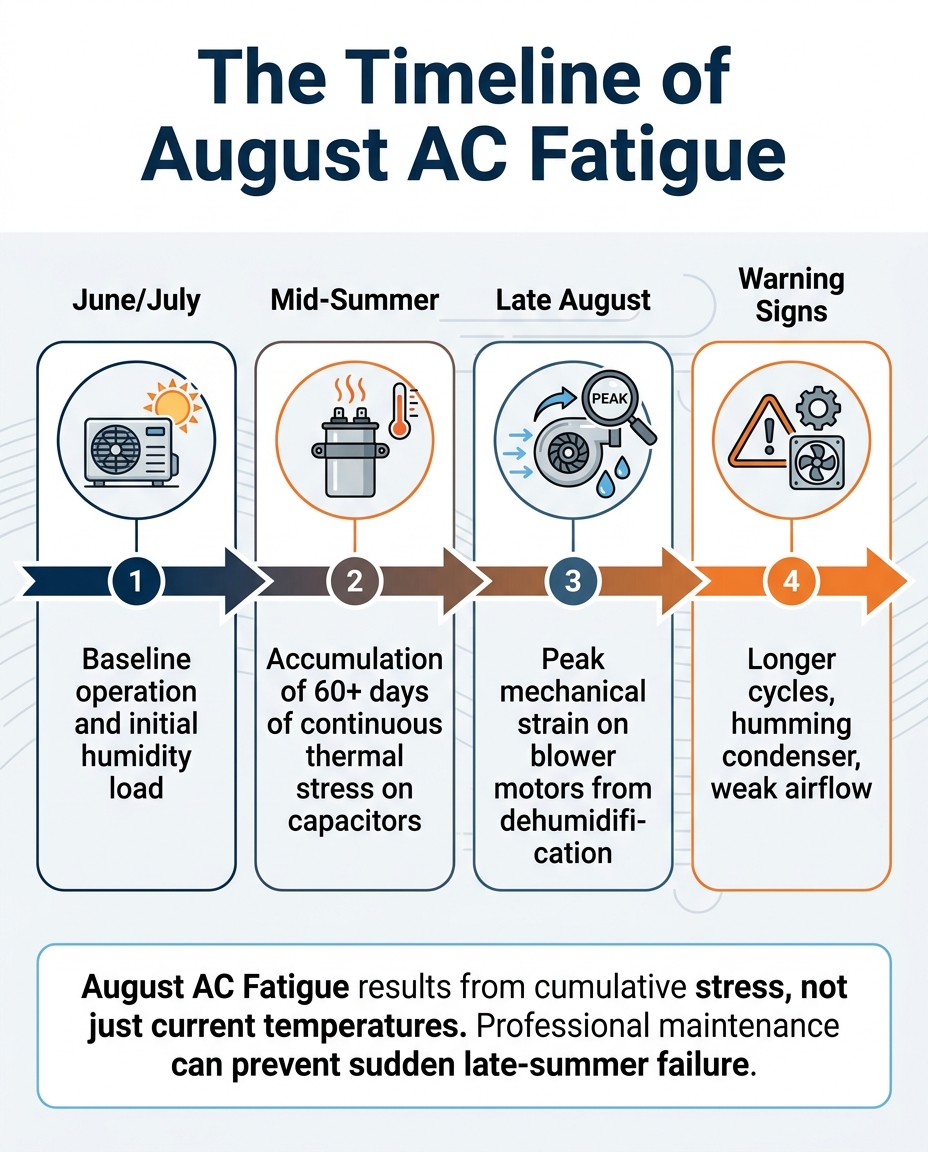
To truly grasp why a perfectly fine air conditioner suddenly starts acting up, our technicians often explain the science of thermal degradation. By the time late August rolls around, your system has likely endured 60+ days of cumulative thermal stress. Heat is the natural enemy of mechanical and electrical components, and in an HVAC system, that heat comes from two distinct sources. First, there is the ambient outdoor temperature, which bakes the condenser unit sitting in your yard. Second, and often more destructive, is the internal heat generated by the system's own operation. Every time the compressor kicks on, electrical current surges through the wires, generating friction and heat within the motors and circuitry.
Continuous high-temperature operation accelerates the degradation of these internal parts. When an air conditioner runs for 12 to 16 hours a day to fight off a heatwave, the internal temperatures of the motors and electrical contacts remain elevated. Over weeks and months, this constant thermal expansion and contraction begins to weaken wire insulation, dry out motor lubricants, and stress electrical connections. This compounding stress peaks in late summer, which is historically a prime time for HVAC component failures. The materials simply reach their fatigue limit after weeks of uninterrupted operation.
To help mitigate the effects of this intense operational period, enrolling in a preventative maintenance plan ensures that your system starts the season in the best possible condition, giving it a fighting chance against the relentless summer heat.
Common components affected by thermal stress include:
• Electrical contacts: Constant arcing and high temperatures can cause pitting and carbon buildup.
• Motor bearings: Lubrication breaks down faster under sustained high-heat conditions.
• Wiring harnesses: Insulation can become brittle and crack after prolonged exposure to internal heat.
• Compressor valves: The internal mechanics of the compressor experience microscopic wear that compounds over time.

Why Capacitors Surrender to Late-Summer Heat
One of the most frequent casualties of 60+ days of cumulative thermal stress our team typically sees is the run capacitor. You can think of the capacitor as a heavy-duty battery that jump-starts the compressor and fan motors. Because these large motors require a massive jolt of electricity to overcome inertia and start spinning, your home's standard electrical current isn't enough. The capacitor stores energy and releases it in a powerful burst every time the system cycles on. However, thermal fatigue specifically targets these devices after months of constant cycling.
The mechanical reality is that capacitors contain a dielectric fluid that can break down or leak when subjected to prolonged, intense heat. As the capacitor weakens, it loses its ability to deliver that crucial jolt of energy. When this happens, the motors have to work much harder to start. They begin pulling more amperage from your electrical panel, which in turn generates even more heat, creating a destructive feedback loop. Diagnosing and replacing a defective capacitor requires specialized tools and high-voltage training, making it a strict job for a licensed professional. For example, during a recent summer heatwave, our crew responded to a home here in Greenville experiencing this exact issue. We diagnosed the AC trouble shortly after arriving; our professional showed the homeowner the swollen, defective part, safely replaced it with a new one, and had the system up and running in a timely manner.
The Danger of a Weakened Capacitor
A failing capacitor forces the compressor to struggle just to turn on. This phenomenon is known in the HVAC industry as "hard starting." Every time a compressor hard starts, it draws excessive current and undergoes severe mechanical strain. If left unaddressed, a weakened capacitor will significantly shorten the lifespan of the entire condenser unit. What could have been a straightforward part replacement can quickly escalate into a catastrophic compressor failure, which is one of the most extensive and complex repairs an air conditioning system can require.
The Hidden Toll of Ohio River Valley Humidity on Blower Motors
While temperature gets most of the attention, humidity is the silent stressor that pushes cooling systems to their breaking point. An air conditioner's job is twofold: lowering the ambient temperature and removing moisture from the indoor air. The oppressive July and August humidity in the Kentuckiana region specifically forces your system into much longer cooling cycles. Removing gallons of moisture daily places heavy, continuous loads on your indoor blower motor and the entire condensate drainage system.
As warm, humid air passes over the freezing cold evaporator coil, moisture condenses into water droplets. The blower motor has to work tirelessly to push heavy, moisture-laden air through the ductwork. At Allegiance Heating & Air, our deep local experience means we understand exactly how Ohio River Valley weather patterns impact your equipment. In our years serving Greenville and the surrounding communities, we see firsthand how this regional humidity amplifies mechanical strain, forcing blower motors to run at maximum capacity just to keep the indoor environment dry enough to feel comfortable.
Furthermore, all that extracted moisture has to go somewhere. Over the course of August late-summer continuous operation, dust, dirt, and biological growth can mix with the water, creating a sludge that clogs the condensate drain line. A clogged drain can trigger a safety switch that shuts the entire system down to prevent indoor flooding. For more insights on handling this specific regional challenge, read our guide on preparing your AC for a humid Indiana summer.
Recognizing the Subtle Signs of August AC Fatigue
Catching the symptoms of cumulative wear early is the best way to prevent a total shutdown. Because the degradation happens slowly over the course of the season, the warning signs are often subtle. Ignoring these signs can lead to severe consequences. Just recently during a hot week in August, our team had to promptly replace an old system for a local customer who lost air conditioning completely due to unchecked system fatigue. To avoid a similar situation, watch for these key indicators:
• Longer cooling cycles: The system runs constantly but struggles to reach the temperature set on the thermostat, indicating a loss of efficiency.
• Humming at the condenser: A distinct electrical humming or buzzing sound from the outdoor unit is a classic sign that a motor is trying to start but is being held back by a failing capacitor.
• Weak or warm airflow: If the air coming from your vents feels weak or lukewarm, it points to a struggling blower motor, a refrigerant issue, or a frozen evaporator coil.
• Unusual noises: Rattling, grinding, or squealing sounds point to loose hardware, failing motor bearings, or worn mechanical components that need immediate attention.
• Spiking energy bills: A sudden, unexplained jump in your electrical usage often means the system is pulling excess amperage to compensate for failing parts.
Why Spring Maintenance Doesn't Make a System Invincible
A pattern we see often is homeowners feeling frustrated after experiencing a breakdown when they had the system serviced earlier in the year. It is important to clarify that preventative maintenance is absolutely essential for efficiency and baseline health. However, a tune-up in May does not guarantee flawless operation in late August. Even a perfectly tuned, meticulously cleaned system can experience part degradation after 60+ days of cumulative thermal stress.
Think of spring HVAC maintenance like getting an oil change and a multi-point inspection for your vehicle before a long road trip. The oil change is necessary to protect the engine, and the inspection ensures everything is tight and safe. But driving that car continuously across the country for thousands of miles will still wear down the tire tread and stress the alternator. Similarly, your air conditioner's components degrade strictly from the sheer volume of work they perform during the summer months.
Needing an end-of-summer repair is a normal part of HVAC ownership in extreme climates. Our technicians can clean the coils and tighten electrical connections in the spring, but they cannot stop the natural thermal fatigue that occurs inside a capacitor after hundreds of thousands of start-and-stop cycles. Understanding this helps set realistic expectations for system performance as the season draws to a close.
When to Call a Professional vs. Basic Homeowner Upkeep
As your system battles through August late-summer continuous operation, knowing what you can handle yourself and what requires an expert is vital. Replacing high-voltage capacitors, diagnosing blower motor amperage, and checking pressurized refrigerant levels are strictly for licensed professionals. Attempting to DIY these repairs is dangerous and can cause irreversible damage to the equipment.
However, we always recommend one crucial homeowner task that makes a massive difference: checking and replacing the air filter. After months of trapping dust, pollen, and pet dander, a filter installed in June is likely suffocating the system by August. A clogged filter forces the blower motor to work twice as hard, accelerating thermal stress and potentially causing the evaporator coil to freeze solid.
If you install a fresh filter and clear away any leaves or debris blocking the outdoor unit, but the system still exhibits long cycles or weak airflow, it is time for a professional diagnostic. Addressing these issues before total failure can save the compressor and extend the system's life. If you notice persistent symptoms, it is always best to schedule a free estimate to have our experts evaluate the equipment.
• Airflow Management — Specific Action: Replacing dirty air filters every 30-90 days — Who Should Perform It: Homeowner
• Exterior Clearance — Specific Action: Removing leaves, twigs, and debris from around the condenser — Who Should Perform It: Homeowner
• Electrical Diagnostics — Specific Action: Testing and replacing weakened run capacitors — Who Should Perform It: Licensed Professional
• Refrigerant Checks — Specific Action: Measuring pressures and locating system leaks — Who Should Perform It: Licensed Professional
• Motor Evaluation — Specific Action: Testing blower motor amperage and hard-starting issues — Who Should Perform It: Licensed Professional
Frequently Asked Questions About Late-Summer AC Struggles
Why is my AC struggling to cool my house suddenly?
A sudden drop in cooling performance usually indicates that the system is suffering from cumulative wear, such as a clogged air filter or a failing run capacitor. After months of continuous use, components lose their efficiency and struggle to remove heat from the home. If changing the air filter does not resolve the issue, our team can perform a professional diagnostic to pinpoint the exact mechanical failure.
Does an AC work harder in August?
Yes, an air conditioner works significantly harder in August due to the combination of peak ambient temperatures and high humidity levels. The system must run longer cycles to lower the temperature and extract heavy moisture from the air. This sustained workload prevents the internal components from cooling down, leading to increased thermal stress and mechanical strain.
Why did my AC stop working at the end of summer?
End-of-summer breakdowns are frequently caused by the compounding effects of 60+ days of cumulative thermal stress on electrical parts. Components like contactors, motors, and capacitors reach their fatigue limits after cycling on and off thousands of times since June. What appears to be a sudden failure is usually the final result of weeks of subtle, progressive wear that our technicians diagnose daily.
What are the signs of a failing AC capacitor?
The most common sign of a failing capacitor is a distinct humming or clicking noise coming from the outdoor condenser unit while the fan blades remain still. You may also notice the system struggling to start, tripping the circuit breaker, or blowing warm air indoors. Because capacitors hold dangerous amounts of high-voltage energy, we strongly advise they only be tested and replaced by qualified technicians.
Can high humidity cause an AC to freeze up?
High humidity can contribute to a frozen system if the airflow is restricted or the condensate drain becomes clogged with biological growth. When the blower motor struggles to push humid air across a dirty coil or through a clogged filter, the condensation on the coil drops below freezing. This ice buildup eventually blocks all airflow, requiring the system to be turned off completely to thaw.
How often should I change my AC filter during peak summer months?
During peak summer months, you should check your air filter every 30 days and replace it if it appears visibly dirty. Because the system is running almost continuously, the filter traps airborne particles at a much faster rate than it does in the spring or fall. A clean filter is the easiest and most effective way to protect your blower motor from unnecessary strain.
Protect Your Comfort Through the End of the Season
Dealing with The August Fatigue: Why Well-Maintained ACs Suddenly Struggle at Summer's End is a common challenge for homeowners, but it doesn't have to result in a miserable end to the season. The mechanical struggles your system faces right now are a natural result of 60+ days of cumulative thermal stress. By understanding the heavy toll that continuous operation and high humidity take on capacitors and blower motors, you can make informed decisions about your home's comfort.
We encourage you to act on the subtle signs of wear—like longer cycles or unusual humming—rather than waiting for a complete breakdown on a hot afternoon. Having our team evaluate your system now can save you from extensive repairs later. If you are concerned about the health of your cooling equipment, we offer flexible financing options to ensure that necessary late-season repairs or replacements fit comfortably within your household budget. Don't let late-summer fatigue compromise your family's comfort; reach out to the experts at Allegiance Heating & Air today.
Contact Us Or Schedule Expert Service
Other Blogs
ready to transform your home?
Discover our exceptional home services tailored to meet your needs and enhance your living space.
WHAT OUR CLIENTS HAVE TO SAY ABOUT US

We had a complete HVAC system and a hot water heater installed. The guys were professional, well mannered, and completed the work in a timely manner. Would definitely use them again.
I was nervous at first because my AC broke in the middle of 80 degree weather which is strange for April, but Allegiance Heating and Air was incredibly prompt and professional. The technician arrived within an hour, explained the problem clearly, and completed the repair. The technician , Mr. Garrett Moon was a very nice and courteous young man. He found the problem and fixed it within a timely manner. I highly recommend them for any heating or cooling needs. I’ll definitely give them a call again should I ever have another issue, but hopefully not. Knock on wood 😁. Give them a call… you won’t be disappointed!
From the moment I called to schedule a service, the team was quick to respond and arrived right on time. The technician was professional, friendly, and clearly knowledgeable about my heating system. He explained the repair options in plain language and completed the job efficiently. I appreciated the reliable service and the fact that the work was done the same day. I would definitely recommend Allegiance Heating and Air for any residential HVAC needs.
5/5 stars – I was very impressed with the efficient, affordable and timely service from Allegiance Heating and Air. The technician arrived on time, and performed the service quickly, no repairs needed at this time. Communication was clear and the whole experience felt hassle‑free. I would definitely recommend them for any residential HVAC needs.
Knowledgeable, experienced individual.
Explains Allegiance Heating and Air was incredibly reliable, professional and affordable. They arrived right on time, kept the work area clean and finished the furnace repair quickly. The technician explained everything clearly and the price was a great value. If happiness had a location on Google Maps, it would be here.
Gilbert had to go above and beyond because York is no longer making the part for my furnace. But he was able to find a way to construct a housing bracket for my furnace. Ingenuity, determination and integrity is what finally got my furnace fixed. Gilbert is truly a one of a kind technician.
Thank you for always going the extra mile. Gilbert is always respectful and helpful with any concerns.
"Great service, most knowledgeable and capable HVAC business in Kentuckiana!! Pete Flemming and Bryan the owner, are HVAC encyclopedias. They have the highest integrity of any HVAC business I have ever used. Allegiance has put numerous units in for me over the last 17 years. I will continue to use and trust them."
"Fast response from Allegiance when our heat was out on New Year’s day! Service technician was friendly and efficient. He took the time to explain the problem, tell us about the temporary fix and the plan for permanent repair. We were impressed!"
"Love Allegiance! Their technicians, in particular Benjamin, explain everything. Fast and thorough. A/C was out on a Sunday. Called Allegiance and within a few hours Benjamin arrived. Such a comfort as he was the one who last serviced our units. He quickly replaced part and cooling is restored!"
"My heat pump went out and I had to call after hours. The technician (Garrett) was outstanding and thorough. He got my system up and working until Monday and gave me several options of units. Also took the time to explain the issue to my Home warranty company. I highly recommend this company."
"Right on time :) respectful, fast, and polite. Even gave my fur babies some attention."
"Had Garrett out today to fix our AC. Fantastic tech. He showed up exactly when he said he would and kept us informed of what he was checking and what he found. Highly recommend!"
"Lucas with Allegiance showed up on time as promised, was professional and extremely patient and responsive with all my questions. He took care of the issue, and I feel he was trustworthy! He had us back to cool and comfortable on one of the hottest days of the year."
"Lucas did a great job! Very professional and expedient. Explained the process very well and represented Allegiance as a truly professional and reputable company."
"Arrived on time and work diligently to fix issue. These guy are great. Worked quickly to resolve my issues."
"Lucas was great - he spent a lot of time trying to figure out what was going on and explained everything he was doing. I trust Allegiance and wouldn’t want anyone else working on/in my house!!"

RELATED ARTICLES
Top Benefits of Professional Thermostat Installation in Jeffersonville, IN
Ultimate Guide to Furnace Maintenance and Replacement