


The Repair vs Replace Your HVAC Decision Guide Every Greenville, IN Homeowner Needs
Following this repair vs replace your hvac decision guide can save you thousands of dollars and a lot of frustration. Here's a quick answer to help you decide right now:
| Situation | Recommendation |
|---|---|
| System under 8-10 years old, minor issue | Repair |
| Active manufacturer warranty | Repair |
| Repair cost x system age is under $5,000 | Repair |
| Repair cost is under 50% of new system cost | Repair |
| System over 12-15 years old with recurring failures | Replace |
| Repair cost x system age exceeds $5,000 | Replace |
| Repair cost exceeds 50% of replacement cost | Replace |
| System uses R-22 refrigerant (pre-2010) | Replace |
| Carbon monoxide risk or cracked heat exchanger | Replace immediately |
| 3 or more repairs in the last 3 years | Replace |
Every homeowner eventually faces this moment: your HVAC system breaks down, a technician gives you a repair quote, and suddenly you're wondering whether it makes more sense to fix it or just replace the whole thing. It's one of the most common — and most financially significant — decisions you'll make as a homeowner.
Get it right, and you protect your comfort and your budget. Get it wrong, and you could end up either pouring money into a dying system or replacing a unit that had several good years left.
The good news is that this doesn't have to be a guessing game. There are proven frameworks — including the $5,000 Rule and the 50% Rule — that HVAC professionals use every day to cut through the uncertainty. Pair those with a clear look at your system's age, repair history, energy bills, and safety status, and the right answer usually becomes clear.
This guide walks you through all of it, step by step.
Understanding System Lifespans and the Age Factor
When you are trying to determine whether to fix or swap out your heating and cooling equipment, the calendar is one of your most objective tools. Like any complex machinery with moving parts, HVAC units have a finite operational life. In our service areas — stretching from Greenville, IN, down to New Albany and across the river into Louisville, KY — our systems work incredibly hard. We experience humid, scorching summers and freezing, snowy winters, meaning our heating and cooling systems rarely get a long vacation.
To make an informed decision, it is essential to ask yourself: How Old Is Too Old for an HVAC System? Let's look at the typical lifespans for the three primary types of climate control equipment:
- Central Air Conditioners (15–20 Years): With regular seasonal maintenance, a high-quality central air conditioning unit can last up to two decades. However, in southern Indiana, once an AC unit hits the 12-year mark, we typically see a drop-off in efficiency and a steady increase in minor component failures.
- Furnaces (15–20+ Years): Gas and electric furnaces are the workhorses of winter comfort. Because they do not contain complex chemical refrigerants and operate under different physical demands than cooling units, they routinely lean toward the 15-to-25-year range before their heat exchangers or electronic controls begin to fail systematically.
- Heat Pumps (10–15 Years): Because heat pumps provide both heating in the winter and cooling in the summer, they run almost year-round. This dual-duty cycle means they experience double the wear and tear of a standalone AC or furnace, typically bringing their reliable lifespan down to 10 to 15 years.
The average homeowner will go through one to two AC replacements and at least one furnace replacement over a 30-year span of homeownership. Knowing where your unit falls on this timeline is your starting benchmark.

When to Repair vs Replace Your HVAC System based on Age
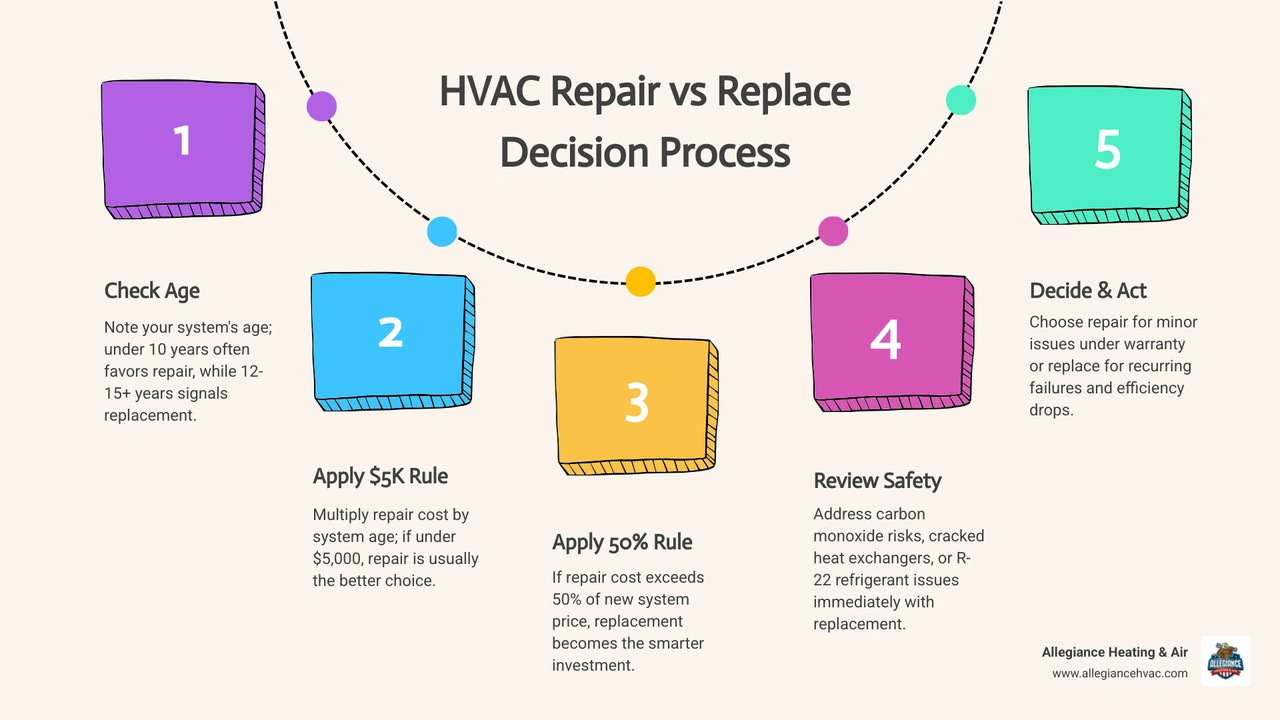
Age alone shouldn't condemn a system, but it strongly dictates how we approach repairs. When evaluating your unit, we recommend a simple age-based checklist to determine When to Repair vs Replace Your HVAC System.
If your system is under 10 years old, it is almost always wiser to opt for a repair. At this stage of its life, the equipment is likely still highly efficient, and the breakdown is usually an isolated, minor issue — such as a failed capacitor, a worn contactor, or a dirty flame sensor. Furthermore, units in this age bracket frequently have an active manufacturer warranty that covers the cost of replacement parts, leaving you responsible only for the labor.
Conversely, once a system crosses the 12-to-15-year threshold, the physical wear on major components like the compressor or the heat exchanger becomes severe. Repairs on older systems often act as temporary band-aids on a larger, systemic problem. If your system is out of warranty, parts can become increasingly difficult to source, and you run the risk of paying for a repair today only to have a different component fail next month.
The Mathematical Formulas: The 50% Rule and the $5,000 Rule
When emotional appeals about "peace of mind" aren't enough, we turn to math. Hard numbers remove the guesswork and help you make an objective financial decision. There are two primary formulas used by professional HVAC estimators to guide homeowners: the 50% Rule and the $5,000 Rule.
| Decision Tool | How It Works | Best Used For | What the Result Means |
|---|---|---|---|
| The 50% Rule | Compares the direct repair quote to the total cost of a brand-new system. | Major, expensive component failures (compressors, heat exchangers). | If the repair cost is more than 50% of a new system, replace it. |
| The $5,000 Rule | Multiplies the age of the system by the repair quote. | Mid-range repairs on aging systems where the right path is unclear. | If the total is over $5,000, replace the unit. If under, repair it. |
Using these rules prevents a scenario known as "systemic decline." This is the domino effect where one aging part fails, places extra stress on surrounding components, and triggers a cascade of expensive service calls. If you find yourself repeatedly calling for service, you should review the Signs Your HVAC Needs Replacing Not Just Fixing to protect your budget from endless repair bills.
Applying the $5,000 Rule to Your Decision
The $5,000 Rule is an industry-standard calculation that multiplies the age of your system by the cost of the proposed repair. If the resulting number is under $5,000, a repair is generally the more sensible economic choice. If the total exceeds $5,000, your money is better spent on a replacement.
Let's look at two real-world examples to see how this works:
- Scenario A (The Repair Choice): You have an 8-year-old heat pump that needs a new blower motor. The repair quote is $350. $$\text{8 years} \times \$350 = \$2,800$$Since $2,800 is well below the $5,000 threshold, repairing the unit is the smart, cost-effective path.
- Scenario B (The Replace Choice): You have a 12-year-old air conditioner with a failed compressor. The repair quote is $1,200.$$\text{12 years} \times \$1,200 = \$14,400$$Because $14,400 far exceeds the $5,000 limit, investing that money into a 12-year-old machine is a poor financial decision. That money is much better utilized as a down payment on a modern, reliable system.
How the 50% Rule Guides Your Repair vs Replace Your HVAC Decision Guide
The 50% Rule is even simpler but highly effective for major component failures. It states that if the cost of repairing your current unit is more than 50% of what it would cost to install a brand-new system, you should always choose replacement.
This rule is built around the concept of residual value. A 15-year-old furnace has virtually zero residual asset value. Spending half the price of a brand-new, warrantied furnace just to keep a zero-value machine running for another year or two is a bad investment. It is the home-comfort equivalent of putting a brand-new transmission into a car with 300,000 miles on it.
When you use this repair vs replace your hvac decision guide, you look at the total picture: a new system doesn't just fix the immediate breakdown; it resets your warranty to day one, drastically lowers your energy bills, and eliminates the threat of unexpected repair bills for years to come.
Safety Concerns and Environmental Factors That Force a Replacement
While mathematical formulas are excellent for financial planning, safety hazards and environmental regulations override all rules of thumb. There are certain scenarios where we will strongly advise against a repair because continuing to operate the system poses a direct threat to your household's safety or violates federal environmental laws.
First and foremost is the threat of carbon monoxide poisoning. In a gas furnace, combustion gases are safely vented out of your home through a metal or plastic flue, separated from your indoor breathing air by a metal wall called the heat exchanger. Over years of heating and cooling, this metal expands and contracts. Eventually, it can crack.
A cracked heat exchanger is an absolute safety emergency. It allows carbon monoxide to leak directly into your home's ductwork and blow through your living spaces. When a heat exchanger cracks, a simple patch or weld is not a safe or legal option. Because the heat exchanger is the core of the furnace, replacing it is incredibly labor-intensive. In nearly every case, we find that a complete Furnace Replacement Is Necessary to guarantee your family's safety.
Other critical safety issues include severe electrical fire hazards, such as scorched wiring harnesses inside the air handler, or repeated overheating issues that safety limit switches can no longer prevent.
On the environmental and regulatory side, the type of refrigerant your air conditioner or heat pump uses plays a massive role. If your system was installed before 2010, it likely runs on R-22 refrigerant (commonly known as Freon). Because R-22 is an ozone-depleting substance, the EPA phased it out completely.
While it is still legal to operate an R-22 system, importing or manufacturing the chemical is completely banned. If an older R-22 system develops a refrigerant leak, sourcing the reclaimed gas is extraordinarily expensive. Sinking money into repairing an R-22 system is highly discouraged; those funds are much better spent transitioning to a modern system utilizing eco-friendly refrigerants like R-410A or newer alternatives.
Energy Efficiency, Comfort, and Performance Indicators
Even if your old system isn't broken down right now, it might be costing you a fortune to run. Older HVAC units operate under outdated efficiency standards. For example, systems built in the early 2000s often have a SEER (Seasonal Energy Efficiency Ratio) rating of 10 or lower. Today, modern entry-level systems start at 13.4 SEER2 (the updated testing standard), with high-efficiency models reaching well over 20 SEER2.
If you are noticing constantly rising energy bills despite normal usage, your system is likely sliding down an efficiency curve. Over time, compressors lose mechanical compression, coils corrode and restrict heat transfer, and fan motors consume more electricity to deliver the same amount of airflow.
To see how much you could save by upgrading, we recommend reading our Standard Efficiency vs High Efficiency HVAC Comparison. Homeowners in Southern Indiana who upgrade an older, struggling system to a high-efficiency model frequently see a 20% to 40% reduction in their monthly cooling costs. You can learn more about these long-term financial benefits in our guide on How Much Does a High Efficiency HVAC Save Over Time.
Beyond energy bills, pay attention to these daily performance indicators:
- Uneven Temperatures: Are some rooms ice-cold while others are stifling hot? This is often a sign that your older system's single-stage compressor can no longer maintain balanced airflow throughout your ductwork.
- Poor Humidity Control: A key job of your air conditioner is to pull moisture out of the air. If your home feels muggy or sticky in the summer, your AC is failing to run long enough or efficiently enough to dehumidify.
- Excessive Noise: Clanking, squealing, or rattling noises indicate failing bearings, loose belts, or an unbalanced blower wheel.
- Frequent Short-Cycling: If your unit turns on and off every few minutes, it is placing massive stress on its electrical components and failing to regulate your home's climate.
Modern systems utilize variable-speed technology. Instead of running at 100% capacity or being completely off, variable-speed compressors and blowers ramp up and down incrementally. This allows them to run at lower, ultra-efficient speeds for longer periods, providing whisper-quiet operation, perfect humidity control, and incredibly consistent temperatures throughout your entire home.
Navigating Your Repair vs Replace Your HVAC Decision Guide
Making the final call requires looking at your personal timeline, warranty status, and parts availability. If you plan on moving out of your home within the next year or two, you may want to lean toward repairing the system to keep your immediate expenses low, provided it is safe to operate. However, if you plan to stay in your home for five years or longer, upgrading to a new system is almost always the smarter financial move because you will actually live there long enough to recoup your investment through lower utility bills and zero repair expenses.
Warranty status is another major pivot point. Most reputable manufacturers offer a 5-to-10-year warranty on parts. If your system is still covered, a major breakdown is much less painful because you only have to cover the labor costs. If the warranty has expired, you are on the hook for both parts and labor, which quickly tilts the scales toward replacement.
Furthermore, you can actively prevent these stressful "repair vs. replace" emergencies by taking care of your equipment. Routine professional maintenance keeps your system running at peak efficiency and catches minor issues before they turn into system-ending catastrophes. Learn more about how we keep your system running smoothly by checking out How a Maintenance Plan Extends Equipment Life.
When to Choose Repair for Your Heating and Cooling
You should comfortably choose to repair your system if:
- The issue is minor and isolated: Replacing a capacitor, fan belt, contactor, or thermostat is simple and inexpensive.
- The system is under 10 years old: The equipment still has plenty of efficient operating years left.
- The manufacturer's warranty is active: The cost of replacement parts is fully covered.
- Your energy bills are stable: The system is still converting electricity or gas into home comfort efficiently.
- The repair cost fits comfortably within both the 50% Rule and the $5,000 Rule.
When Replacement is the Smarter Long-Term Investment
You should seriously consider replacing your system if:
- The warranty has expired and a major component has failed: Replacing a compressor, evaporator coil, or heat exchanger out-of-pocket is rarely a wise investment on an old system.
- The system is over 12–15 years old: The unit is nearing or has exceeded its expected lifespan.
- You have experienced three or more repairs in the last three years: Frequent breakdowns are a clear warning sign of systemic failure.
- The system uses R-22 refrigerant: Sourcing phased-out Freon is no longer economically viable.
- There is an active safety hazard: A cracked heat exchanger or severe electrical damage makes the system unsafe to operate.
When you do decide to replace, the quality of the installation is just as important as the brand of the equipment. A poorly installed system will suffer from reduced efficiency, frequent breakdowns, and a shortened lifespan from day one. To understand why professional expertise is non-negotiable, read our article on why Professional HVAC Installation Beats DIY.
If you are ready to explore your replacement options, we have put together comprehensive local resources. Check out our Heating Replacement Guide New Albany IN or our Heating Replacement Louisville KY Guide for expert advice tailored to your specific community.
Frequently Asked Questions about HVAC Repair vs. Replacement
How does the type of refrigerant affect my repair vs replace your hvac decision guide?
The type of refrigerant your system uses is one of the most critical factors in this repair vs replace your hvac decision guide. If your system was installed before 2010, it likely uses R-22 Freon. Because of strict environmental regulations aimed at protecting the ozone layer, R-22 is no longer manufactured or imported.
If your R-22 system develops a refrigerant leak, the cost to source reclaimed refrigerant for a recharge is incredibly high. Sinking money into repairing an R-22 system is generally a poor investment. Modern systems use eco-friendly R-410A or newer refrigerants, which are readily available, highly efficient, and much better for the environment.
What are the safety risks of delaying an HVAC replacement?
Delaying a necessary HVAC replacement can expose your family to serious safety risks. The most severe hazard is carbon monoxide poisoning caused by a cracked heat exchanger in a gas furnace. Because carbon monoxide is odorless, tasteless, and invisible, a leak can go unnoticed without functioning detectors, leading to severe illness or death.
Additionally, older systems with deteriorating electrical wiring present significant fire hazards. Aging components can overheat, causing short circuits that can ignite dust, insulation, or nearby structural materials. If an HVAC technician identifies a critical safety issue, the system should be shut down immediately and replaced.
Are there rebates or tax credits available for upgrading my system in 2026?
Yes! Upgrading your heating and cooling system in May 2026 is more affordable than ever thanks to a variety of financial incentives. Under federal tax credits (such as the Energy Efficient Home Improvement Credit), homeowners can claim substantial tax credits for installing qualifying high-efficiency heat pumps, air conditioners, and furnaces.
Additionally, local utility companies in southern Indiana and the Louisville area frequently offer cash-back rebates for upgrading to energy-efficient systems. When you combine these federal tax credits and utility incentives with our flexible financing options, upgrading to a high-efficiency system becomes an incredibly smart, budget-friendly decision.
Conclusion
Deciding whether to repair or replace your heating and cooling system doesn't have to be a stressful or confusing process. By analyzing your system's age, utilizing mathematical formulas like the 50% and $5,000 rules, and keeping safety and efficiency at the forefront, you can make an informed choice that protects both your family's comfort and your hard-earned money.
At Allegiance Heating & Air, LLC, we have been "Taking Home Comfort Under Our Wing" since 2005. As a family-owned business based right here in Greenville, IN, we pride ourselves on providing honest, transparent advice. Our licensed, insured, and highly trained technicians never use high-pressure sales tactics. We treat your home and your budget with the same respect we would show our own.
Whether you need a quick, reliable repair to get your system back up and running, or you want to explore your options for a modern, high-efficiency replacement, we are here to help. Contact us today to schedule an honest, professional system evaluation, and let us help you find the perfect comfort solution for your home.
Ready to secure your year-round home comfort? Explore our comprehensive HVAC Services or schedule an appointment with our trusted Greenville team today!
Contact Us Or Schedule Expert Service
Other Blogs
ready to transform your home?
Discover our exceptional home services tailored to meet your needs and enhance your living space.
WHAT OUR CLIENTS HAVE TO SAY ABOUT US

We had a complete HVAC system and a hot water heater installed. The guys were professional, well mannered, and completed the work in a timely manner. Would definitely use them again.
I was nervous at first because my AC broke in the middle of 80 degree weather which is strange for April, but Allegiance Heating and Air was incredibly prompt and professional. The technician arrived within an hour, explained the problem clearly, and completed the repair. The technician , Mr. Garrett Moon was a very nice and courteous young man. He found the problem and fixed it within a timely manner. I highly recommend them for any heating or cooling needs. I’ll definitely give them a call again should I ever have another issue, but hopefully not. Knock on wood 😁. Give them a call… you won’t be disappointed!
From the moment I called to schedule a service, the team was quick to respond and arrived right on time. The technician was professional, friendly, and clearly knowledgeable about my heating system. He explained the repair options in plain language and completed the job efficiently. I appreciated the reliable service and the fact that the work was done the same day. I would definitely recommend Allegiance Heating and Air for any residential HVAC needs.
5/5 stars – I was very impressed with the efficient, affordable and timely service from Allegiance Heating and Air. The technician arrived on time, and performed the service quickly, no repairs needed at this time. Communication was clear and the whole experience felt hassle‑free. I would definitely recommend them for any residential HVAC needs.
Knowledgeable, experienced individual.
Explains Allegiance Heating and Air was incredibly reliable, professional and affordable. They arrived right on time, kept the work area clean and finished the furnace repair quickly. The technician explained everything clearly and the price was a great value. If happiness had a location on Google Maps, it would be here.
Gilbert had to go above and beyond because York is no longer making the part for my furnace. But he was able to find a way to construct a housing bracket for my furnace. Ingenuity, determination and integrity is what finally got my furnace fixed. Gilbert is truly a one of a kind technician.
Thank you for always going the extra mile. Gilbert is always respectful and helpful with any concerns.
"Great service, most knowledgeable and capable HVAC business in Kentuckiana!! Pete Flemming and Bryan the owner, are HVAC encyclopedias. They have the highest integrity of any HVAC business I have ever used. Allegiance has put numerous units in for me over the last 17 years. I will continue to use and trust them."
"Fast response from Allegiance when our heat was out on New Year’s day! Service technician was friendly and efficient. He took the time to explain the problem, tell us about the temporary fix and the plan for permanent repair. We were impressed!"
"Love Allegiance! Their technicians, in particular Benjamin, explain everything. Fast and thorough. A/C was out on a Sunday. Called Allegiance and within a few hours Benjamin arrived. Such a comfort as he was the one who last serviced our units. He quickly replaced part and cooling is restored!"
"My heat pump went out and I had to call after hours. The technician (Garrett) was outstanding and thorough. He got my system up and working until Monday and gave me several options of units. Also took the time to explain the issue to my Home warranty company. I highly recommend this company."
"Right on time :) respectful, fast, and polite. Even gave my fur babies some attention."
"Had Garrett out today to fix our AC. Fantastic tech. He showed up exactly when he said he would and kept us informed of what he was checking and what he found. Highly recommend!"
"Lucas with Allegiance showed up on time as promised, was professional and extremely patient and responsive with all my questions. He took care of the issue, and I feel he was trustworthy! He had us back to cool and comfortable on one of the hottest days of the year."
"Lucas did a great job! Very professional and expedient. Explained the process very well and represented Allegiance as a truly professional and reputable company."
"Arrived on time and work diligently to fix issue. These guy are great. Worked quickly to resolve my issues."
"Lucas was great - he spent a lot of time trying to figure out what was going on and explained everything he was doing. I trust Allegiance and wouldn’t want anyone else working on/in my house!!"

RELATED ARTICLES

All About Controlling Indoor Humidity with HVAC

Pre-School Year Allergy Defense: Upgrading Your Greenville Home's Filtration Before September