Why Summer Energy Bills Hit So Hard — and What You Can Do About It
The best summer energy efficiency tips for homeowners can mean the difference between a manageable utility bill and a number that makes you wince. In Greenville, IN, summers bring real heat and real humidity — and that combination forces air conditioners to work overtime. The average home spends around $1,900 per year on utility bills, and nearly half of that goes straight to heating and cooling. During peak summer months, air conditioning alone can account for 50% or more of your total electric bill.
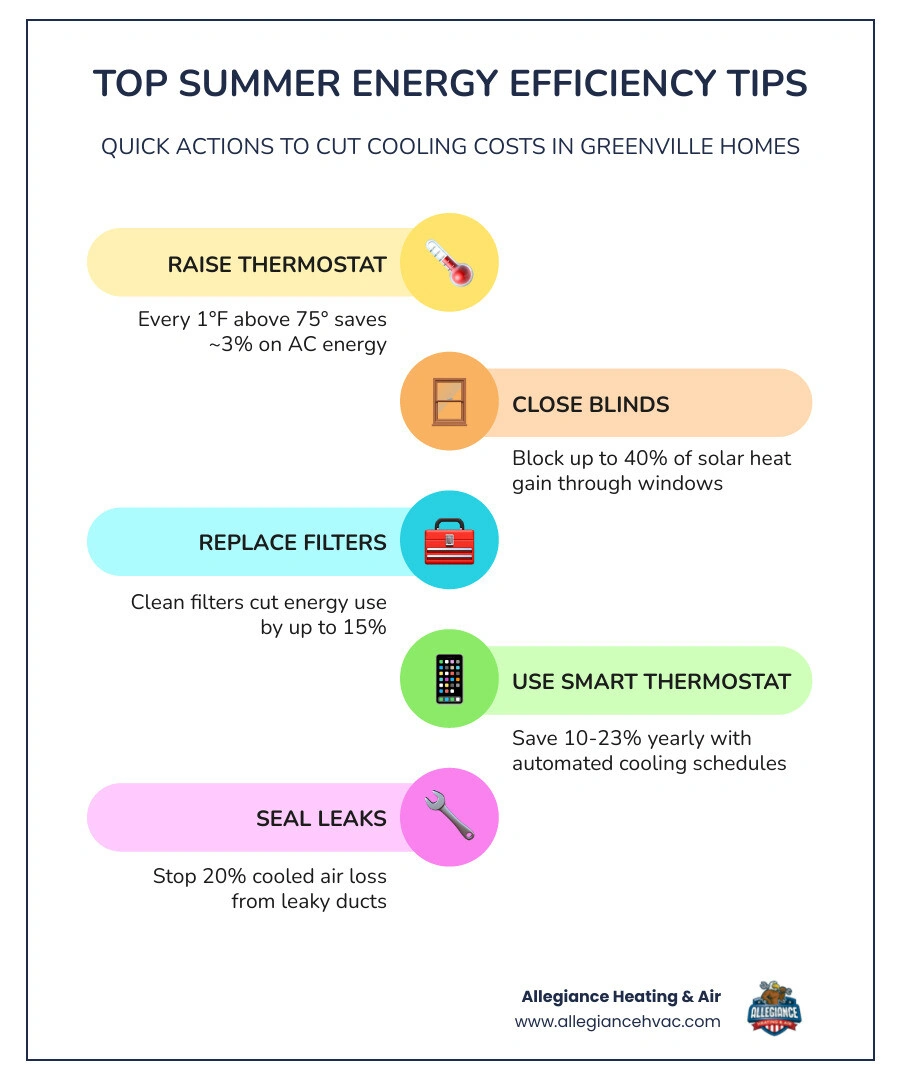
Here are the most effective ways to reduce summer cooling costs:
- Raise your thermostat — Every degree above 75°F saves roughly 3% on cooling energy.
- Use ceiling fans — The wind-chill effect lets you raise the thermostat by 4°F without losing comfort.
- Close blinds and curtains — Sunlight through windows accounts for up to 40% of total heat gain in a home.
- Replace air filters — Clogged filters increase energy use by up to 15%.
- Seal ducts and air leaks — About 20% of cooled air is lost through leaky ducts in a typical home.
- Run appliances at night — Dishwashers, dryers, and ovens add heat that your AC has to fight during the day.
- Install a smart thermostat — Programmable and smart thermostats can save 10–23% annually on cooling costs.
- Use ENERGY STAR appliances and lighting — LED bulbs emit 75–80% less heat than incandescent bulbs, reducing your cooling load.
- Add window film or cellular shades — These can cut solar heat gain by 40–70%.
- Schedule professional AC maintenance — Dirty coils alone can increase energy consumption by up to 30%.
The good news is that most of these steps cost little to nothing. You don't need a major renovation to make a meaningful dent in your summer energy bills — you just need to know where to start.
This guide walks through each strategy in practical detail, from no-cost habit changes to smart upgrades worth the investment, so you can keep your Greenville home cool without letting your electric bill run wild.
Simple guide to summer energy efficiency tips for homeowners:
High-Impact Summer Energy Efficiency Tips for Homeowners
To keep your home comfortable during Southern Indiana’s sweltering July afternoons, we have to look at how heat enters your living spaces in the first place. Heat enters your home in three main ways: solar radiation (sunlight streaming through glass), conduction (heat traveling through your roof and walls), and infiltration (warm, humid air creeping through cracks and gaps).
Fighting this heat by simply turning down your air conditioner is like trying to dry your floor while the faucet is still running. Instead, a passive-first approach stops the heat from getting inside, reducing the overall cooling load on your HVAC system.

By combining passive heat-blocking strategies with smart system management, you can keep your home comfortable without forcing your air conditioner to run constantly. Let's start with the easiest, most cost-effective adjustments you can make at home, starting with the windows and your thermostat settings. For a deep dive into temperature management, check out our guide on the Best Thermostat Settings for Summer Energy Savings.
Strategic Window Management and Ventilation
Windows are beautiful, but they are also thermal weak spots. In fact, windows are responsible for 25–30% of residential cooling and heating loads. When sunlight penetrates through windows, it heats up your floors, furniture, and air, accounting for up to 40% of the total heat gain in an average home.
To combat this, your window coverings are your first line of defense. Standard blinds help, but upgrading to cellular (honeycomb) shades is a game-changer. Their unique pocketed design traps air, reducing solar heat gain by up to 62% compared to bare windows. If you want to keep the view while blocking the heat, consider applying a low-e window film. This reflective window film blocks up to 99% of UV rays and 79% of solar energy, reducing solar heat gain by 40–70% on treated glass.
Another highly effective option is the installation of solar shades or exterior protective screens. Shading your windows with protective screens can cut cooling costs by up to 25%.
On milder summer nights when the humidity drops, you can use natural ventilation to purge hot air. By opening windows on opposite sides of your home, you can create a cross-ventilation effect. Positioning a fan to blow outward through a window on the warm side of the house while opening a window on the cool, shaded side will pull fresh, cool air directly through your living space.
Implementing Smart Thermostat Settings for Summer Energy Efficiency Tips for Homeowners
Using a smart thermostat is one of the easiest ways to implement summer energy efficiency tips for homeowners. A programmable or smart thermostat can save you 10–23% annually on cooling costs by automatically tailoring your home's temperature to your daily routine.
If you are still adjusting your thermostat manually, you are likely wasting energy. For optimal savings, keep your thermostat set to 78°F or higher when you are home. When you head out to work or go to bed, adjust the temperature 7 to 10 degrees higher. For every degree you set your thermostat above 80°F, you can save approximately 2% to 3% on cooling costs.
Many modern smart thermostats feature occupancy-based adjustments, using motion sensors and geofencing to detect when the house is empty and automatically shifting into an energy-saving away mode.
Additionally, you can use pre-cooling techniques to save money if your local utility provider uses time-of-use rates. This involves setting your thermostat a few degrees lower in the early morning hours when outdoor temperatures are cool and electricity rates are lowest. As the afternoon peak demand approaches, you can raise the thermostat setting, allowing your home to slowly warm up while avoiding heavy AC usage during the hottest, most expensive hours of the day.
Optimizing HVAC Performance and Airflow
No matter how well you shade your windows, your air conditioner still has to do the heavy lifting when heat waves settle over Southern Indiana. If your HVAC system is struggling against restricted airflow or dirty components, it will consume far more electricity than necessary. Airflow problems can reduce your heating and cooling system's efficiency by up to 15 percent, making routine maintenance an absolute necessity.
Taking care of your system doesn't just lower your monthly bills; it also prevents unexpected breakdowns on ninety-degree days. You can keep your system running smoothly by following our comprehensive Summer AC Maintenance Checklist for Homeowners.
Essential Maintenance Tasks for Peak AC Efficiency
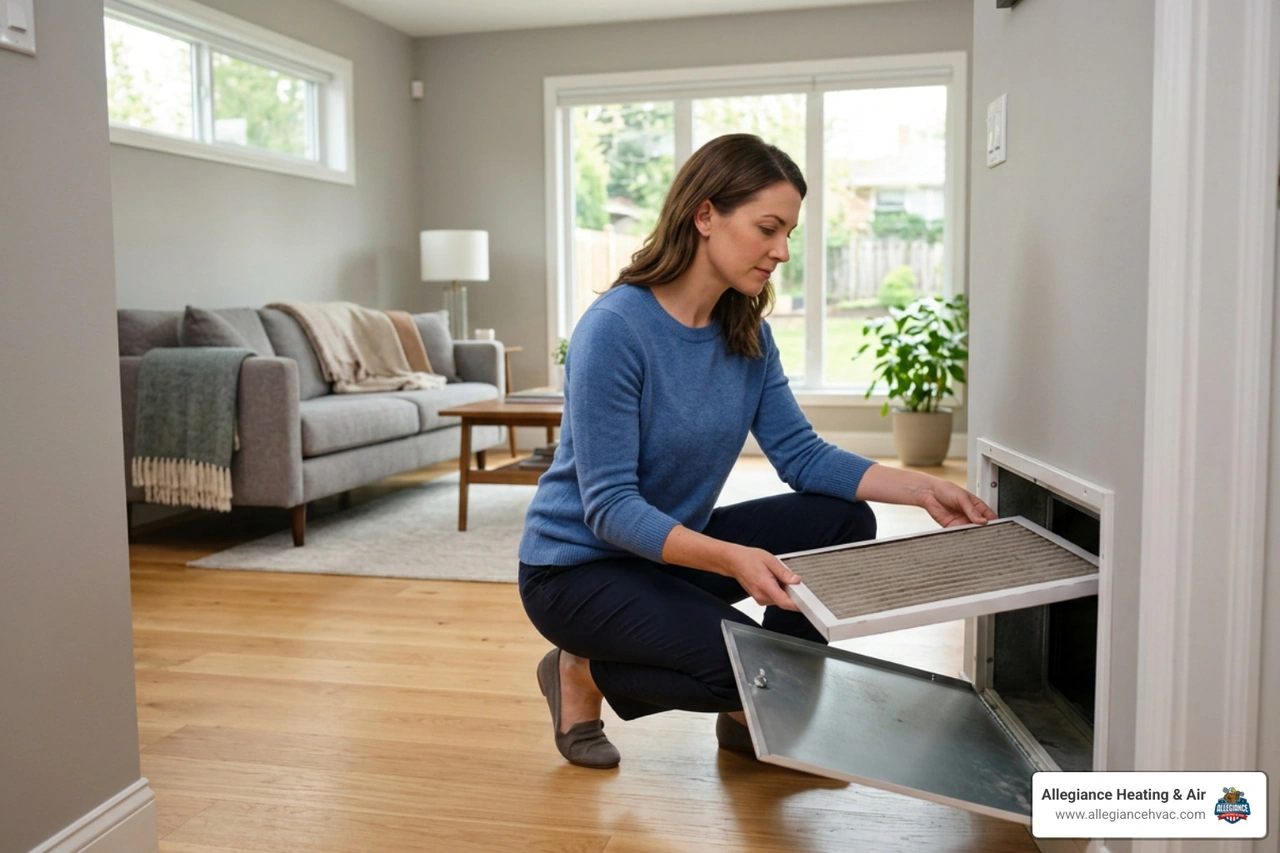
The most critical maintenance task you can perform yourself is regular filter replacement. Clogged filters restrict airflow, forcing your system's blower motor to work harder and run longer. This restriction can increase your system's energy use by up to 15%.
We recommend checking your air filter monthly during the peak summer season and replacing it at least every 60 to 90 days. For help determining if your filter is ready for a change, read about the Signs Your Air Filter Needs Replaced. When shopping for a replacement, look for mid-range pleated MERV 8 to 11 filters, which offer an excellent balance between air filtration and unrestricted airflow. Learn more about the process in our guide on Replacing Your Air Filter.
Beyond the filter, your outdoor condenser unit needs room to breathe. Ensure there is at least a two-foot clearance of clear space around the outdoor unit, keeping it free of tall grass, weeds, shrubs, and fallen leaves.
Over time, outdoor condenser coils collect dirt, pollen, and dust, which act as an insulating blanket and prevent the unit from releasing heat. Dirty coils can increase your air conditioner's energy consumption by up to 30%. While homeowners can gently hose away loose debris from the exterior coils, scheduling a professional tune-up once a year ensures that the internal evaporator coils, electrical connections, and refrigerant levels are thoroughly inspected and cleaned.
Sealing Ducts and Controlling Indoor Humidity
Even the most efficient air conditioner will waste energy if the cold air it produces never makes it to your living spaces. In a typical home, about 20% of the air that moves through the duct system is lost because of improper installation, loose connections, and cracks. This means you are paying to cool your attic or crawlspace. Sealing and insulating furnace ducts can improve the efficiency of your cooling system by as much as 20% or more, keeping that precious cold air inside your home.

Humidity control is another vital aspect of summer comfort in places like Floyds Knobs and New Albany. High humidity makes the air feel much warmer than it actually is because it prevents sweat from evaporating off your skin.
Your air conditioner naturally removes moisture as it cools, but on exceptionally humid days, it can struggle to keep up. To learn how to manage this balance, read our article on How to Control Indoor Humidity with Your HVAC.
Using an ENERGY STAR certified dehumidifier can assist your HVAC system by pulling excess moisture from the air. These certified models remove the same amount of moisture while using nearly 30% less energy than conventional dehumidifiers, allowing you to feel perfectly comfortable at a higher thermostat setting.
Appliance Efficiency and Regional Considerations
Your heating and cooling system isn't the only thing drawing power and creating heat inside your home during the summer. Every major appliance you run acts as a miniature space heater, releasing warmth that your air conditioner must then work to remove. By choosing energy-efficient models and adjusting how and when you use your appliances, you can make a major impact on your home's thermal load.
Investing in high-efficiency appliances pays off over time by lowering both your water and electric bills. The table below illustrates the substantial savings offered by upgrading to modern, certified options:
| Appliance Type | Standard Model Performance | ENERGY STAR Certified Performance | Lifetime or Annual Savings |
|---|---|---|---|
| Dishwasher | High water and power consumption | Uses less water and electricity | Saves 3,870 gallons of water over its lifetime |
| Clothes Dryer | High heat generation, long runtimes | Uses 20% less energy (Heat pump models use 30% less) | Significantly reduces indoor heat generation |
| Washing Machine | High hot water draw | Uses 25% less energy and 33% less water | Lowers water heating loads by utilizing cold water |
| Freezer | Continuous cycling | At least 10% more energy efficient | Lowers baseline continuous electrical draw |
Lighting and Appliance Adjustments to Reduce Internal Heat
Traditional incandescent light bulbs are incredibly inefficient, converting 90% of the electricity they use into heat rather than light. Switching to ENERGY STAR certified LED bulbs is one of the fastest, simplest upgrades you can make. LEDs use 70–90% less energy than conventional incandescent bulbs, last at least 15 times longer, and emit 75–80% less heat. Similarly, upgrading to ENERGY STAR certified light fixtures can reduce lighting energy use by up to 90% while producing far less heat.
In the kitchen, consider changing how you cook. Standard ovens release an immense amount of heat directly into your home. Using an induction cooktop is a highly efficient alternative; induction technology is three times more efficient than a standard gas stove because it transfers electromagnetic energy directly to your cookware, leaving the surrounding air cool.
On hot summer evenings, taking the cooking outside to an outdoor grill is an excellent way to keep the kitchen cool.
Finally, be mindful of "phantom load" or "vampire power"—the energy consumed by electronics and chargers even when they are turned off. Using advanced power strips can automatically cut power to devices like gaming consoles, televisions, and computer monitors when they aren't in use, preventing unnecessary energy draw and heat generation.
Regional Challenges: Humidity, Wildfire Smoke, and Pool Maintenance
Homeowners in Southern Indiana face unique environmental challenges during the summer. Unlike arid western regions where evaporative coolers (which use 75% less electricity than traditional AC) work beautifully, our high relative humidity makes evaporative cooling impractical. We must rely on refrigerant-based air conditioning and proper dehumidification to maintain comfortable indoor spaces.
In recent years, summer has also brought occasional periods of outdoor wildfire smoke. During these events, it is crucial to keep your windows closed and set your HVAC system to "recirculate" rather than drawing in outdoor air. This keeps your indoor air clean but places a heavier burden on your air filter, meaning you'll need to check and replace it more frequently to prevent airflow restrictions.
For homeowners with backyard pools in areas like Georgetown or Sellersburg, pool equipment can be a major source of summer energy consumption. Standard single-speed pool pumps run at a constant, high-energy rate. Upgrading to an ENERGY STAR certified variable-speed pool pump can reduce your pump's energy use by up to 70%, saving up to $350 a year.
Additionally, using a conventional or liquid pool cover when the pool is not in use can reduce water evaporation by 40% to 50%, saving water and preserving chemical balance so you don't have to run your filtration system as long.
Upgrading to High-Efficiency Systems and Utilizing Incentives
If your air conditioner is more than ten to fifteen years old, it may be time to consider an upgrade. Older units operate at much lower efficiency levels, and as their components wear down, they require more energy to provide the same level of cooling. Modern cooling systems are designed to meet strict environmental and efficiency standards, offering a reliable way to permanently lower your summer energy bills.
When planning a replacement, it helps to understand your options. We recommend starting with our Standard Efficiency vs High Efficiency HVAC Comparison to see how modern engineering makes a difference.
If you are ready to explore your options, our team specializes in Energy Efficient AC Installation to ensure your new system is sized and installed perfectly for your home.
Long-Term Summer Energy Efficiency Tips for Homeowners with HVAC Upgrades
When shopping for a new air conditioner, the Seasonal Energy Efficiency Ratio (SEER2) is the key metric to look for. Higher SEER2 ratings indicate greater efficiency. To understand how these ratings translate to monthly savings, take a look at our High SEER vs Standard SEER AC Comparison.
Upgrading to a high-efficiency system can save you an incredible amount of money over the lifespan of the equipment. Learn more about these long-term returns in our detailed guide: How Much Does a High Efficiency HVAC Save Over Time.
Modern HVAC upgrades offer incredible efficiency through advanced technologies:
- Heat Pumps: These systems provide both heating and cooling by moving heat rather than creating it, offering remarkable year-round efficiency.
- Ductless Mini-Splits: Perfect for homes without existing ductwork or for zoning specific rooms, mini-splits save 30–50% over fixed-speed systems by avoiding the energy losses associated with ductwork.
- Geothermal Cooling: By tapping into the stable temperatures underground, geothermal heat pumps drop operating costs by 40–60% compared to conventional systems.
Making these upgrades is more accessible than ever thanks to federal financial incentives. Under the Inflation Reduction Act, homeowners can qualify for significant tax credits to help offset the cost of high-efficiency systems. You can read all about these opportunities in our guide on Federal Tax Credits for Furnace and AC Replacement.
Frequently Asked Questions About Summer Energy Efficiency
What is the most effective low-cost way to reduce summer cooling bills?
The most effective low-cost strategy is a combination of comprehensive air sealing and strategic ceiling fan use. Basic weatherization—such as applying exterior caulk to cracks around window frames and adding fresh weatherstripping to exterior doors—can reduce your cooling costs by an average of 30%. This stops hot, humid outdoor air from infiltrating your home. When you pair this with ceiling fans in occupied rooms, you can raise your thermostat setting without any loss of personal comfort.
How do ceiling fans help lower energy use?
Ceiling fans do not actually cool the air in a room; instead, they cool people by creating a wind-chill effect on your skin. This breeze helps sweat evaporate more quickly, making you feel up to 4°F cooler than the actual room temperature.
To take advantage of this, ensure your ceiling fan blades are rotating counterclockwise in the summer to push a refreshing downdraft of air straight down. Because fans cool people and not rooms, always turn them off when you leave a room to avoid wasting electricity.
What should I do to save energy when going on vacation?
When you head out of town, you can give your HVAC system a well-deserved break. Set your thermostat to an energy-saving vacation mode, keeping the indoor temperature around 85°F to protect your home from extreme heat while minimizing AC runtime.
Before you walk out the door, close all your blinds and curtains to block solar heat gain. Finally, unplug non-essential electronics—such as TVs, computer monitors, chargers, and small kitchen appliances—to eliminate phantom power draw while you are away.
Conclusion
Maximizing your summer energy efficiency doesn't require sacrificing your comfort. By combining simple, everyday habits—like managing your window coverings, utilizing ceiling fans, and setting your thermostat strategically—with proactive maintenance, you can keep your home cool and your utility bills under control all summer long.
At Allegiance Heating & Air, LLC, we have been proudly serving our neighbors in Greenville, IN, and surrounding communities like Floyds Knobs, New Albany, and Clarksville since 2005. As a family-owned business, we are dedicated to providing trusted, professional HVAC services with a focus on honest customer satisfaction. Our mission is simple: "Taking Home Comfort Under Our Wing."
Whether you need a quick system tune-up to boost your efficiency or are ready to explore a high-efficiency AC upgrade, we are here to help. Schedule your professional AC maintenance with Allegiance Heating & Air today and let our experienced team keep your home perfectly comfortable all summer long!
Contact Us Or Schedule Expert Service
Other Blogs
ready to transform your home?
Discover our exceptional home services tailored to meet your needs and enhance your living space.
WHAT OUR CLIENTS HAVE TO SAY ABOUT US

We had a complete HVAC system and a hot water heater installed. The guys were professional, well mannered, and completed the work in a timely manner. Would definitely use them again.
I was nervous at first because my AC broke in the middle of 80 degree weather which is strange for April, but Allegiance Heating and Air was incredibly prompt and professional. The technician arrived within an hour, explained the problem clearly, and completed the repair. The technician , Mr. Garrett Moon was a very nice and courteous young man. He found the problem and fixed it within a timely manner. I highly recommend them for any heating or cooling needs. I’ll definitely give them a call again should I ever have another issue, but hopefully not. Knock on wood 😁. Give them a call… you won’t be disappointed!
From the moment I called to schedule a service, the team was quick to respond and arrived right on time. The technician was professional, friendly, and clearly knowledgeable about my heating system. He explained the repair options in plain language and completed the job efficiently. I appreciated the reliable service and the fact that the work was done the same day. I would definitely recommend Allegiance Heating and Air for any residential HVAC needs.
5/5 stars – I was very impressed with the efficient, affordable and timely service from Allegiance Heating and Air. The technician arrived on time, and performed the service quickly, no repairs needed at this time. Communication was clear and the whole experience felt hassle‑free. I would definitely recommend them for any residential HVAC needs.
Knowledgeable, experienced individual.
Explains Allegiance Heating and Air was incredibly reliable, professional and affordable. They arrived right on time, kept the work area clean and finished the furnace repair quickly. The technician explained everything clearly and the price was a great value. If happiness had a location on Google Maps, it would be here.
Gilbert had to go above and beyond because York is no longer making the part for my furnace. But he was able to find a way to construct a housing bracket for my furnace. Ingenuity, determination and integrity is what finally got my furnace fixed. Gilbert is truly a one of a kind technician.
Thank you for always going the extra mile. Gilbert is always respectful and helpful with any concerns.
"Great service, most knowledgeable and capable HVAC business in Kentuckiana!! Pete Flemming and Bryan the owner, are HVAC encyclopedias. They have the highest integrity of any HVAC business I have ever used. Allegiance has put numerous units in for me over the last 17 years. I will continue to use and trust them."
"Fast response from Allegiance when our heat was out on New Year’s day! Service technician was friendly and efficient. He took the time to explain the problem, tell us about the temporary fix and the plan for permanent repair. We were impressed!"
"Love Allegiance! Their technicians, in particular Benjamin, explain everything. Fast and thorough. A/C was out on a Sunday. Called Allegiance and within a few hours Benjamin arrived. Such a comfort as he was the one who last serviced our units. He quickly replaced part and cooling is restored!"
"My heat pump went out and I had to call after hours. The technician (Garrett) was outstanding and thorough. He got my system up and working until Monday and gave me several options of units. Also took the time to explain the issue to my Home warranty company. I highly recommend this company."
"Right on time :) respectful, fast, and polite. Even gave my fur babies some attention."
"Had Garrett out today to fix our AC. Fantastic tech. He showed up exactly when he said he would and kept us informed of what he was checking and what he found. Highly recommend!"
"Lucas with Allegiance showed up on time as promised, was professional and extremely patient and responsive with all my questions. He took care of the issue, and I feel he was trustworthy! He had us back to cool and comfortable on one of the hottest days of the year."
"Lucas did a great job! Very professional and expedient. Explained the process very well and represented Allegiance as a truly professional and reputable company."
"Arrived on time and work diligently to fix issue. These guy are great. Worked quickly to resolve my issues."
"Lucas was great - he spent a lot of time trying to figure out what was going on and explained everything he was doing. I trust Allegiance and wouldn’t want anyone else working on/in my house!!"

RELATED ARTICLES

Signs It's Time for Furnace Maintenance Before Winter Hits
How to Change Your HVAC Air Filter in 5 Easy Steps