What Does an HVAC Maintenance Visit Include? Here's the Quick Answer
What does an HVAC maintenance visit include is something every homeowner in Greenville, IN should understand before scheduling service. In short, a professional technician inspects, cleans, and tests your entire heating and cooling system to catch small problems before they become expensive ones. Most visits take 45 minutes to an hour and cover both your equipment and your safety.
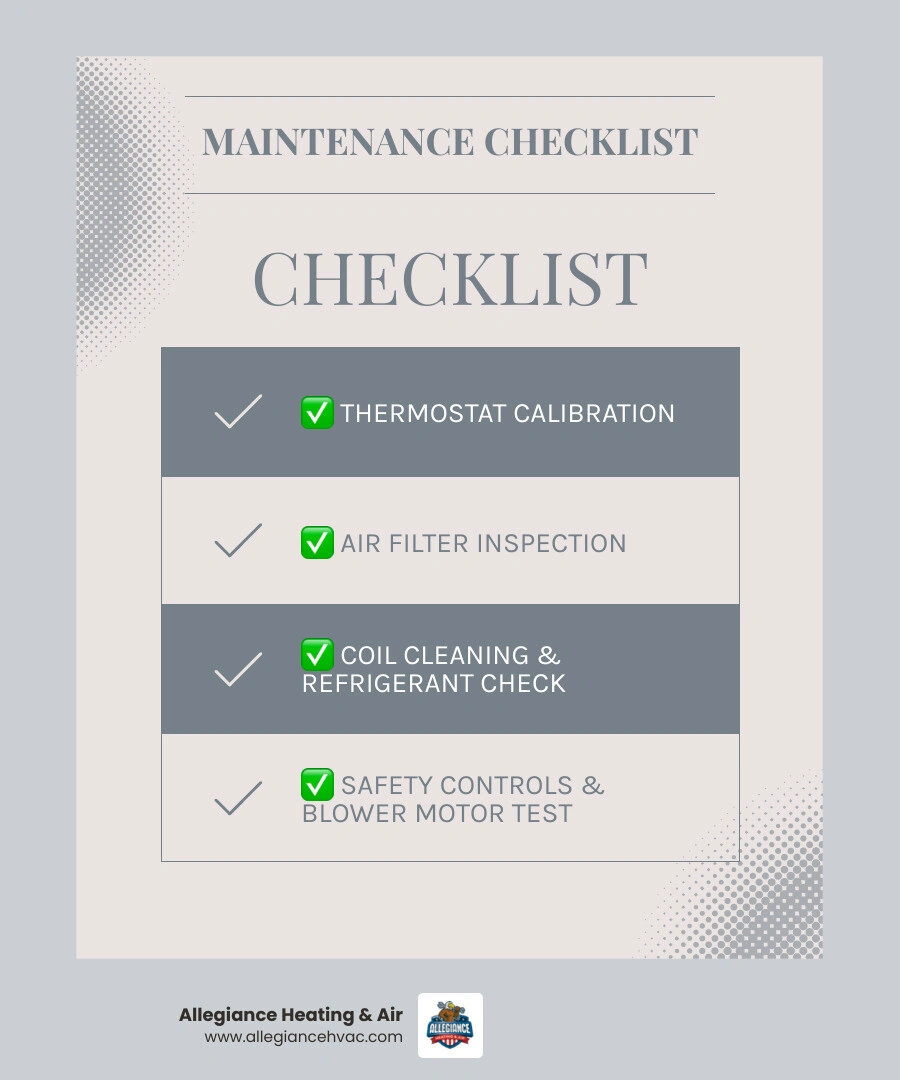
Here's what a standard HVAC maintenance visit covers:
• Thermostat calibration — verifying accurate temperature readings and proper settings
• Air filter inspection and replacement — checking for clogs that restrict airflow and reduce efficiency
• Electrical connections — tightening loose wiring and testing voltage and amperage draws
• Coil cleaning — brushing and rinsing evaporator and condenser coils for better heat transfer
• Refrigerant check — measuring levels and inspecting for leaks
• Condensate drain flush — clearing blockages that can cause water damage or mold
• Blower motor inspection — evaluating airflow and measuring motor amperage
• Safety controls testing — checking limit switches, pressure switches, and emergency shutoffs
• Heating-specific checks — inspecting the heat exchanger, burner assembly, ignition system, and testing for carbon monoxide
• Ductwork visual inspection — looking for leaks, damage, and buildup
• Post-visit report — a written summary of findings and any recommended repairs
Skipping this routine service can raise your utility bills by up to 15% and shorten the life of your equipment significantly. Regular maintenance, on the other hand, can extend the life of your HVAC system by up to 48%.
Think of it like an annual physical for your home's most hardworking system. Everything gets checked, cleaned, and adjusted so your equipment runs the way it's supposed to — efficiently, safely, and reliably through every Indiana season.
What does an hvac maintenance visit include terms to remember:
• Annual HVAC Maintenance: Is It Worth It?
• How Often Should You Service Your HVAC System
The Core Components: What Does an HVAC Maintenance Visit Include for Cooling Systems?
When the humidity starts to climb in southern Indiana, your air conditioner becomes your best friend. To keep that friendship from turning sour, a professional cooling tune-up focuses on heat transfer and mechanical endurance. One of the most critical steps we take is cleaning the outdoor condenser coils. Over time, these coils get caked with dirt, grass clippings, and pollen, which acts like a thick blanket, trapping heat inside the unit. By rinsing these coils, we allow the system to release heat more effectively, which can lower energy use by up to 15%.
A thorough annual HVAC maintenance complete guide emphasizes that professional service goes far beyond what a homeowner can do with a garden hose. While you can certainly clear leaves away from the unit, a technician uses specialized tools to measure the system’s "vitals."
• Air Filters — Homeowner DIY: Replace every 30–90 days — Professional Technician: Inspect and evaluate MERV compatibility
• Outdoor Unit — Homeowner DIY: Clear debris and trim plants — Professional Technician: Deep clean coils and check fan alignment
• Thermostat — Homeowner DIY: Set schedules and change batteries — Professional Technician: Calibrate sensors and test communication
• Electrical — Homeowner DIY: Visual check of wires — Professional Technician: Tighten connections and measure amperage
• Condensate System — Homeowner DIY: Check for visible leaks — Professional Technician: Flush drain lines and clean the pan
• Refrigerant — Homeowner DIY: Not applicable (requires license) — Professional Technician: Measure levels and check for leaks
Knowing how often should you service your HVAC system — which is ideally twice a year — ensures that these mechanical evaluations happen before the peak of summer.
What does an hvac maintenance visit include for thermostat calibration and airflow?
Airflow is the lifeblood of your HVAC system. During a visit, we don't just "feel" the air coming out of the vents; we measure it. We check the blower motor amperage to ensure it isn't working too hard, which is a common sign of a failing motor or a major blockage. We also measure the temperature differential — the difference between the air going into the return and the air coming out of the supply. If this "split" isn't within a specific range, it tells us something is wrong with the system's efficiency.
We also spend time at your thermostat. A miscalibrated thermostat can cause your AC to run longer than necessary or fail to reach the desired temperature, leading to uneven comfort. We verify that the location of the thermostat isn't affected by "ghost" heat from a nearby lamp or drafty window, ensuring your settings actually match the reality of your home. Following a spring HVAC maintenance checklist helps identify these airflow and calibration issues before the first heatwave hits.
What does an hvac maintenance visit include for electrical safety and refrigerant?
Electricity and water (in the form of condensation) are a dangerous mix. We inspect all electrical connections to ensure they are tight and free of corrosion. A loose wire can cause a system to short out or even pose a fire hazard. We also test the capacitors — the components that give your motors the "kick" they need to start. Capacitors are one of the most frequent causes of AC breakdowns, and they often show signs of bulging or leaking before they fail completely.
Refrigerant levels are another high-priority check. Your AC doesn't "use up" refrigerant like a car uses gas; if the levels are low, there is a leak. We measure the operating pressures, superheat, and subcooling to ensure the system is charged exactly to the manufacturer's specifications. Too much or too little refrigerant can damage the compressor, which is the most expensive part of the system to replace.
Heating System Tune-Up: Ensuring Winter Reliability in Greenville, IN
As the leaves turn and the air gets crisp in Floyds Knobs and Georgetown, our focus shifts to the furnace or heat pump. A heating tune-up is as much about safety as it is about comfort. We follow a strict HVAC maintenance plan that prioritizes the integrity of the heat exchanger. This is the part that keeps the combustion gases (like carbon monoxide) separate from the air you breathe. We visually inspect it for cracks or signs of heat stress, as even a tiny hairline fracture can be a major safety risk.
Combustion safety and burner adjustments
For gas furnaces, the burner assembly needs to be clean to ensure "complete combustion." We look for a steady blue flame; a flickering yellow flame can indicate that the burners are dirty or that the gas-to-air ratio is off. We also clean the flame sensor, a small rod that tells the furnace it's safe to keep the gas valve open. If this sensor gets coated in soot, your furnace might cycle on and off rapidly, or not start at all.
We also check the pilot light or electronic ignition system and measure the gas pressure. Proper gas pressure ensures the furnace runs at its rated efficiency without over-firing, which can wear out components prematurely.
Heat pump and boiler specific checks
If you use a heat pump, the maintenance visit includes checking the reversing valve. This is the magic part that allows the system to switch from cooling to heating. We also test the defrost cycle to make sure the outdoor unit doesn't turn into a block of ice during a New Albany winter.
For those with boilers, we inspect the piping for leaks and check the expansion tank. We also bleed the radiators or baseboard units to ensure there are no air pockets preventing heat from reaching every room. Understanding the benefits our maintenance plan provides means knowing that these specialized checks are tailored to your specific equipment type.
Beyond the Unit: Ductwork and Air Quality Inspections
Your HVAC system is only as good as the "veins" that carry the air. During a maintenance visit, we take a look at the visible portions of your ductwork. It is estimated that 20% to 30% of conditioned air is lost through duct leaks in the average home. That is money literally disappearing into your attic or crawlspace.
We look for:
• Visible damage — crushed ducts or disconnected sections
• Dust accumulation — which can indicate a leak on the "return" side pulling in dirty attic air
• Insulation review — ensuring the ducts stay the right temperature so the air doesn't lose its "cool" (or heat) on the way to the vent
Many homeowners ask, is an HVAC maintenance plan worth it? When you consider that we also inspect for mold and check the airflow pressure throughout the house, the answer is a resounding yes. We want to ensure that the air you're paying to heat or cool actually makes it to your living spaces.
Identifying leaks and buildup
If we find significant buildup or evidence of pests, we may recommend a deeper cleaning. However, during a standard maintenance visit, our goal is to identify these red flags early. We also check the seals around your indoor air handler. If these seals are failing, the system will pull in unconditioned, humid air from your utility room or basement, forcing the system to work twice as hard.
Air filtration and IAQ products
Indoor Air Quality (IAQ) is a major part of home comfort. We don't just swap your filter; we check to see if the filter you're using is the right fit for your system. Using a filter with a MERV rating that is too high can actually "choke" your system, causing the blower motor to overheat. We also inspect and clean any peripheral IAQ products you might have, such as:
• Whole-home humidifiers — checking the water panel and solenoid valve
• UV lights — ensuring the bulbs are still effective at killing bacteria and mold
• Air purifiers — verifying the electronic cells or HEPA filters are clean
Homeowner Prep: How to Get Ready for Your Service Call
To make the most of the 45 to 60 minutes our technician spends at your home, a little preparation goes a long way. This ensures we spend our time on the technical stuff rather than moving boxes.
What does an hvac maintenance visit include in terms of your involvement? Mostly, it’s about providing access. We will need to get to:
1. The outdoor unit (condenser)
2. The indoor unit (furnace or air handler in the attic, basement, or closet)
3. The thermostat
4. Several supply and return vents throughout the house
When comparing an HVAC membership plan vs pay-per-visit, members often get priority scheduling, making it even easier to fit a visit into a busy schedule.
Simple tasks you can do yourself
While you should leave the electrical and refrigerant work to the pros, you can help your system stay healthy between visits:
• Clear the area: Keep at least two feet of space around your outdoor unit. Trim back bushes and remove any tall grass or weeds.
• Check your vents: Make sure furniture or curtains aren't blocking your return air grilles.
• Filter changes: This is the single most important DIY task. Check your filter once a month; if you can't see light through it, replace it.
• Monitor the "sounds": If you hear a new squeal, thud, or whistle, write it down so you can tell the tech during the visit.
What to expect during the 60-minute visit
When we arrive, we’ll start by asking if you’ve noticed any "hot spots" or unusual noises. Then, we get to work on the inspection and cleaning. Once we’ve finished the technical checklist, we sit down with you to go over a diagnostic report.
This report isn't just a receipt; it's a health chart for your system. We’ll discuss the performance evaluation, the condition of your parts (like those capacitors we mentioned), and whether any repairs are needed now to prevent a breakdown later. We believe in honest, transparent service, so we’ll always explain the "why" behind any recommendation.
Frequently Asked Questions about HVAC Maintenance
How often should I schedule a maintenance visit?
Ideally, you should have your system serviced twice a year. We recommend a cooling-focused visit in the spring and a heating-focused visit in the fall. If you have a heat pump that works year-round, these two visits are even more critical because the system never gets a "season off."
Will maintenance help lower my utility bills?
Yes! A clean, well-tuned system operates much more efficiently. According to the Department of Energy, simply replacing a dirty filter with a clean one can lower your AC's energy consumption by 5% to 15%. When you add in clean coils and a calibrated thermostat, the savings really add up.
Does a maintenance visit keep my warranty valid?
In many cases, yes. Most major HVAC manufacturers require proof of regular professional maintenance to keep their limited warranties in effect. If a major part like a compressor fails, the manufacturer may ask for service receipts to prove the failure wasn't caused by neglect. Keeping these records can save you thousands of dollars in the long run.
Conclusion: Taking Home Comfort Under Our Wing
At Allegiance Heating & Air, LLC, we’ve been serving our neighbors in Greenville, Clarksville, and the surrounding communities since 2005. As a family-owned business, we know that your home is your sanctuary, and a broken HVAC system is more than just an inconvenience — it’s a disruption to your family’s peace.
Our mission is to provide the most thorough, honest, and professional maintenance in southern Indiana. We don't just "check the boxes"; we treat your system as if it were keeping our own families comfortable. From New Albany to Sellersburg, we are committed to providing year-round reliability and "Taking Home Comfort Under Our Wing."
Ready to ensure your system is prepared for the season ahead? Explore our Maintenance Plan options today and enjoy the peace of mind that comes with a professionally tuned HVAC system.
Contact Us Or Schedule Expert Service
Other Blogs
ready to transform your home?
Discover our exceptional home services tailored to meet your needs and enhance your living space.
WHAT OUR CLIENTS HAVE TO SAY ABOUT US

We had a complete HVAC system and a hot water heater installed. The guys were professional, well mannered, and completed the work in a timely manner. Would definitely use them again.
I was nervous at first because my AC broke in the middle of 80 degree weather which is strange for April, but Allegiance Heating and Air was incredibly prompt and professional. The technician arrived within an hour, explained the problem clearly, and completed the repair. The technician , Mr. Garrett Moon was a very nice and courteous young man. He found the problem and fixed it within a timely manner. I highly recommend them for any heating or cooling needs. I’ll definitely give them a call again should I ever have another issue, but hopefully not. Knock on wood 😁. Give them a call… you won’t be disappointed!
From the moment I called to schedule a service, the team was quick to respond and arrived right on time. The technician was professional, friendly, and clearly knowledgeable about my heating system. He explained the repair options in plain language and completed the job efficiently. I appreciated the reliable service and the fact that the work was done the same day. I would definitely recommend Allegiance Heating and Air for any residential HVAC needs.
5/5 stars – I was very impressed with the efficient, affordable and timely service from Allegiance Heating and Air. The technician arrived on time, and performed the service quickly, no repairs needed at this time. Communication was clear and the whole experience felt hassle‑free. I would definitely recommend them for any residential HVAC needs.
Knowledgeable, experienced individual.
Explains Allegiance Heating and Air was incredibly reliable, professional and affordable. They arrived right on time, kept the work area clean and finished the furnace repair quickly. The technician explained everything clearly and the price was a great value. If happiness had a location on Google Maps, it would be here.
Gilbert had to go above and beyond because York is no longer making the part for my furnace. But he was able to find a way to construct a housing bracket for my furnace. Ingenuity, determination and integrity is what finally got my furnace fixed. Gilbert is truly a one of a kind technician.
Thank you for always going the extra mile. Gilbert is always respectful and helpful with any concerns.
"Great service, most knowledgeable and capable HVAC business in Kentuckiana!! Pete Flemming and Bryan the owner, are HVAC encyclopedias. They have the highest integrity of any HVAC business I have ever used. Allegiance has put numerous units in for me over the last 17 years. I will continue to use and trust them."
"Fast response from Allegiance when our heat was out on New Year’s day! Service technician was friendly and efficient. He took the time to explain the problem, tell us about the temporary fix and the plan for permanent repair. We were impressed!"
"Love Allegiance! Their technicians, in particular Benjamin, explain everything. Fast and thorough. A/C was out on a Sunday. Called Allegiance and within a few hours Benjamin arrived. Such a comfort as he was the one who last serviced our units. He quickly replaced part and cooling is restored!"
"My heat pump went out and I had to call after hours. The technician (Garrett) was outstanding and thorough. He got my system up and working until Monday and gave me several options of units. Also took the time to explain the issue to my Home warranty company. I highly recommend this company."
"Right on time :) respectful, fast, and polite. Even gave my fur babies some attention."
"Had Garrett out today to fix our AC. Fantastic tech. He showed up exactly when he said he would and kept us informed of what he was checking and what he found. Highly recommend!"
"Lucas with Allegiance showed up on time as promised, was professional and extremely patient and responsive with all my questions. He took care of the issue, and I feel he was trustworthy! He had us back to cool and comfortable on one of the hottest days of the year."
"Lucas did a great job! Very professional and expedient. Explained the process very well and represented Allegiance as a truly professional and reputable company."
"Arrived on time and work diligently to fix issue. These guy are great. Worked quickly to resolve my issues."
"Lucas was great - he spent a lot of time trying to figure out what was going on and explained everything he was doing. I trust Allegiance and wouldn’t want anyone else working on/in my house!!"

RELATED ARTICLES
Meet the Pros: Top Furnace Repair Experts in Greenville
How to Improve Indoor Air Quality in Your Jeffersonville Home