
Why Getting the Right AC Size Matters for Your Greenville, IN Home
Figuring out what size air conditioner do I need is one of the most important decisions you'll make before buying or replacing a cooling system. Choose wrong, and you'll pay for it every month — either through sky-high energy bills, a home that never quite cools down, or a system that breaks down years ahead of schedule.
Here's a quick answer to get you started:
AC Size Reference by Home Square Footage
| Home Size (sq ft) | Recommended Tonnage | BTU Capacity |
|---|---|---|
| 1,000 - 1,200 | 2 tons | 24,000 BTU |
| 1,200 - 1,500 | 2.5 tons | 30,000 BTU |
| 1,500 - 2,000 | 3 tons | 36,000 BTU |
| 2,000 - 2,500 | 3.5 - 4 tons | 42,000 - 48,000 BTU |
| 2,500 - 3,000+ | 5 tons | 60,000 BTU |
These numbers are a solid starting point, but your actual required size depends on more than just square footage. Climate, insulation, ceiling height, sun exposure, and how many people live in your home all play a real role. Most homes need somewhere between 16 and 30 BTUs per square foot — that's a wide range, and where you fall on that spectrum matters.
In Greenville, IN and the surrounding southern Indiana area, summer heat and humidity add extra demand to your cooling system. Getting the size right isn't just about comfort — it's about efficiency, equipment life, and avoiding costly mistakes down the road.
This guide walks you through exactly how to calculate the right AC size for your home, step by step.
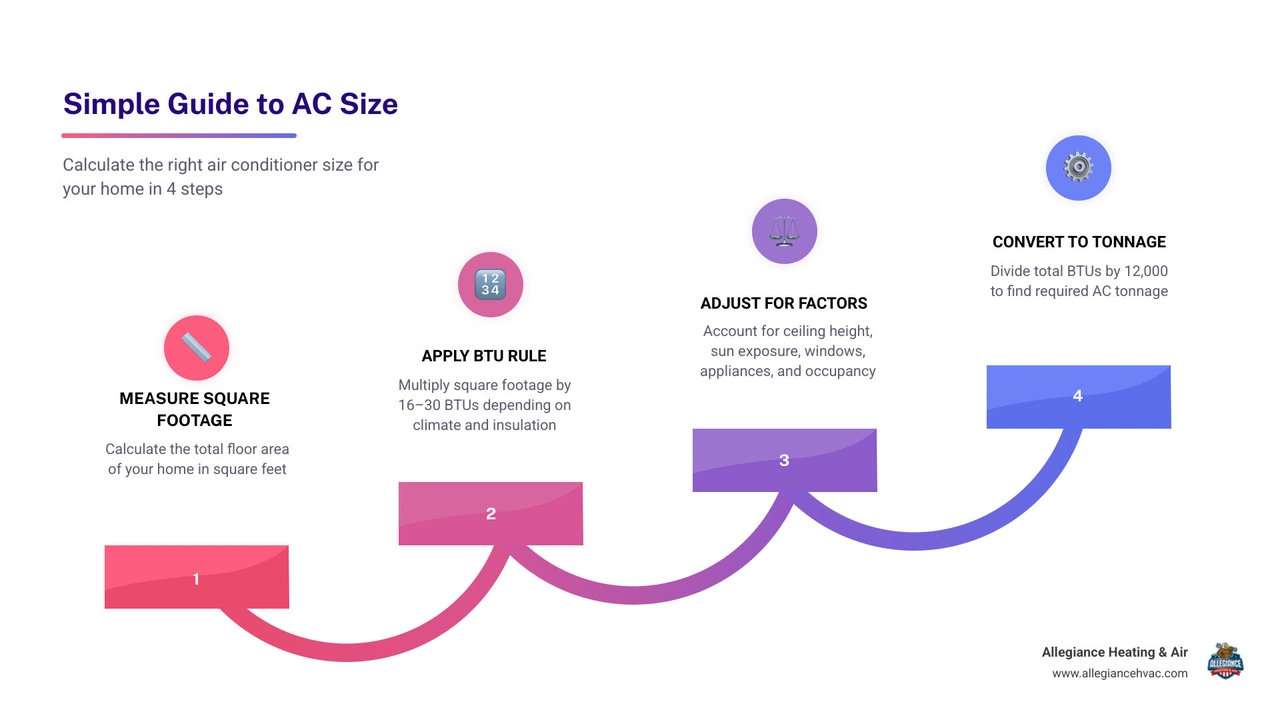
Simple guide to what size air conditioner do i need:
- List the top-rated HVAC companies serving Jeffersonville, Indiana.
- how to choose the right ac system for your home
What Size Air Conditioner Do I Need? The Core Calculations
When you start looking into air conditioning systems, you will immediately run into two technical terms: BTUs and tons. Understanding how these two measurements work together is the first step to figuring out what size air conditioner do I need.
What is a BTU?
BTU stands for British Thermal Unit. It is a basic unit of heat energy. In air conditioning, a BTU rating tells you how much heat energy an AC unit can extract from your home in one hour. The higher the BTU rating, the more cooling power the system has.
What is an AC Ton?
In residential HVAC, we also talk about "tonnage." This does not refer to how much the physical air conditioner weighs on a scale! Instead, a "ton" is a traditional measurement of cooling capacity. One ton of cooling capacity is equal to 12,000 BTUs per hour.
The term comes from the old days of refrigeration when people used actual blocks of ice to cool buildings. One ton of cooling is the amount of heat energy required to melt one ton (2,000 pounds) of ice over a 24-hour period.
To help you visualize the math, here is how BTUs convert to tonnage:
- 1.5 Tons = 18,000 BTUs/hr
- 2.0 Tons = 24,000 BTUs/hr
- 2.5 Tons = 30,000 BTUs/hr
- 3.0 Tons = 36,000 BTUs/hr
- 3.5 Tons = 42,000 BTUs/hr
- 4.0 Tons = 48,000 BTUs/hr
- 5.0 Tons = 60,000 BTUs/hr
Most residential central air conditioning systems range from 1.5 tons to 5 tons, usually increasing in half-ton increments. If your calculated needs fall between two standard sizes, it is generally best to consult a professional rather than automatically rounding up to the next size. For a deeper dive into how these measurements impact your overall heating and cooling strategy, check out our guide on How to Choose the Right Size HVAC for Your Home.
How to Calculate What Size Air Conditioner Do I Need by Square Footage
The simplest and most common starting point for sizing an air conditioner is calculating the total square footage of the conditioned living space.
How to Calculate Square Footage
To find the square footage of a single room, measure the length and the width of the room in feet, then multiply those two numbers together.
For example, if you have a living room that is 15 feet long and 20 feet wide, the square footage is 300 square feet.
If you are trying to size a central air conditioning system for your entire home, you will need to add up the square footage of all the conditioned areas (including hallways, bedrooms, and bathrooms). Do not include unconditioned spaces like unfinished basements, garages, or attics unless you plan to run ductwork and cool those spaces as well.
The 20 BTU Rule of Thumb
Once you have your total square footage, you can apply the general industry rule of thumb: allot 20 BTUs of cooling capacity for every square foot of living space.
Let’s look at a quick example. If you have a 1,500-square-foot home in a moderate climate:
- 1,500 sq ft x 20 BTUs = 30,000 BTUs
- 30,000 BTUs ÷ 12,000 BTUs per ton = 2.5 tons
This means a 1,500-square-foot home will typically require about 30,000 BTUs, or a 2.5-ton air conditioner, under standard conditions.
Quick Room Coverage Chart
If you are sizing a room air conditioner (like a window unit or a small ductless mini-split), you can use this quick reference chart:
- 100 to 150 sq ft: 5,000 BTUs
- 150 to 250 sq ft: 6,000 BTUs
- 250 to 350 sq ft: 8,000 BTUs
- 350 to 450 sq ft: 10,000 BTUs
- 450 to 550 sq ft: 12,000 BTUs
- 550 to 700 sq ft: 14,000 BTUs
- 700 to 1,000 sq ft: 18,000 BTUs
While the 20 BTU rule is an excellent starting point, it is only a baseline. To get an accurate size, you must also look at how your local climate and specific home features affect the overall heat load.
How Climate Zones Affect What Size Air Conditioner Do I Need
Where you live plays a massive role in how hard your air conditioner has to work. A 1,500-square-foot home in a cool, northern climate requires significantly less cooling capacity than the exact same home sitting in a hot, humid southern region.
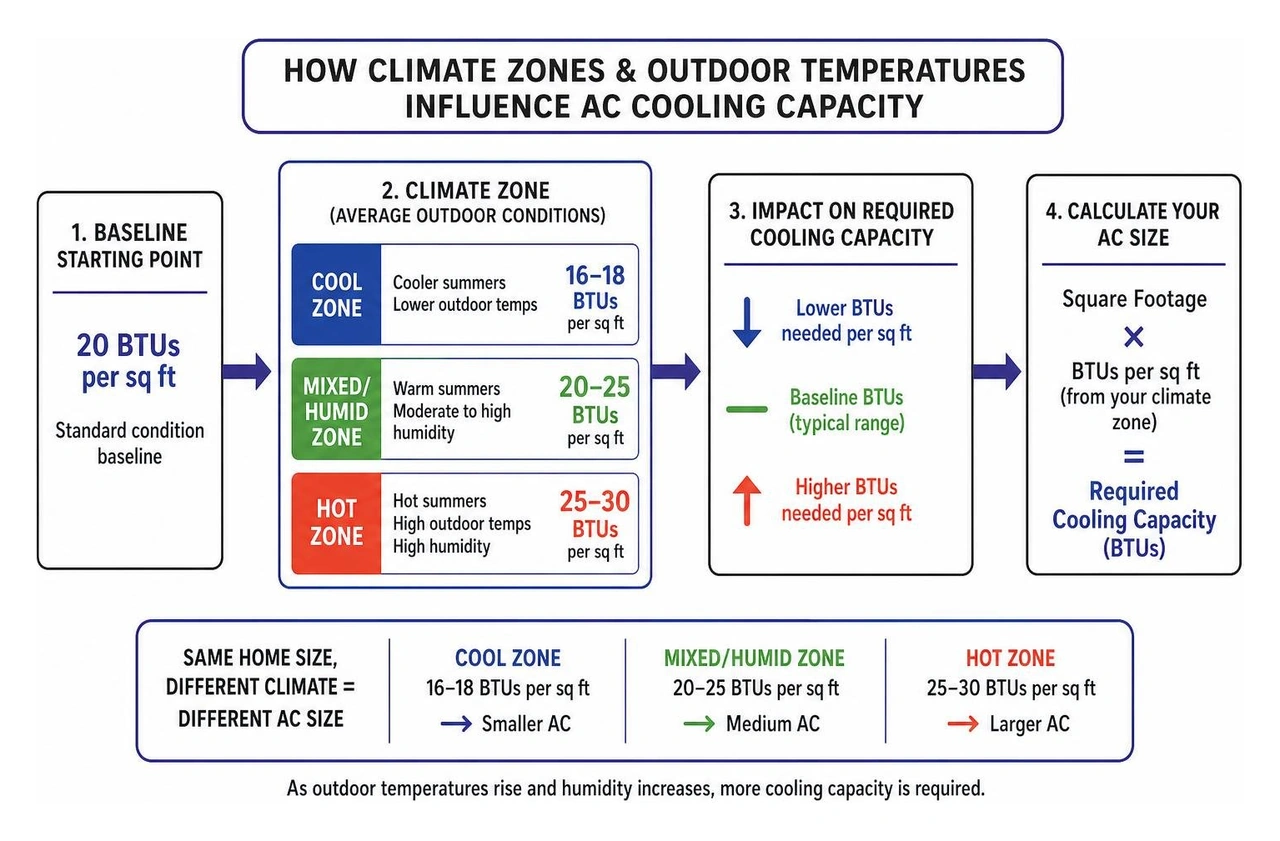
The United States is divided into distinct climate zones. In cooler northern zones, the baseline cooling requirement might drop to 16 to 18 BTUs per square foot. In extremely hot southern zones, the baseline can easily jump to 25 to 30 BTUs per square foot.
Here in Greenville, IN, and across the greater Louisville metro area, we sit in a mixed, humid climate zone. Our summers bring intense humidity alongside high temperatures. This means our local climate demands a system that can handle both the sensible heat (the actual temperature on the thermometer) and the latent heat (the moisture in the air).
Because of this humidity, a home in southern Indiana will generally require a slightly higher cooling capacity per square foot than a home of the same size in a dry, mild climate. For our area, a rule of thumb of 20 to 25 BTUs per square foot is often a more realistic starting point before adjusting for other home-specific variables.
Crucial Sizing Factors Beyond Square Footage
If square footage were the only thing that mattered, every single 2,000-square-foot house in Indiana would use the exact same 3.5-ton AC unit. In reality, two identical homes standing side-by-side can have completely different cooling loads.
When determining what size air conditioner do I need, we must evaluate several crucial home features:
- Ceiling Height: Standard calculations assume a standard 8-foot ceiling. If your home has vaulted ceilings, open lofts, or 9- to 10-foot ceilings, you have more volume of air to cool. As a rule of thumb, add about 10% more cooling capacity for 9-foot ceilings and 20% to 25% more for ceilings over 10 feet.
- Insulation Quality: A well-insulated home with modern R-value insulation in the walls and attic keeps outdoor heat from entering. Older homes with poor or settled insulation will experience rapid heat transfer, requiring a larger AC unit to maintain a comfortable indoor temperature.
- Windows and Sun Exposure: Windows are the primary source of heat gain in most homes. Double-pane, low-E windows reflect a lot of solar heat, while older single-pane windows let it right in. Additionally, rooms with large, south- or west-facing windows receive direct afternoon sunlight and may require up to 10% to 15% more cooling capacity than shaded, north-facing rooms.
- Occupant Load: People generate body heat — roughly 400 to 600 BTUs per hour per person. If you have a large family or regularly host gatherings in a specific room, you need to account for that extra heat.
- Kitchen Considerations: Kitchens are full of heat-generating appliances like ovens, stoves, dishwashers, and refrigerators. If you are sizing an open-concept living area that includes the kitchen, you should generally add an extra 4,000 BTUs to your calculation to offset the heat generated during cooking.
- Shade and Landscaping: Tall trees, deep roof overhangs, and nearby buildings that shade your home during the hottest parts of the day can naturally lower your home's heat load, reducing the strain on your air conditioner.
Understanding these variables is a key part of making an informed investment. For a complete look at what to consider before choosing a new system, take a look at our AC System Buying Guide 2026.
Sizing Differences Across AC System Types
The physical design of your air conditioning system also changes how capacity is distributed and sized.
Central Air Conditioning
Central AC systems rely on a network of ductwork to distribute cooled air throughout the entire home. These systems are sized for the total load of the house. However, central systems are highly dependent on the condition of your ducts. If your ductwork is leaky, uninsulated, or poorly designed, you can lose up to 30% of your cooling capacity before the air ever reaches your rooms, which may require a slightly larger system to compensate (though sealing your ducts is always the better solution!).
Ductless Mini-Split Systems
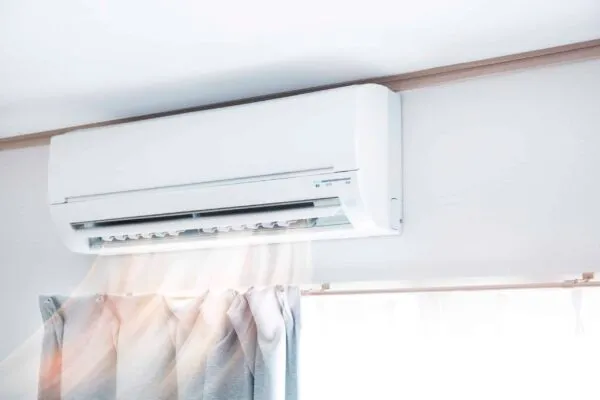
Mini-splits allow you to cool specific zones or rooms individually. Because you can turn off units in unoccupied rooms, you can often size mini-split indoor heads precisely to the individual room's square footage. This zoned approach is incredibly efficient because you aren't wasting energy cooling the entire house when you are only using one or two rooms.
Heat Pumps
A heat pump works just like an air conditioner during the summer, but it reverses its operation in the winter to provide heat. Sizing a heat pump requires balancing both your cooling load and your heating load to ensure year-round comfort. To learn more about how these systems compare, read our detailed breakdown: Central AC vs Heat Pump for Your Home.
Window and Portable AC Units
Window air conditioners are highly localized and excellent for single rooms. Portable AC units, on the other hand, sit inside the room and exhaust hot air through a plastic hose. Because portable units radiate some heat from the exhaust hose back into the room, they are less efficient than window units and generally require 10% to 20% more BTUs to cool the exact same space.
The Consequences of Incorrect AC Sizing
When it comes to air conditioners, many homeowners assume that "bigger is always better." This is one of the most expensive mistakes you can make. Buying an air conditioner that is either too large or too small for your home leads to serious comfort and mechanical issues.
The Problems with an Oversized AC Unit
An oversized air conditioner will cool your home down very quickly, but it will turn off almost immediately after starting. This is called short-cycling.
Because the unit only runs for a few minutes at a time, it never runs long enough to perform one of its most important jobs: dehumidification. An air conditioner removes moisture from the air as it runs. Short-cycling leaves your home feeling cold, clammy, and damp, which can eventually lead to mold and mildew growth. Furthermore, the constant starting and stopping places massive mechanical stress on the compressor, leading to premature system failure and higher energy bills.
The Problems with an Undersized AC Unit
An undersized air conditioner simply cannot keep up with the summer heat. On hot July days in southern Indiana, an undersized unit will run continuously without ever reaching your thermostat's set temperature.
This constant operation leads to high electricity bills, excessive wear and tear on the system's moving parts, and a home that remains uncomfortably warm when you need cooling the most.
To help you spot these issues in your own home, here is a quick comparison:
| System Symptom | Oversized AC Unit | Undersized AC Unit |
|---|---|---|
| Run Time | Cycles on and off rapidly (short-cycling) | Runs continuously without stopping |
| Indoor Humidity | High; air feels cold and clammy | Normal to high; home remains warm |
| Energy Bills | High due to starting power spikes | High due to non-stop operation |
| System Lifespan | Reduced due to compressor wear | Reduced due to constant motor strain |
| Temperature | Uneven; hot and cold spots | Consistently too warm throughout |
If your current system is showing any of these signs, it may be time to look into a replacement that is properly matched to your home's actual heat load. You can read more about how to make this transition smoothly in our guide to Choose the Right AC for Replacement.
Professional Sizing: The Manual J Load Calculation
While DIY calculations and square footage charts are excellent for getting a rough estimate, professional HVAC contractors do not rely on rules of thumb to size a central air conditioning system. Instead, we use the industry gold standard: the Manual J Load Calculation.
Developed by the Air Conditioning Contractors of America (ACCA), a Manual J calculation is a highly detailed, scientific assessment of your home's precise thermal characteristics.
A professional Manual J calculation takes into account:
- The exact local climate data and outdoor design temperatures for your specific area.
- The direction your home faces (orientation to the sun).
- The R-value of the insulation in your attic, walls, and floors.
- The total square footage of all windows, their solar heat gain coefficient (SHGC), and frame materials.
- The construction materials of your exterior walls and roofing.
- The amount of heat generated by occupants, lighting, and appliances.
- Ductwork location, insulation, and leakage rates.
By inputting all of these variables into specialized software, we can determine the exact heating and cooling load of your home down to the single BTU. This ensures that the system we install is perfectly sized for maximum efficiency and comfort.
If you are located in the Louisville metro area or southern Indiana, having a local expert perform this calculation is the best way to protect your investment. Learn more about our professional installation services by visiting our Air Conditioning Installation Louisville KY and AC Installation Replacement New Albany IN service pages.
Frequently Asked Questions About AC Sizing
How do I find the size of my existing AC unit using the model number?
You don't need to guess the size of your current system — you can usually find it coded directly into the model number on the outdoor condenser unit's manufacturer plate.
Look for the metal nameplate on the side of your outdoor unit. Find the model number (not the serial number) and look for a two-digit even number. This number represents the cooling capacity in thousands of BTUs.
Here is how to decode those numbers:
- 18 = 18,000 BTUs (1.5 tons)
- 24 = 24,000 BTUs (2 tons)
- 30 = 30,000 BTUs (2.5 tons)
- 36 = 36,000 BTUs (3 tons)
- 42 = 42,000 BTUs (3.5 tons)
- 48 = 48,000 BTUs (4 tons)
- 60 = 60,000 BTUs (5 tons)
For example, if your model number is AC036X1021, the "36" in the middle indicates that your current system is a 3-ton (36,000 BTU) unit.
Does the SEER rating affect the size of the AC unit I should buy?
No, the SEER (Seasonal Energy Efficiency Ratio) or SEER2 rating measures the efficiency of the air conditioner, not its cooling capacity.
Think of capacity (tonnage) as the size of your car's engine, while SEER is the miles-per-gallon rating. A 3-ton unit with a 14 SEER2 rating and a 3-ton unit with a 20 SEER2 rating provide the exact same amount of cooling power. However, the 20 SEER2 unit will use significantly less electricity to get the job done.
When buying a new system, you should first determine the correct capacity (tons) your home needs, and then choose the highest SEER2 rating that fits your budget to maximize your long-term energy savings.
To help you weigh your options, take a look at our comparisons on High SEER vs Standard SEER AC Comparison and Standard Efficiency vs High Efficiency HVAC Comparison. You can also learn more about why these metrics matter in our guide on Energy Efficiency Standards for Your HVAC: Why Is This Important and discover the long-term benefits in How Much Does a High Efficiency HVAC Save Over Time.
How do I convert BTUs to tons for central air conditioning?
Converting BTUs to tons is simple math. Because one ton of cooling capacity equals 12,000 BTUs per hour, you simply divide your total BTU requirement by 12,000.
For example, if a detailed load calculation shows your home requires 42,000 BTUs of cooling capacity:
- 42,000 ÷ 12,000 = 3.5 tons
Conclusion
Determining what size air conditioner do I need is the critical first step toward achieving reliable, energy-efficient comfort in your home. While online calculators and simple rules of thumb are great for getting a general idea of your cooling needs, they cannot replace the accuracy of a professional load calculation.
At Allegiance Heating & Air, LLC, we have been "Taking Home Comfort Under Our Wing" as a family-owned business since 2005. Our licensed and insured technicians are dedicated to helping homeowners throughout Greenville, IN, and the surrounding southern Indiana and Louisville-area communities find the perfect HVAC solutions for their homes. We pride ourselves on honest, transparent service and ensuring your system is sized perfectly for year-round comfort.
If you are ready to upgrade your cooling system or want to make sure your home is equipped with the right size AC unit before the summer heat hits, we are here to help. Contact us today to schedule a professional assessment and get an accurate system recommendation tailored specifically to your home.
Ready to maximize your home's comfort and efficiency? Visit our Air Conditioning Services Page to schedule your professional system consultation today!
Contact Us Or Schedule Expert Service
Other Blogs
ready to transform your home?
Discover our exceptional home services tailored to meet your needs and enhance your living space.
WHAT OUR CLIENTS HAVE TO SAY ABOUT US

We had a complete HVAC system and a hot water heater installed. The guys were professional, well mannered, and completed the work in a timely manner. Would definitely use them again.
I was nervous at first because my AC broke in the middle of 80 degree weather which is strange for April, but Allegiance Heating and Air was incredibly prompt and professional. The technician arrived within an hour, explained the problem clearly, and completed the repair. The technician , Mr. Garrett Moon was a very nice and courteous young man. He found the problem and fixed it within a timely manner. I highly recommend them for any heating or cooling needs. I’ll definitely give them a call again should I ever have another issue, but hopefully not. Knock on wood 😁. Give them a call… you won’t be disappointed!
From the moment I called to schedule a service, the team was quick to respond and arrived right on time. The technician was professional, friendly, and clearly knowledgeable about my heating system. He explained the repair options in plain language and completed the job efficiently. I appreciated the reliable service and the fact that the work was done the same day. I would definitely recommend Allegiance Heating and Air for any residential HVAC needs.
5/5 stars – I was very impressed with the efficient, affordable and timely service from Allegiance Heating and Air. The technician arrived on time, and performed the service quickly, no repairs needed at this time. Communication was clear and the whole experience felt hassle‑free. I would definitely recommend them for any residential HVAC needs.
Knowledgeable, experienced individual.
Explains Allegiance Heating and Air was incredibly reliable, professional and affordable. They arrived right on time, kept the work area clean and finished the furnace repair quickly. The technician explained everything clearly and the price was a great value. If happiness had a location on Google Maps, it would be here.
Gilbert had to go above and beyond because York is no longer making the part for my furnace. But he was able to find a way to construct a housing bracket for my furnace. Ingenuity, determination and integrity is what finally got my furnace fixed. Gilbert is truly a one of a kind technician.
Thank you for always going the extra mile. Gilbert is always respectful and helpful with any concerns.
"Great service, most knowledgeable and capable HVAC business in Kentuckiana!! Pete Flemming and Bryan the owner, are HVAC encyclopedias. They have the highest integrity of any HVAC business I have ever used. Allegiance has put numerous units in for me over the last 17 years. I will continue to use and trust them."
"Fast response from Allegiance when our heat was out on New Year’s day! Service technician was friendly and efficient. He took the time to explain the problem, tell us about the temporary fix and the plan for permanent repair. We were impressed!"
"Love Allegiance! Their technicians, in particular Benjamin, explain everything. Fast and thorough. A/C was out on a Sunday. Called Allegiance and within a few hours Benjamin arrived. Such a comfort as he was the one who last serviced our units. He quickly replaced part and cooling is restored!"
"My heat pump went out and I had to call after hours. The technician (Garrett) was outstanding and thorough. He got my system up and working until Monday and gave me several options of units. Also took the time to explain the issue to my Home warranty company. I highly recommend this company."
"Right on time :) respectful, fast, and polite. Even gave my fur babies some attention."
"Had Garrett out today to fix our AC. Fantastic tech. He showed up exactly when he said he would and kept us informed of what he was checking and what he found. Highly recommend!"
"Lucas with Allegiance showed up on time as promised, was professional and extremely patient and responsive with all my questions. He took care of the issue, and I feel he was trustworthy! He had us back to cool and comfortable on one of the hottest days of the year."
"Lucas did a great job! Very professional and expedient. Explained the process very well and represented Allegiance as a truly professional and reputable company."
"Arrived on time and work diligently to fix issue. These guy are great. Worked quickly to resolve my issues."
"Lucas was great - he spent a lot of time trying to figure out what was going on and explained everything he was doing. I trust Allegiance and wouldn’t want anyone else working on/in my house!!"

RELATED ARTICLES
Furnace on the Fritz? What to Check Before Dialing a Pro
What Is A Ductless Mini-Split System?