Why HVAC Repair vs New Unit Long-Term Savings Is the Most Important Decision Your Heating and Cooling System Will Force You to Make
Understanding hvac repair vs new unit long-term savings is the difference between spending wisely on your home comfort system and throwing money at a machine that is already in decline. For homeowners in Greenville, IN, where Southern Indiana summers push cooling systems hard and winters demand reliable heat, getting this decision wrong can cost thousands of dollars over just a few years.
Here is the quick answer most homeowners are looking for:
Replace your HVAC system if any of the following are true:
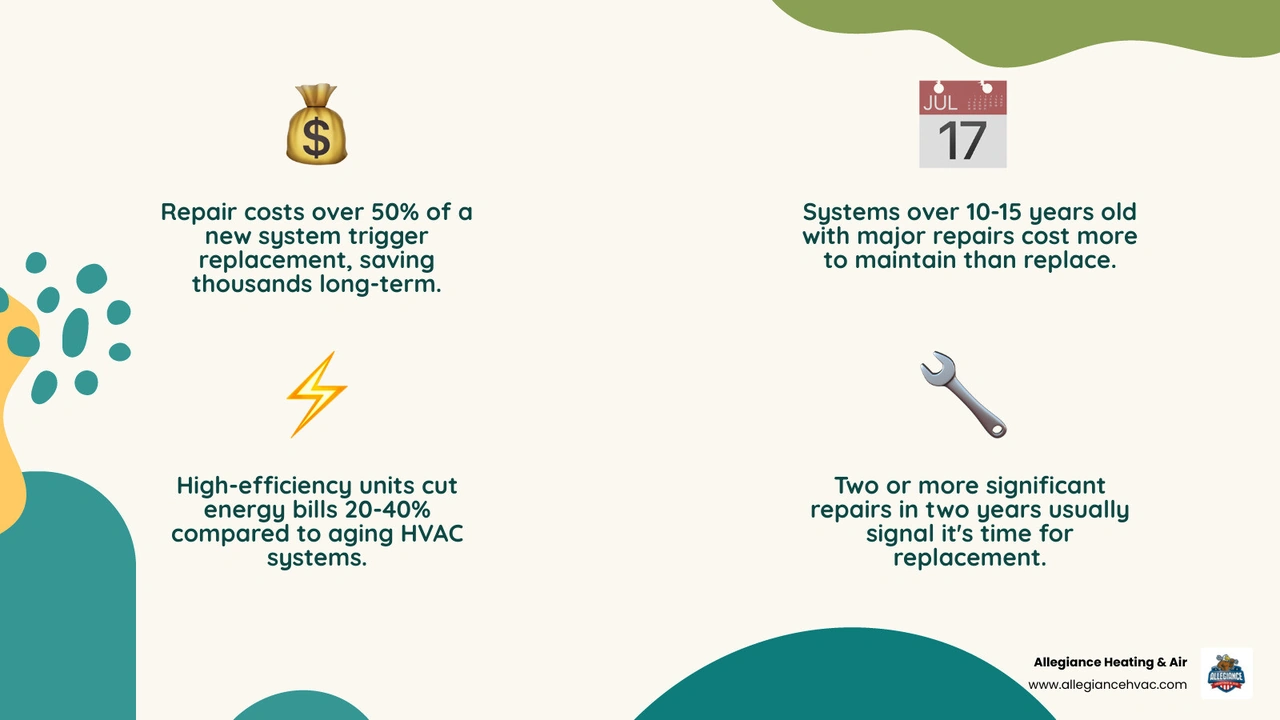
- The repair cost exceeds 50% of the price of a new system
- Your system age multiplied by the repair cost exceeds 5,000 (the 5,000 rule)
- Your system is over 10-15 years old and needs a major component repair
- You are paying for 2 or more significant repairs within 2 years
- Your system uses R-22 refrigerant, which is no longer produced and extremely costly to recharge
- Your energy bills have increased 20-40% with no clear explanation
Repair your system if all of the following are true:
- The system is under 10 years old
- The repair involves a minor wear component like a capacitor, contactor, or thermostat
- The repair cost is well under 30% of a new system's price
- The system has had no major breakdowns in the past two years
The hard part is that most homeowners face this choice in the worst possible moment — when the AC quits during a July heat wave or the furnace goes quiet on a cold Indiana morning. That urgency makes it easy to make a rushed call that costs more in the long run.
This guide walks you through a clear, step-by-step framework so you can make a confident, financially sound decision — whether that means a targeted repair or a full system upgrade.
Evaluating System Age and Lifespan Modifiers

Before diving into the math of repairs versus replacement, we must first look at the clock. Every heating and cooling system has a natural operational lifespan. While regular maintenance helps keep things running smoothly, physical wear and tear eventually catches up with even the most premium equipment.
As a general rule, here is what you can expect for typical equipment lifespans:
- Central Air Conditioners: 10 to 15 years
- Air-Source Heat Pumps: 10 to 15 years
- Gas Furnaces: 15 to 20 years
- Boilers: 20 to 30 years
However, these numbers are not set in stone. Regional climate plays a massive role in how quickly a system ages. Here in Southern Indiana and the greater Louisville area, our weather is anything but moderate. We experience extreme temperature swings, from humid, scorching summer weeks to freezing winter stretches.
Because our systems must work incredibly hard throughout both seasons, local equipment often experiences accelerated wear. In our region, it is common for a system's reliable operational lifespan to be shortened by 3 to 5 years compared to systems running in milder climates.
When you are trying to calculate How Long Does an HVAC System Last, you must factor in these local climate demands. A 12-year-old air conditioner in Southern Indiana has logged a lot of high-stress hours, making it a much stronger candidate for replacement than a system of the same age in a cooler climate.
Signs Your System is Reaching End of Life
Age is a primary indicator, but your system will also show physical and operational symptoms when it is nearing the end of its useful life. If you notice several of these signs occurring simultaneously, it is a strong signal that repairs will only act as temporary patches:
- Frequent Breakdowns: If you find yourself calling for service multiple times over a single season, your system is experiencing systemic decline.
- Rising Utility Bills: A sudden or steady increase of 20% to 40% in your monthly energy bills (without a corresponding change in utility rates) indicates that your system's efficiency is dropping rapidly.
- Uneven Temperatures: If some rooms feel like iceboxes while others remain warm, your system's compressor or blower is struggling to move air and regulate temperatures effectively.
- Humidity Issues: Older, declining air conditioners lose their ability to remove moisture from the air, leaving your home feeling clammy and uncomfortable.
- Excessive Noise and Dust: Failing motors, cracked ductwork, and worn compressors often create loud rattling, squealing, or buzzing sounds while pulling excess dust into your living spaces.
Recognizing these Signs Your HVAC System Is Reaching End of Life early allows you to plan an upgrade on your own terms, rather than waiting for a catastrophic failure during extreme weather.
Financial Frameworks: HVAC Repair vs New Unit Long Term Savings
When you are faced with a significant repair estimate, it is easy to fall into the "repair spiral." This happens when you pay for one repair, only for another component to fail a few months later. To keep your home comfort budget on track, we recommend using two objective, mathematical frameworks to guide your decision.
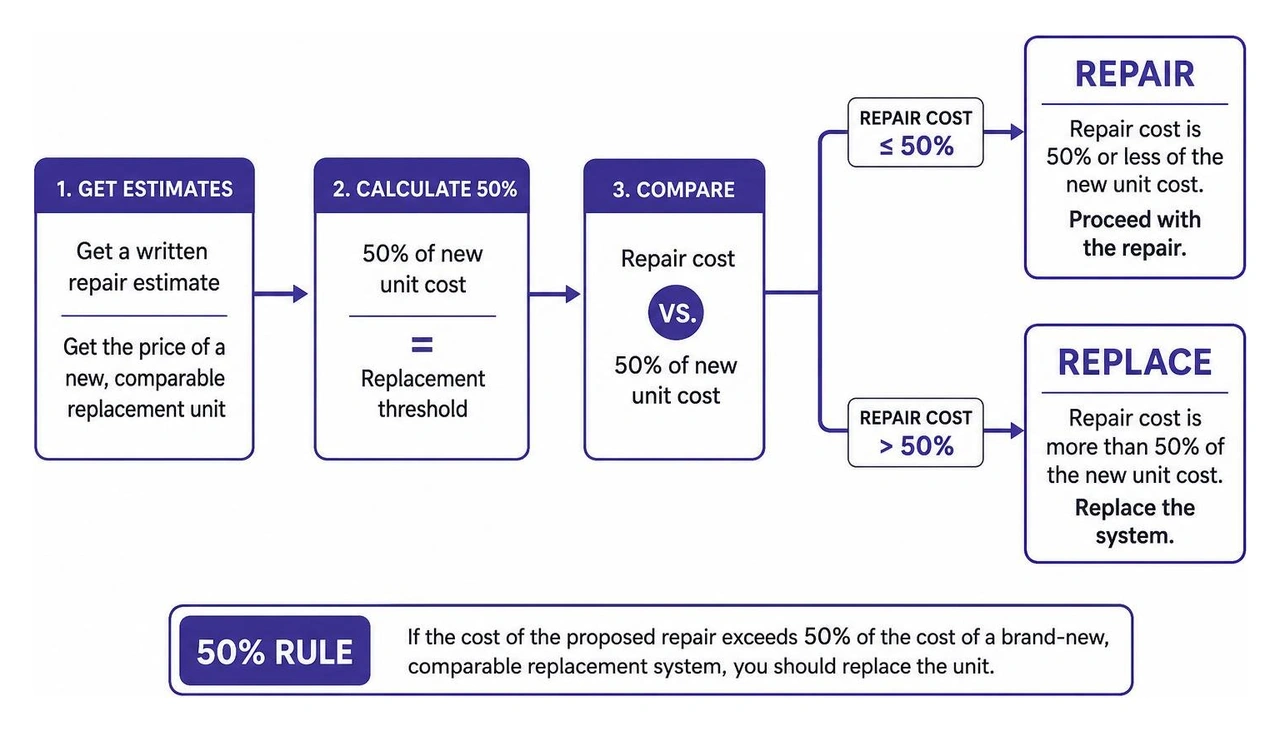
The 50% Rule
The 50% rule is straightforward: if the cost of the proposed repair exceeds 50% of the cost of a brand-new, comparable replacement system, you should replace the unit. Investing a large sum into an older, out-of-warranty system is rarely a sound decision, as the remaining components are still subject to wear and failure.
The Age-Adjusted Rule (The 5,000 Rule)
The 5,000 rule provides a more customized approach by factoring in the exact age of your equipment. To use this rule, simply multiply the age of your system (in years) by the written repair estimate (in dollars):
$$\text{System Age (Years)} \times \text{Repair Estimate (Dollars)} = \text{Decision Index}$$
- If the result is under 5,000, proceeding with the repair is generally a safe and cost-effective choice.
- If the result is over 5,000, the math strongly points toward replacing the system.
For example, if a 12-year-old air conditioner requires a major repair, multiplying 12 by the repair estimate will easily push the index past the 5,000 threshold. In this scenario, investing that money into a new unit is the smarter financial move. Conversely, if a 5-year-old system needs the same repair, the index remains well below 5,000, making a repair the logical path.
Using these structured frameworks helps you avoid throwing "sunk costs" into a terminal machine. You can learn more about applying these rules in our detailed guide on How to Decide Between HVAC Repair and Replacement.
Analyzing Minor Repairs vs. Major Component Failures
Not all repairs are created equal. Some components are designed to wear out over time and are relatively simple to resolve, while others represent the core mechanical heart of the system.
Minor Repairs (Almost Always Worth Doing)
If your system is generally in good health, certain minor wear items are always worth replacing, regardless of system age:
- Run Capacitors: These small cylindrical parts store electrical energy to start the motors. They are common wear items and highly straightforward to replace.
- Contactors: These electrical switches control the flow of electricity to the compressor and fan.
- Thermostats: Upgrading or replacing a faulty thermostat is a quick way to restore proper system communication.
- Flame Sensors and Igniters: Cleaning or replacing these furnace components ensures safe, reliable heating.
Major Component Failures (The Turning Point)
Certain major failures signal that your system is no longer viable, especially if the unit is past its 10-year mark:
- Compressor Failure: The compressor is the heart of your air conditioner. Replacing a failed compressor on an older system is rarely a good investment, as the surrounding components are statistically nearing the end of their lifespans.
- Cracked Heat Exchanger: In a gas furnace, a cracked heat exchanger is a severe safety hazard that can leak deadly carbon monoxide into your home. For safety and liability reasons, a cracked heat exchanger requires immediate equipment shutdown and almost always warrants a full system replacement.
- Evaporator Coil Leaks on Older Refrigerant Systems: Finding and patching leaks on older coils is highly complex and often unsuccessful in the long run.
Understanding these distinctions is key when learning When to Repair vs Replace Your HVAC System.
Calculating HVAC Repair vs New Unit Long Term Savings
While a new heating and cooling system requires an upfront investment, it immediately begins paying you back in several ways. To calculate the true hvac repair vs new unit long-term savings, you must look beyond the initial installation and factor in ongoing operational costs:
- Energy Bill Reductions: Modern high-efficiency systems consume 20% to 40% less energy than older models. Over a decade of operation, these monthly utility savings can offset a significant portion of the replacement cost.
- Elimination of Repair Costs: A new system comes with a fresh manufacturer's warranty (typically 10 years on parts). This means you can say goodbye to unexpected repair bills for a decade.
- Reduced Maintenance Risk: New systems are highly reliable, requiring only standard annual safety inspections and filter changes to maintain peak performance.
By comparing the cumulative cost of repeated repairs and high utility bills against the predictable, efficient performance of new equipment, the financial benefit of upgrading becomes clear. Explore these long-term returns further in our analysis of How Much Does a High Efficiency HVAC Save Over Time.
Energy Efficiency and Environmental Factors
Energy efficiency standards have advanced dramatically over the last decade. If your current system was installed prior to recent regulatory shifts, you are operating on outdated baseline efficiencies.
- SEER2 Standards: In 2023, the Department of Energy implemented SEER2 (Seasonal Energy Efficiency Ratio 2) standards, which use more rigorous testing protocols to reflect real-world operating conditions. Modern high-efficiency systems regularly achieve SEER2 ratings of 16 to 18 or higher, whereas older systems in local homes often operate at actual ratings as low as 8 to 10 SEER. Upgrading from a 10 SEER system to a 16 SEER2 unit can reduce your cooling energy consumption by approximately 37%.
- AFUE Ratings: For furnaces, the Annual Fuel Utilization Efficiency (AFUE) rating determines how much fuel is converted directly into heat. Older conventional furnaces often operate at 80% AFUE, meaning 20% of your fuel is wasted up the chimney. Modern high-efficiency condensing furnaces can achieve up to 96% to 98% AFUE, virtually eliminating wasted energy.
- Variable-Speed Technology: Traditional HVAC systems are single-stage, meaning they operate like a car that can only go 0 or 100 mph. They blast on at full capacity, shut off, and repeat. Modern systems utilize variable-speed compressors and blower motors that adjust precisely to your home's real-time heating and cooling needs, running quietly at lower speeds to maintain a constant temperature while using a fraction of the power.
Additionally, refrigerant regulations have changed the landscape. The production and import of R-22 refrigerant was phased out completely. If your system was installed before 2010, it likely relies on R-22. Because the remaining supply is extremely scarce, recharging an R-22 system after a leak is incredibly costly. Furthermore, the industry is currently undergoing a phase-down of R-410A, transitioning to newer, environmentally friendly, low-Global Warming Potential (GWP) refrigerants.
Investing in repairs on a system with obsolete refrigerant is a high-risk financial move. Deciding When Should You Replace Your Furnace or AC often comes down to these regulatory realities.
Maximizing HVAC Repair vs New Unit Long Term Savings with Modern Technology
Upgrading your home comfort system does more than just lower your power bills; it introduces advanced technology that transforms your indoor living environment:
- Smart Thermostats: Modern systems integrate seamlessly with smart thermostats that learn your daily schedule, automatically adjusting temperatures when you are away to maximize savings.
- Zoning Capabilities: Zoning allows you to divide your home into distinct comfort areas, directing heating or cooling only where it is needed.
- Advanced Humidity Control: Variable-speed systems run longer, gentler cycles that continuously pull excess moisture from the air, keeping your home comfortable at higher thermostat settings during humid Indiana summers.
- Hospital-Grade Indoor Air Quality (IAQ): Modern air handlers can accommodate advanced, multi-stage filtration systems that capture up to 99.9% of airborne particles, including dust, pollen, pet dander, and pathogens.
These features represent a massive leap forward in comfort and health, showing clear Signs Your HVAC Needs Replacing Not Just Fixing.
Incentives, Rebates, and Tax Credits
Taking advantage of current incentives is one of the best ways to maximize your long-term savings. While federal programs like the Section 25C tax credits have shifted, several valuable opportunities remain active:
- State-Level HEAR Rebates: The Home Electrification and Appliance Rebates (HEAR) program offers substantial rebates for income-qualified homeowners who upgrade to high-efficiency heat pumps.
- Local Utility Incentives: Many local electric and gas utilities offer cash-back rebates for installing qualifying high-efficiency furnaces, air conditioners, and heat pumps.
- Manufacturer Promotions: Leading HVAC manufacturers frequently offer seasonal rebates and promotional financing terms during the spring and fall shoulder seasons.
We encourage you to read more about how to leverage these programs in our guide on Federal Tax Credits for Furnace and AC Replacement.
Frequently Asked Questions about HVAC Repair vs Replacement
Is it better to replace both the AC and furnace at the same time?
Yes, in most cases, replacing both units simultaneously is highly recommended. Your heating and cooling systems are designed to work together as a matched set. Pairing a brand-new, high-efficiency outdoor air conditioner with an old, inefficient indoor furnace blower can prevent the new system from achieving its rated efficiency.
Additionally, replacing both systems at once allows you to share installation overhead and labor, which is significantly more cost-effective than scheduling two separate installations a few years apart.
How can I extend the lifespan of my current heating and cooling system?
The absolute best way to protect your investment is through consistent, proactive care.
- Change Filters Regularly: Clean air filters prevent dust buildup on critical system components and maintain proper airflow.
- Keep the Outdoor Unit Clear: Ensure grass, leaves, and debris are cleared away from your outdoor condenser to allow for proper heat transfer.
- Seal Your Ducts: Leaky ductwork forces your system to work harder to heat and cool your home, accelerating wear.
- Schedule Professional Maintenance: Having our certified technicians perform seasonal tune-ups twice a year ensures minor issues are caught and resolved before they turn into major system failures.
For more practical tips, check out our guide on How to Extend the Life of Your Heating and Cooling System.
Does a new HVAC system increase home resale value?
Absolutely. A modern, high-efficiency HVAC system is a major selling point for prospective home buyers. It provides peace of mind that they won't face an expensive mechanical failure shortly after moving in. Furthermore, many modern systems come with transferable manufacturer warranties, which directly enhances the property's overall market appeal and value.
Conclusion
Navigating the choice between repairing an aging unit and investing in a new system doesn't have to be overwhelming. By understanding your system's age, utilizing clear financial frameworks like the 50% and 5,000 rules, and factoring in the substantial energy savings of modern technology, you can make an informed decision that protects your budget and your home comfort.
At Allegiance Heating & Air, LLC, we have been "Taking Home Comfort Under Our Wing" as a family-owned business since 2005. Serving Greenville, IN, and our surrounding Southern Indiana and Louisville-area communities, our licensed and insured technicians are dedicated to providing honest, transparent guidance. We never push unnecessary replacements, and we stand behind our work with a deep commitment to customer satisfaction.
Whether you need a reliable, professional repair to keep your current system running safely or you want to explore high-efficiency replacement options tailored to your home, we are here to help. Schedule your professional HVAC consultation with Allegiance Heating & Air today and let us help you find the most cost-effective path forward for your home.
Contact Us Or Schedule Expert Service
Other Blogs
ready to transform your home?
Discover our exceptional home services tailored to meet your needs and enhance your living space.
WHAT OUR CLIENTS HAVE TO SAY ABOUT US

We had a complete HVAC system and a hot water heater installed. The guys were professional, well mannered, and completed the work in a timely manner. Would definitely use them again.
I was nervous at first because my AC broke in the middle of 80 degree weather which is strange for April, but Allegiance Heating and Air was incredibly prompt and professional. The technician arrived within an hour, explained the problem clearly, and completed the repair. The technician , Mr. Garrett Moon was a very nice and courteous young man. He found the problem and fixed it within a timely manner. I highly recommend them for any heating or cooling needs. I’ll definitely give them a call again should I ever have another issue, but hopefully not. Knock on wood 😁. Give them a call… you won’t be disappointed!
From the moment I called to schedule a service, the team was quick to respond and arrived right on time. The technician was professional, friendly, and clearly knowledgeable about my heating system. He explained the repair options in plain language and completed the job efficiently. I appreciated the reliable service and the fact that the work was done the same day. I would definitely recommend Allegiance Heating and Air for any residential HVAC needs.
5/5 stars – I was very impressed with the efficient, affordable and timely service from Allegiance Heating and Air. The technician arrived on time, and performed the service quickly, no repairs needed at this time. Communication was clear and the whole experience felt hassle‑free. I would definitely recommend them for any residential HVAC needs.
Knowledgeable, experienced individual.
Explains Allegiance Heating and Air was incredibly reliable, professional and affordable. They arrived right on time, kept the work area clean and finished the furnace repair quickly. The technician explained everything clearly and the price was a great value. If happiness had a location on Google Maps, it would be here.
Gilbert had to go above and beyond because York is no longer making the part for my furnace. But he was able to find a way to construct a housing bracket for my furnace. Ingenuity, determination and integrity is what finally got my furnace fixed. Gilbert is truly a one of a kind technician.
Thank you for always going the extra mile. Gilbert is always respectful and helpful with any concerns.
"Great service, most knowledgeable and capable HVAC business in Kentuckiana!! Pete Flemming and Bryan the owner, are HVAC encyclopedias. They have the highest integrity of any HVAC business I have ever used. Allegiance has put numerous units in for me over the last 17 years. I will continue to use and trust them."
"Fast response from Allegiance when our heat was out on New Year’s day! Service technician was friendly and efficient. He took the time to explain the problem, tell us about the temporary fix and the plan for permanent repair. We were impressed!"
"Love Allegiance! Their technicians, in particular Benjamin, explain everything. Fast and thorough. A/C was out on a Sunday. Called Allegiance and within a few hours Benjamin arrived. Such a comfort as he was the one who last serviced our units. He quickly replaced part and cooling is restored!"
"My heat pump went out and I had to call after hours. The technician (Garrett) was outstanding and thorough. He got my system up and working until Monday and gave me several options of units. Also took the time to explain the issue to my Home warranty company. I highly recommend this company."
"Right on time :) respectful, fast, and polite. Even gave my fur babies some attention."
"Had Garrett out today to fix our AC. Fantastic tech. He showed up exactly when he said he would and kept us informed of what he was checking and what he found. Highly recommend!"
"Lucas with Allegiance showed up on time as promised, was professional and extremely patient and responsive with all my questions. He took care of the issue, and I feel he was trustworthy! He had us back to cool and comfortable on one of the hottest days of the year."
"Lucas did a great job! Very professional and expedient. Explained the process very well and represented Allegiance as a truly professional and reputable company."
"Arrived on time and work diligently to fix issue. These guy are great. Worked quickly to resolve my issues."
"Lucas was great - he spent a lot of time trying to figure out what was going on and explained everything he was doing. I trust Allegiance and wouldn’t want anyone else working on/in my house!!"

RELATED ARTICLES
AC Problems That Can't Wait in Sellersburg
New Albany's Go-To: Best Heat Pump Installation Services